Loading subject page…

2,001,377 views


Video Summary: What Is Ph
Ever wondered why your blood maintains a precise pH of 7.4, and even tiny deviations can be life-threatening? pH biology chemistry explained through the concept of hydrogen ion concentration reveals how acids and bases govern everything from cellular metabolism to the effectiveness of medications in US hospitals. Coffee's acidic bite and antacid relief both stem from pH differences on the familiar 0-14 scale. Watch the full video on JoVE Coach to master this concept with expert-led visuals and step-by-step explanations.
What is pH represents one of chemistry's most practical concepts, directly impacting everything from pharmaceutical manufacturing to emergency medicine in US hospitals. The term "pH" stands for "potential of hydrogen" or "power of hydrogen," measuring the concentration of hydrogen ions (H+) or more accurately, hydronium ions (H3O+) in solution.
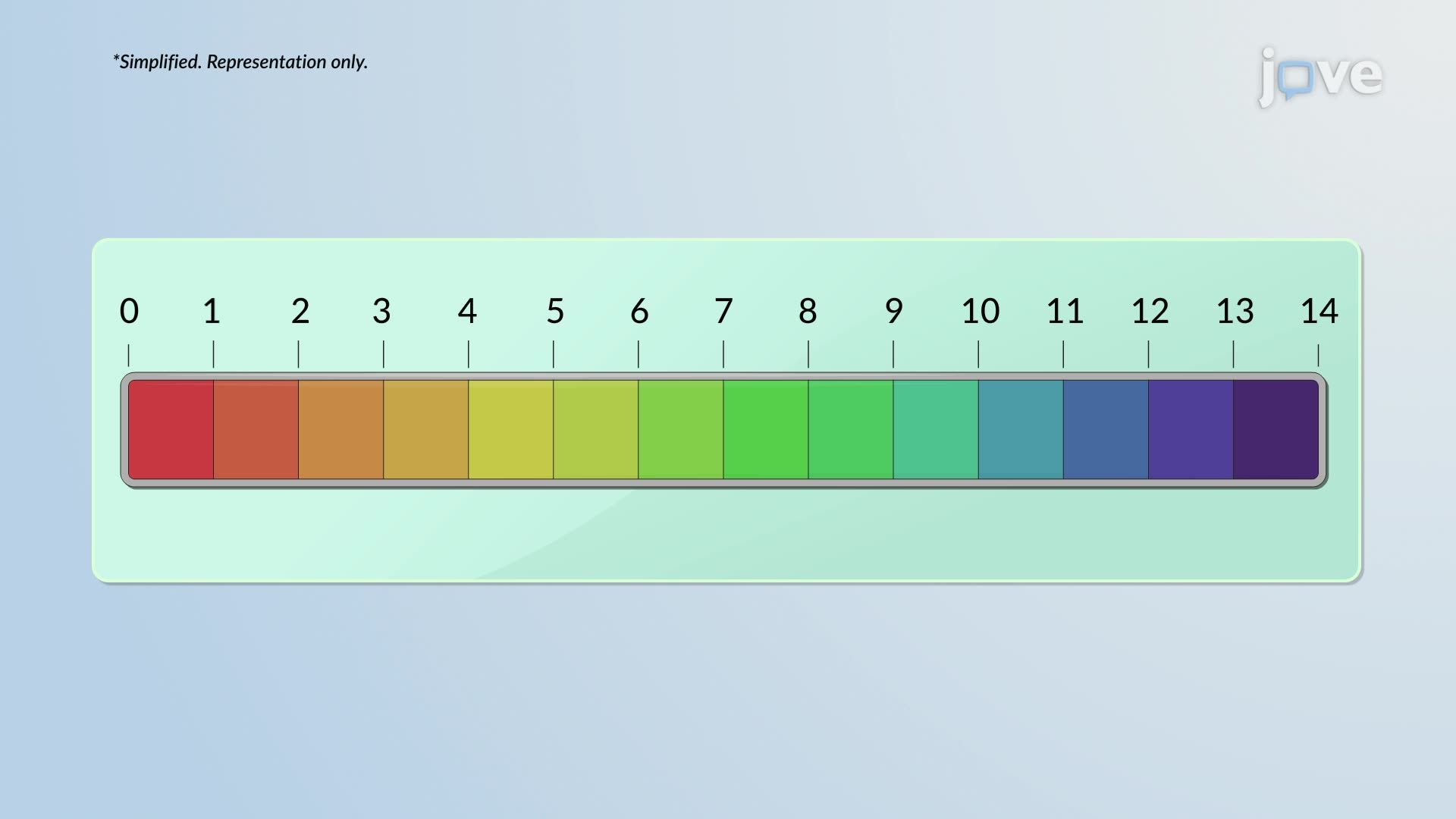
The mathematical relationship pH = -log[H+] means that pH values decrease as hydrogen ion concentration increases. This logarithmic scale compresses an enormous range of concentrations into the manageable 0-14 scale familiar to students taking AP Chemistry or college-level courses.
Acid base pH explained becomes clearer when examining real-world examples across the pH spectrum. Battery acid (pH ~0) contains extremely high hydrogen ion concentrations, while household ammonia (pH ~11) has very low concentrations. This pH scale 0-14 system allows scientists and medical professionals to quickly communicate acidity levels.
In clinical settings, understanding that hydrogen ion concentration pH relationships follow logarithmic patterns proves crucial. A patient's gastric juice (pH ~1.5) contains 1,000 times more hydrogen ions than orange juice (pH ~4.5), explaining why stomach acid can cause severe tissue damage during acid reflux episodes treated in US emergency departments.
Blood pH regulation exemplifies why pH matters in living systems. Human blood maintains a tight pH range of 7.35-7.45 through sophisticated buffer systems. Deviations outside this narrow window-conditions called acidosis (pH < 7.35) or alkalosis (pH > 7.45)-can rapidly become life-threatening, making pH monitoring standard practice in US intensive care units.
Enzyme function depends critically on pH levels. Pepsin, the stomach enzyme that breaks down proteins, works optimally at pH 1.5-2.0, while trypsin in the small intestine functions best at pH 8-9. This concept frequently appears on MCAT questions testing students' understanding of biochemical processes.
pH measurement biology extends far beyond textbook examples. Clinical laboratories routinely analyze urine pH (normal range 4.5-8.0) to assess kidney function and diagnose metabolic disorders. Pharmaceutical companies must carefully control pH during drug manufacturing, as many medications become ineffective or toxic at incorrect pH levels.
Students preparing for nursing entrance exams like the HESI A2 or TEAS often encounter pH scenarios involving IV fluid selection, where understanding acid base neutral pH concepts helps determine appropriate treatments for patients with electrolyte imbalances.
Related Micro-courses