Loading video…


 14 Concepts
 674.6K views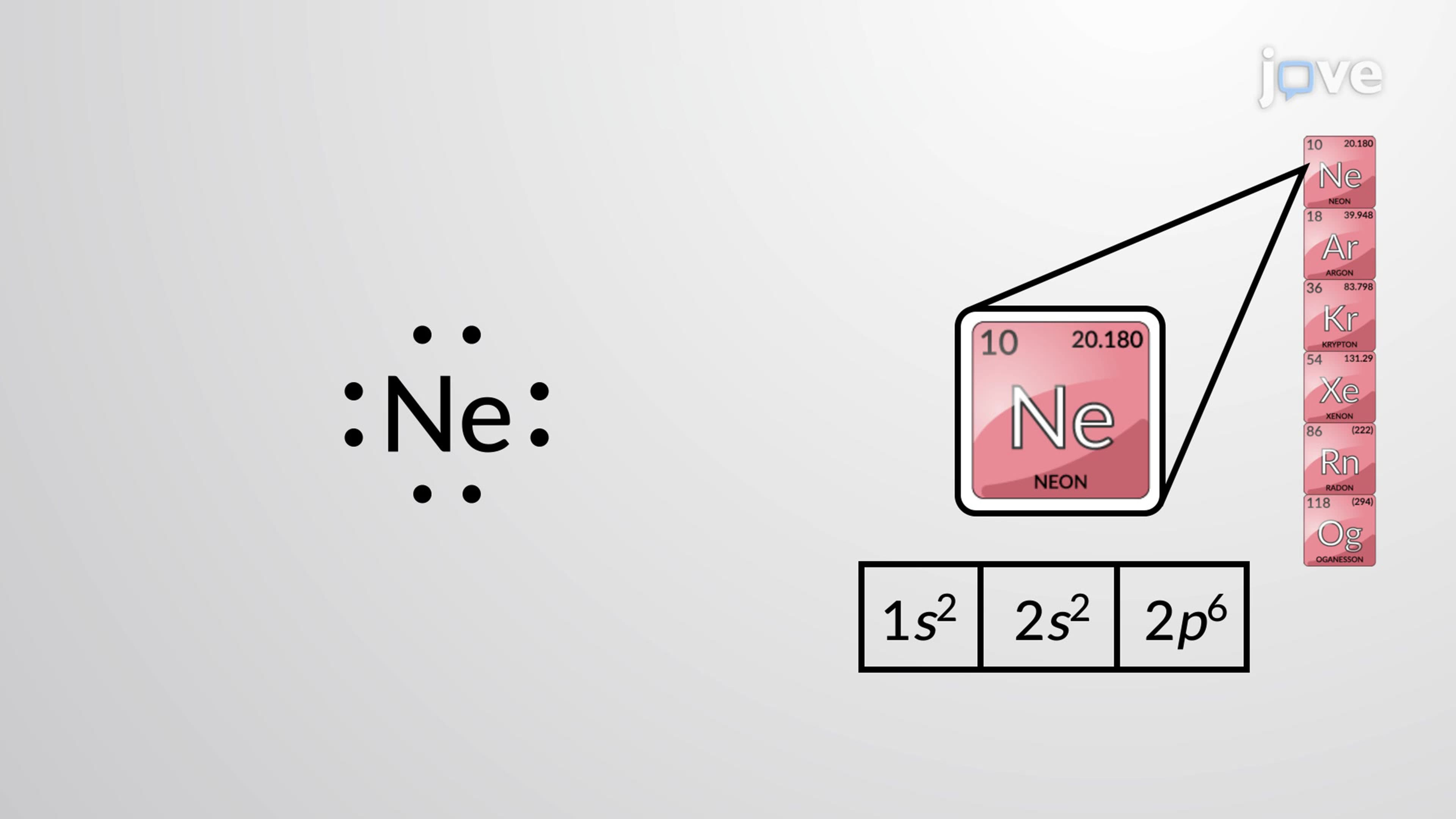

Video Summary: Lewis Symbols and the Octet Rule Explained
Ever wondered why table salt (NaCl) forms so readily while neon gas remains completely unreactive? The answer lies in lewis symbols and the octet rule, fundamental concepts that predict how atoms bond together. Understanding Lewis symbols and the octet rule reveals why carbon dioxide has double bonds and why hydrogen needs only two electrons to be stable. This powerful framework explains chemical behavior from the medications in your pharmacy to the polymers in your smartphone case. Watch the full video on JoVE Coach to master this concept with expert-led visuals and step-by-step explanations.
Lewis symbols represent a revolutionary approach to visualizing chemical bonding, developed by American chemist Gilbert N. Lewis in 1916. This model simplifies complex electron behavior by focusing solely on valence electrons-the outermost electrons responsible for chemical bonding. Each valence electron appears as a dot around the element's symbol, creating an intuitive visual representation of an atom's bonding potential.
The systematic construction of Lewis symbols follows specific rules that reflect electron arrangement. For oxygen (electron configuration: 1s² 2s² 2p⁴), six valence electrons are represented as dots around the O symbol. The first four dots occupy separate sides (north, south, east, west), while the remaining two pair up on occupied sides. This arrangement reflects Hund's rule and explains why oxygen typically forms two bonds.
Students preparing for the AP Chemistry exam frequently encounter Lewis symbol questions, particularly in the molecular geometry and bonding units. Understanding this dot placement system proves essential for predicting molecular shapes and bond angles-concepts that appear regularly on standardized tests like the SAT Subject Test in Chemistry.
The octet rule emerges from the exceptional stability of noble gas electron configurations. Atoms achieve maximum stability when their outermost shell contains eight electrons, mimicking the electronic structure of noble gases like neon or argon. This drive toward stability explains why sodium readily loses one electron (forming Na⁺) while chlorine gains one (forming Cl⁻) to create ionic compounds.
Carbon dioxide exemplifies octet rule applications in covalent bonding. Carbon's four unpaired electrons seek four more to complete its octet, while each oxygen needs two additional electrons. Through double bonding-sharing two electron pairs between carbon and each oxygen-all atoms achieve stable octets.
Hydrogen represents the most common octet rule exception, requiring only two electrons (a duet) to achieve stability by filling its 1s orbital. This exception explains hydrogen's unique bonding behavior in compounds like water (H₂O) and methane (CH₄).
In pharmaceutical chemistry, understanding these principles helps predict drug interactions and molecular stability. For instance, aspirin's effectiveness partly stems from its stable molecular structure, achieved through proper octet fulfillment in its aromatic ring system.
Related Micro-courses