Loading subject page…

Micro-course: Gases
410,818 views
Learn key concepts and earn your certificate.






Kinetic Molecular Theory and Gas Laws Explain Properties of Gas Molecules
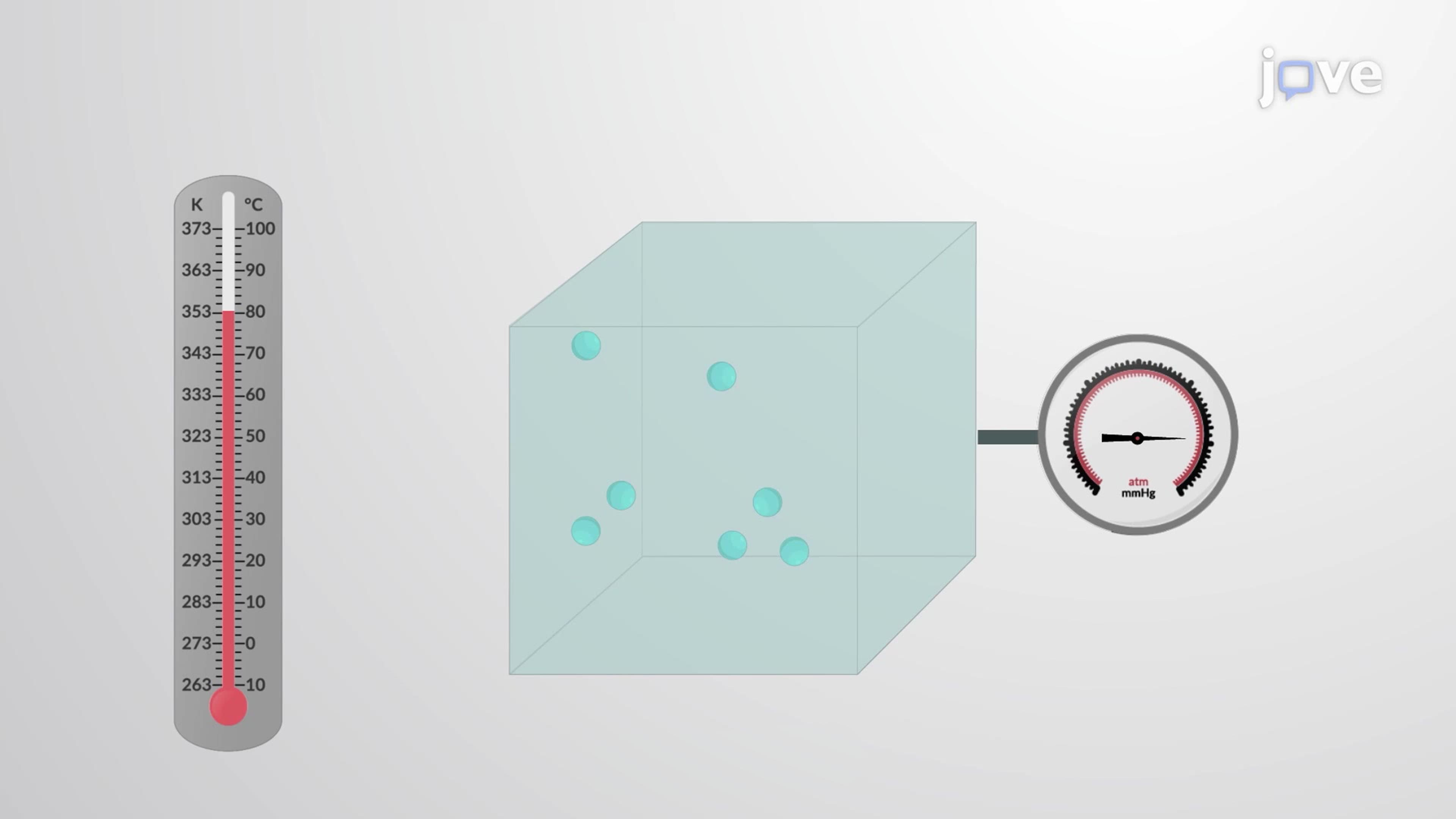

00:00
02:34
Video Summary: Kinetic Molecular Theory and Gas Explained
Ever wonder why a balloon shrinks in cold weather or why pumping more air into a tire increases pressure? Kinetic molecular theory and gas behavior explains these everyday phenomena through the constant motion of gas particles. From understanding why altitude affects breathing in Denver, Colorado, to predicting how car tires perform in different seasons, this theory connects particle-level motion to observable gas properties. The concept unifies Boyle's, Charles's, Gay-Lussac's, Avogadro's, and Dalton's gas laws through fundamental principles of molecular motion and collision dynamics. Watch the full video on JoVE Coach to master this concept with expert-led visuals and step-by-step explanations.
- Understand how Kinetic Molecular Theory And Gas Explained connects particle motion to macroscopic gas properties like pressure, volume, and temperature
- Analyze the relationship between gas particle collisions and pressure changes when volume decreases according to Boyle's law
- Identify how temperature increases affect particle kinetic energy and collision frequency in Gay-Lussac's and Charles's laws
- Compare the effects of adding more gas molecules versus changing temperature on container pressure and volume
- Evaluate how Avogadro's law explains the direct relationship between moles of gas and volume at constant conditions
- Apply Dalton's law to calculate partial pressures in gas mixtures where components act independently
- Recognize the fundamental assumption that gas particles neither attract nor repel each other in ideal conditions
- Explore how collision frequency and molecular spacing determine observable gas behavior in real-world scenarios
Understanding Kinetic Molecular Theory And Gas Behavior Fundamentals
Kinetic Molecular Theory And Gas Explained provides the microscopic foundation for understanding why gases behave as they do. At its core, this theory describes gases as collections of tiny particles in constant, random motion. These particles-whether atoms or molecules-collide with container walls and each other, creating the pressure we measure macroscopically. The theory assumes gas particles are point masses with negligible intermolecular forces, making it particularly accurate for ideal gases under standard conditions.
Pressure and Volume Relationships Through Particle Collisions
When you compress a gas-filled syringe, you're witnessing kinetic molecular theory in action. As volume decreases while temperature and moles remain constant, gas particles have less space to move. This reduction in interparticle spacing increases collision frequency with container walls, directly increasing pressure-Boyle's law in microscopic terms. Consider a scuba tank: the high-pressure air inside results from molecules packed into a small volume, creating frequent wall collisions. This relationship appears frequently on AP Chemistry exams and college physical chemistry courses, where students must connect molecular behavior to mathematical relationships.
Temperature Effects on Molecular Motion and Gas Laws
Temperature changes dramatically affect gas behavior by altering particle kinetic energy. When heating a gas at constant volume-like air in a sealed container on a hot day-increased molecular speeds lead to more forceful and frequent collisions, raising pressure according to Gay-Lussac's law. Conversely, Charles's law describes how gases expand when heated at constant pressure, as seen in hot air balloons over Napa Valley. The increased molecular motion requires more space to maintain the same collision frequency per unit area. These concepts frequently appear on MCAT physical sciences sections and college thermodynamics exams.
Gas Mixtures and Independent Particle Behavior
Dalton's law emerges naturally from kinetic molecular theory's assumption that gas particles don't interact. In Earth's atmosphere-roughly 78% nitrogen, 21% oxygen, and 1% other gases-each component exerts pressure independently. This principle proves crucial in medical applications, such as calculating oxygen partial pressures for patients at different altitudes or determining safe diving depths. The total atmospheric pressure equals the sum of individual gas partial pressures, a concept essential for understanding respiratory physiology and environmental science applications tested on pre-health exams.
Frequently Asked Questions
Kinetic molecular theory describes gases as collections of tiny particles in constant random motion that collide with container walls to create pressure. It explains all major gas laws by connecting molecular-level motion to observable properties like pressure, volume, and temperature. The theory assumes gas particles are point masses with no intermolecular attractions, making it highly accurate for ideal gases under normal conditions.
This concept frequently appears in gas law problems, thermodynamics questions, and molecular behavior sections on AP Chemistry, MCAT, and college general chemistry exams. Students must often explain pressure changes using particle motion, calculate gas properties using combined gas laws, or predict behavior changes when conditions vary. Understanding the molecular basis helps solve complex problems beyond simple formula application.
The basic concepts are accessible to high school students with fundamental math skills and an understanding of particle motion. While the theory involves abstract thinking about invisible particles, relating it to everyday experiences like inflating basketballs or observing weather balloons makes it more concrete. Most students successfully master this topic with practice connecting molecular behavior to observable phenomena.
Weather balloon launches by the National Weather Service demonstrate Charles's law as balloons expand with altitude and temperature changes. Scuba diving safety protocols rely on gas law calculations for safe ascent rates. Automotive tire pressure recommendations account for temperature effects on gas behavior, and altitude effects on breathing in places like Denver showcase pressure-volume relationships.
Focus on connecting particle motion to each gas law rather than memorizing formulas alone. Practice explaining pressure changes using collision frequency concepts and work through problems that combine multiple gas laws. Draw particle diagrams showing different conditions and use real examples like bicycle pumps or weather phenomena to reinforce abstract concepts.
Build on this foundation by exploring thermodynamics, including enthalpy and entropy concepts that extend molecular motion principles. Study intermolecular forces to understand real gas behavior and deviations from ideal conditions. Phase transitions and vapor pressure concepts also rely heavily on kinetic molecular theory principles you've already learned.
This foundational concept supports advanced topics in physical chemistry, thermodynamics, and statistical mechanics. Students who thoroughly understand molecular motion and collision theory find it easier to grasp reaction kinetics, equilibrium principles, and quantum mechanical concepts. The logical thinking developed here transfers to many upper-level chemistry and physics applications.
Dalton's law emerges directly from kinetic molecular theory's assumption that gas particles don't interact with each other. Since each gas component moves independently and collides with container walls separately, each contributes its own pressure regardless of other gases present. This principle proves essential for understanding gas mixtures in applications from atmospheric science to medical gas administration.
Related Micro-courses

12 Concepts

15 Concepts
8 Concepts