Loading concepts…


12 Concepts
7 Concepts
10 Concepts
13 Concepts
10 Concepts
12 Concepts
15 Concepts
8 Concepts
14 Concepts
9 Concepts
21 Concepts
13 Concepts
12 Concepts
10 Concepts
14 Concepts
15 Concepts
10 Concepts
10 Concepts
10 Concepts
10 Concepts
12 Concepts
 10 Concepts
 410.8K Views
 Popular topics
Gases in chemistry represent one of the fundamental states of matter, governed by precise mathematical relationships and molecular behavior. This comprehensive exploration covers essential gas laws chemistry principles, from pressure measurements and Boyle's law to advanced kinetic molecular theory applications. Students master practical calculations using the ideal gas law for real-world scenarios like atmospheric pressure changes and chemical reactions, preparing them for success on standardized exams and laboratory work with JoVE Coach.
1. Pressure Measurement and Atmospheric Effects Gas pressure results from molecular collisions with container walls, directly proportional to particle density. Atmospheric pressure at sea level equals 760 mmHg or 1 atm, measured using mercury barometers where atmospheric pressure balances mercury column height. At higher altitudes like Denver (5,280 feet), reduced air density creates lower atmospheric pressure, affecting cooking times and athletic performance. Manometers measure gas pressure in laboratory containers, with closed-end types measuring absolute pressure and open-end types measuring pressure relative to atmospheric conditions.
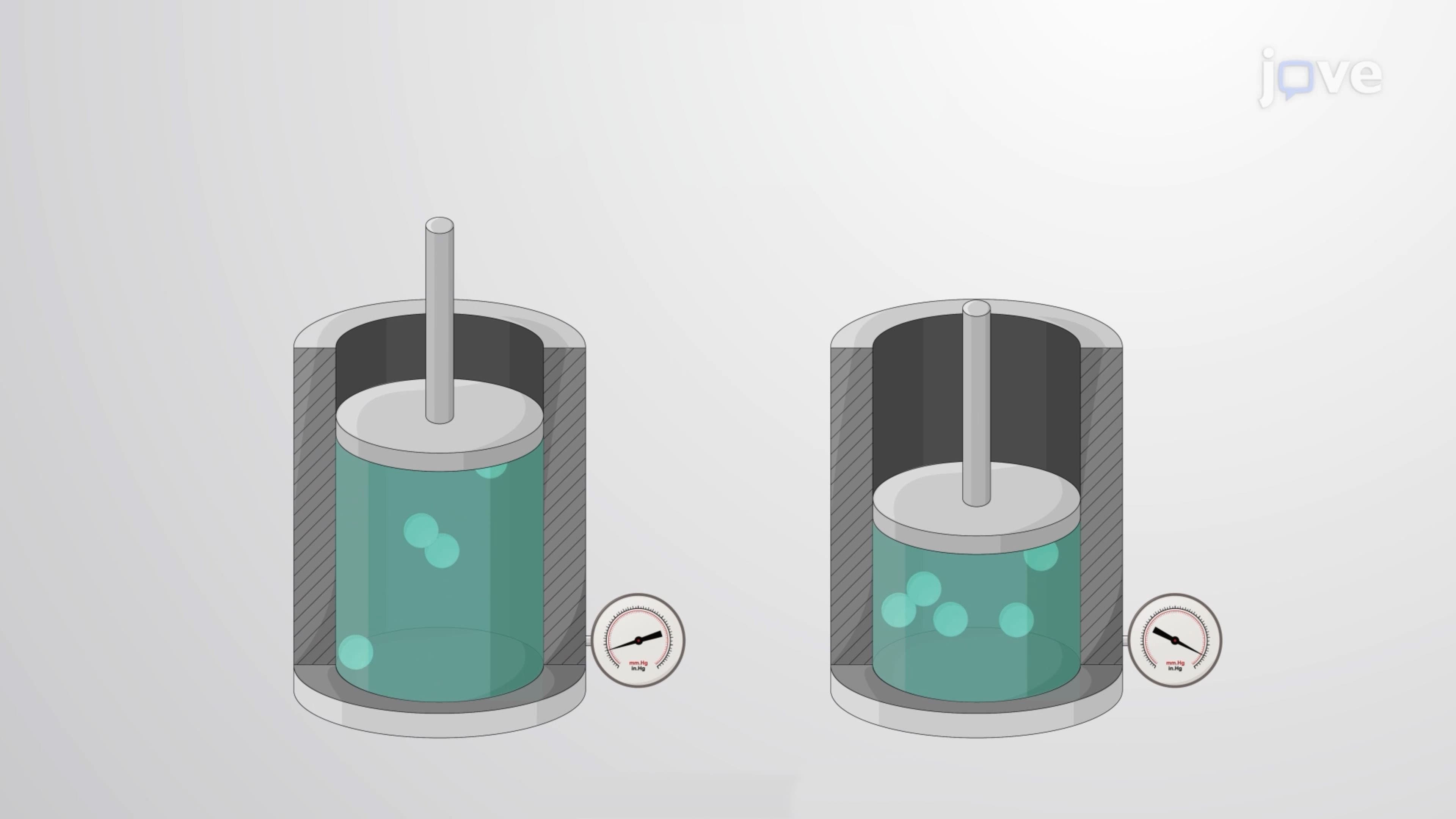
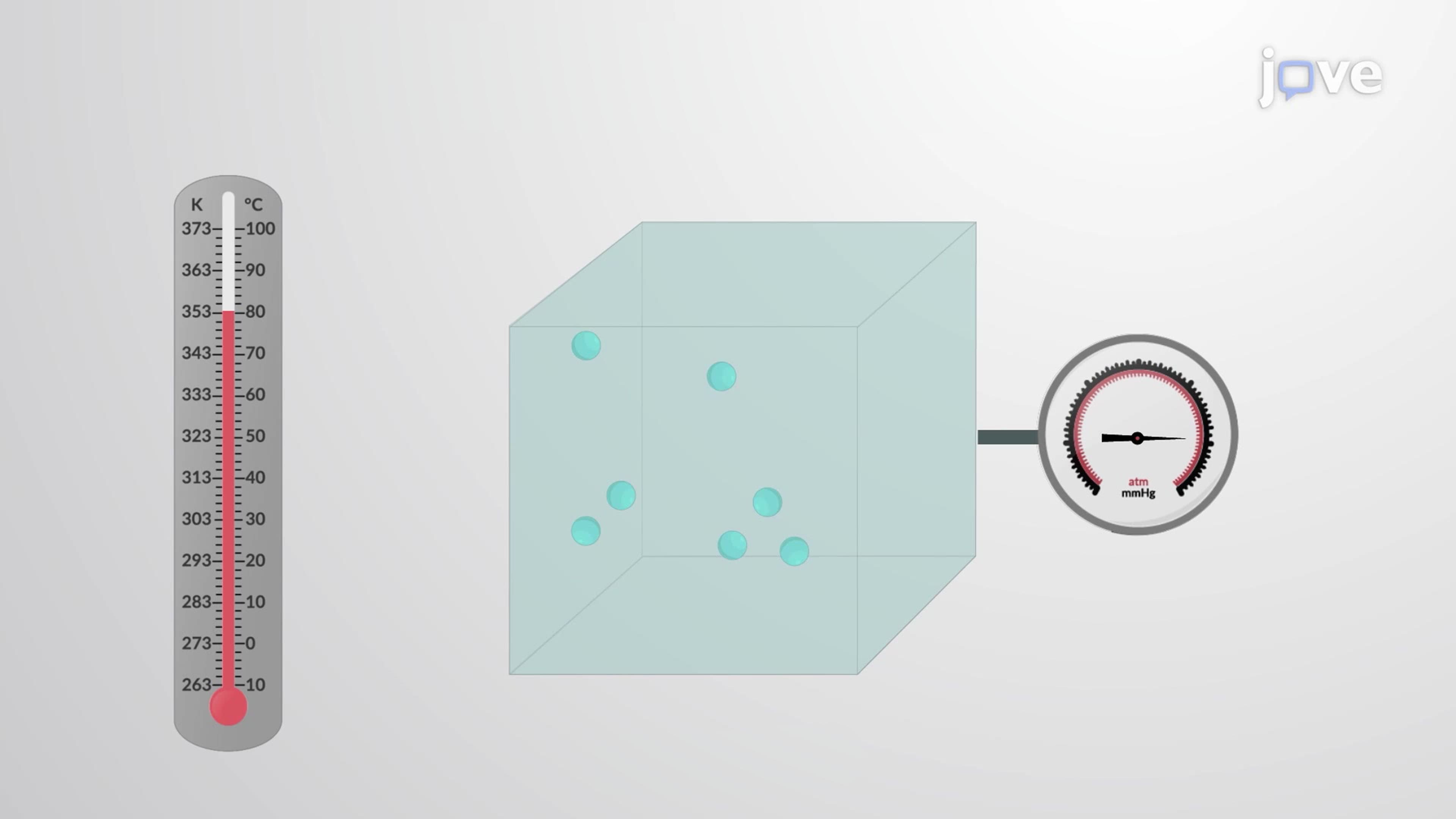
2. Fundamental Gas Laws and Mathematical Relationships Properties and laws of gases establish quantitative relationships between pressure, volume, temperature, and moles. Boyle's law demonstrates inverse pressure-volume relationship at constant temperature, explaining why deep-sea divers must decompress slowly. Charles' law shows direct volume-temperature relationship, evident in hot air balloon operation where heated air expands and becomes less dense. Gay-Lussac's law relates pressure and temperature directly, explaining pressure cooker operation and automobile tire pressure changes with temperature variations.
3. Ideal Gas Law Applications and Calculations The ideal gas law (PV = nRT) enables comprehensive gas calculations using R = 0.08206 L·atm/(mol·K). At standard temperature and pressure (STP: 0°C, 1 atm), one mole of any ideal gas occupies 22.4 L, useful for comparing gas volumes. Density calculations explain why helium balloons rise (lower density than air) and why hot air balloons ascend when heated. Molar mass determinations help identify unknown gases, such as distinguishing carbon dioxide from other combustion products in environmental analysis.
4. Gas Mixtures and Partial Pressures Dalton's law states that total pressure equals the sum of individual gas partial pressures, assuming gases behave independently. In Earth's atmosphere (78% nitrogen, 21% oxygen, 1% other gases), each component contributes proportionally to total atmospheric pressure. Mole fractions determine partial pressures: if nitrogen comprises 0.78 mole fraction at 1 atm total pressure, nitrogen's partial pressure equals 0.78 atm. This principle applies to scuba diving gas mixtures and medical oxygen therapy calculations.
5. Chemical Stoichiometry with Gases Gas stoichiometry combines ideal gas law with balanced chemical equations to calculate reactant and product quantities. In combustion reactions, measuring carbon dioxide volume determines fuel consumption efficiency. Industrial processes like ammonia synthesis require precise gas volume calculations for optimal reactant ratios. At STP conditions, using 22.4 L/mol simplifies calculations, while non-standard conditions require full ideal gas law applications for accurate results in pharmaceutical manufacturing and environmental monitoring.
6. Kinetic Molecular Theory Foundations Kinetic molecular theory explains gas behavior through molecular motion assumptions: negligible particle size, elastic collisions, and average kinetic energy proportional to absolute temperature. Gas particles occupy mostly empty space, enabling high compressibility compared to liquids and solids. At identical temperatures, all gases possess equal average kinetic energy, but lighter molecules move faster than heavier ones. This explains why hydrogen gas diffuses rapidly while carbon dioxide moves slowly through porous materials.
7. Molecular Motion and Gas Properties Root-mean-square (RMS) speed calculations demonstrate inverse relationship between molecular mass and velocity at constant temperature. Lighter gases like helium exhibit broader velocity distributions and higher average speeds than heavier gases like chlorine. Temperature increases cause all gases to move faster, explaining why hot food aromas spread more quickly than cold food odors. Speed distributions shift toward higher velocities with increased temperature, affecting reaction rates and diffusion processes.
8. Diffusion, Effusion, and Molecular Transport Molecular diffusion describes spontaneous gas mixing from high to low concentration regions, limited by frequent molecular collisions and mean free path distances. Graham's law quantifies effusion rates through small openings, with lighter gases effusing faster than heavier ones. Helium balloons deflate more rapidly than oxygen balloons due to helium's lower molar mass and higher effusion rate. These principles apply to gas separation techniques and leak detection methods in industrial applications.
9. Real Gas Behavior and Van der Waals Corrections Real gases deviate from ideal behavior at high pressures and low temperatures due to intermolecular forces and finite molecular volumes. Van der Waals equation corrects for these deviations using experimentally determined constants 'a' (intermolecular attraction) and 'b' (molecular volume). At high pressures, gas molecules occupy significant volume, reducing available space below ideal predictions. At low temperatures, attractive forces become significant, reducing observed pressure below ideal gas calculations, affecting industrial gas processing and storage.