Loading concepts…


12 Concepts
7 Concepts
10 Concepts
13 Concepts
10 Concepts
12 Concepts
15 Concepts
8 Concepts
14 Concepts
9 Concepts
21 Concepts
13 Concepts
12 Concepts
10 Concepts
14 Concepts
15 Concepts
10 Concepts
10 Concepts
10 Concepts
10 Concepts
12 Concepts
 7 Concepts
 670.6K Views
 Popular topics



Atoms and elements form the foundation of chemistry, from Dalton's atomic theory to modern understanding of subatomic particles including protons, neutrons, and electrons. This comprehensive course explores atomic structure elements, isotopes, ions, and the periodic table organization that governs element properties. Students will master calculations involving atomic mass, molar mass, and Avogadro's number while connecting these concepts to real-world applications in medicine, technology, and environmental science. Perfect preparation for standardized exams using JoVE Coach methodology.
1. Atomic Theory Development and Fundamental Laws Dalton's atomic theory revolutionized chemistry by proposing that elements consist of indivisible atoms with identical properties within each element. The theory builds upon the law of conservation of mass, demonstrated when 18 grams of water decomposes into exactly 2 grams of hydrogen and 16 grams of oxygen, and the law of definite proportions, which explains why water always contains hydrogen and oxygen in a 1:8 mass ratio regardless of sample size. These principles led to Dalton's law of multiple proportions, explaining how hydrogen and oxygen form both water (H₂O) and hydrogen peroxide (H₂O₂) in simple whole-number ratios.
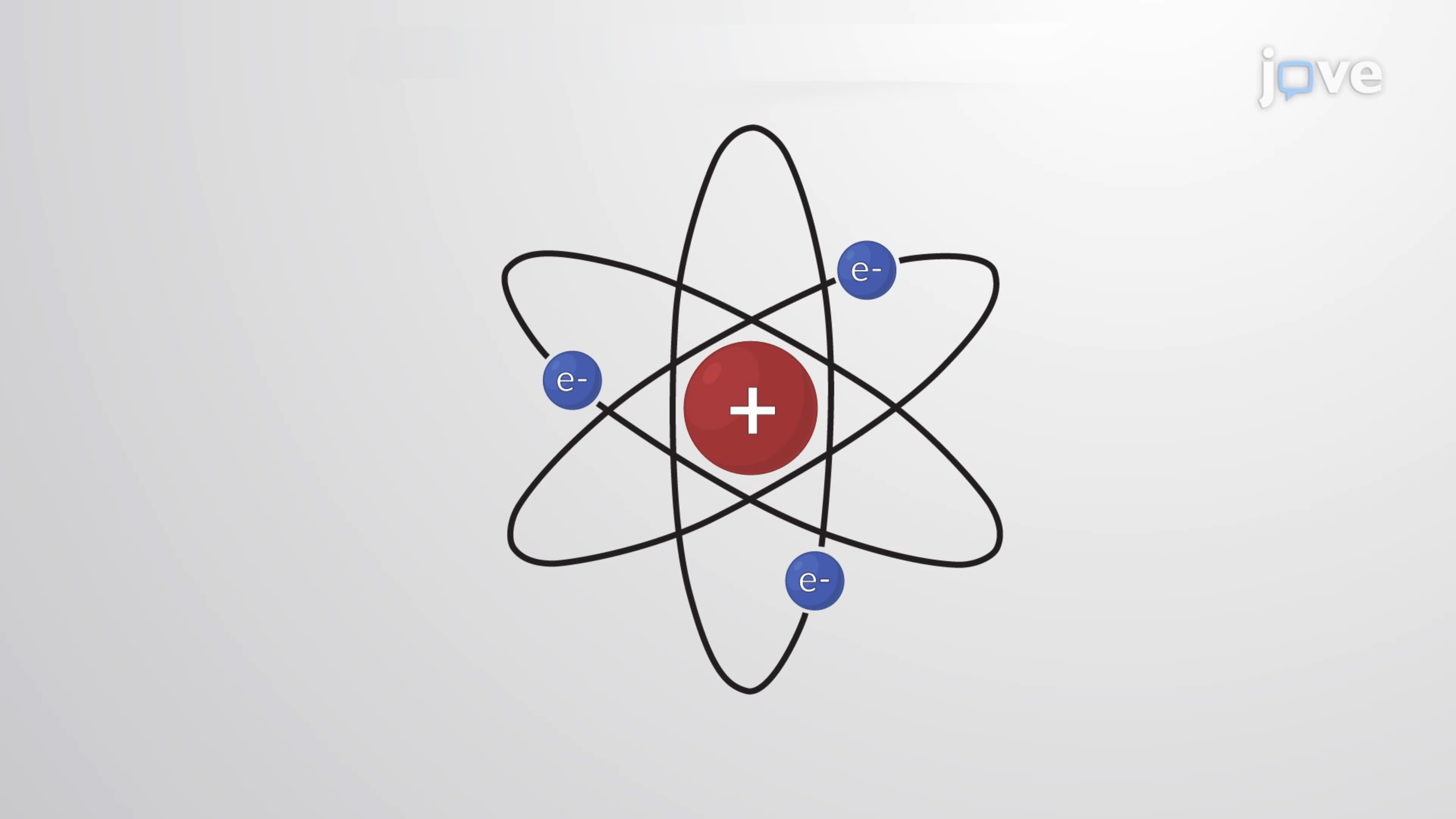
2. Subatomic Particle Discovery and Properties Thomson's cathode ray experiments revealed electrons as negatively charged particles with minimal mass, while Rutherford's gold foil experiment demonstrated that atoms contain a dense, positively charged nucleus surrounded by mostly empty space. Subsequent discoveries identified protons as positively charged nuclear particles and neutrons as electrically neutral nuclear components. Understanding these particles' properties-electrons with -1 charge and negligible mass, protons with +1 charge and ~1 amu mass, and neutrons with no charge and ~1 amu mass-forms the basis for comprehending atomic structure elements and their behavior in chemical reactions.
3. Chemical Symbols, Isotopes, and Nuclear Notation Elements receive one or two-letter chemical symbols, with the first letter capitalized (like Ca for calcium, derived from Latin) and systematic notation indicating atomic composition. Isotopes represent atoms of the same element with identical proton numbers but different neutron counts, such as hydrogen's three forms: protium (no neutrons), deuterium (one neutron), and tritium (two neutrons). Mass spectrometry techniques separate isotopes by mass, enabling calculation of average atomic masses that appear on periodic tables. For example, boron's average atomic mass (10.81 amu) reflects the weighted average of boron-10 (19.9% abundance) and boron-11 (80.1% abundance).
4. Ion Formation and Charge Prediction Patterns Atoms form ions by gaining or losing electrons while maintaining their proton count and essential atomic identity. Metals typically lose electrons to become cations (like Ca²⁺ from calcium losing two electrons), while nonmetals gain electrons to form anions (like F⁻ from fluorine gaining one electron, called fluoride). Periodic table position predicts ionic behavior: Group 1 alkali metals form +1 cations, Group 2 alkaline earth metals form +2 cations, Group 17 halogens form -1 anions, and Group 16 elements form -2 anions. Transition metals can form multiple ion types, while noble gases rarely form ions due to their stable electron configurations.
5. Periodic Table Organization and Element Classification The modern periodic table arranges 118 elements by increasing atomic number across seven periods (rows) and eighteen groups (columns), with elements sharing similar properties appearing in the same group. Major classifications include metals (left and center regions) that conduct electricity and form cations, nonmetals (right region) that typically form anions, and metalloids along the metal-nonmetal boundary exhibiting mixed properties. Specific groups receive names reflecting their properties: alkali metals (Group 1), alkaline earth metals (Group 2), halogens (Group 17), and noble gases (Group 18). This organization enables prediction of element behavior and chemical bonding patterns essential for understanding compound formation.
6. Atomic Mass Calculations and Molar Mass Applications Atomic mass units (amu) or Daltons (Da) measure individual atom masses, with values calculated from isotope masses weighted by natural abundance percentages. Molar mass connects atomic-scale measurements to laboratory-scale quantities, with one mole containing Avogadro's number (6.022 × 10²³) of particles. For practical calculations, an element's molar mass in grams per mole equals its atomic mass in amu numerically. Converting between mass, moles, and particle number enables quantitative chemistry: a 5-gram gold bar (molar mass 196.96 g/mol) contains 0.0254 moles or 1.529 × 10²² atoms, demonstrating how microscopic atomic properties scale to macroscopic laboratory measurements.