Loading subject page…


410,818 views


Video Summary: Real Gases Effects of Intermolecular Explained
Ever wonder why the air in your car tires behaves differently in winter versus summer? Real gases effects of intermolecular forces explain this fascinating phenomenon that challenges our assumptions about gas behavior. Unlike ideal gases that follow perfect mathematical relationships, real gases like oxygen and nitrogen in Earth's atmosphere deviate significantly from predicted values under certain conditions. This deviation becomes especially pronounced in high-pressure systems like scuba tanks or industrial compressors used throughout American manufacturing. Watch the full video on JoVE Coach to master this concept with expert-led visuals and step-by-step explanations.
The behavior of real gases reveals fascinating deviations from the simplified ideal gas model that students first encounter in chemistry. While ideal gases serve as an excellent starting point for understanding gas behavior, real gases effects of intermolecular forces become critically important in practical applications ranging from automotive engineering to pharmaceutical manufacturing across the United States.
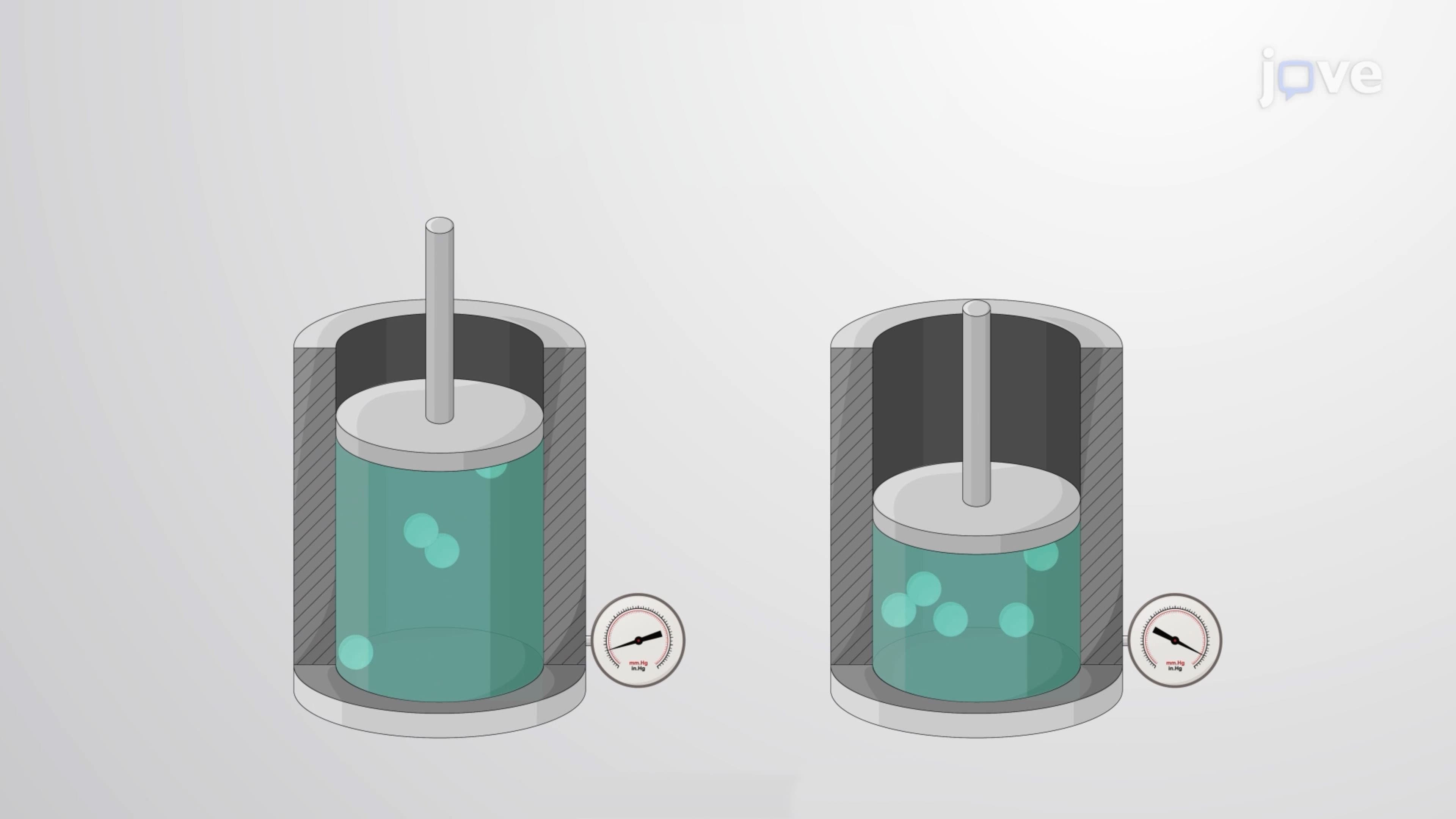
Real gas molecules possess finite volume, unlike the point particles assumed in ideal gas theory. At atmospheric pressure, gas molecules are relatively far apart-imagine a pea rattling inside a basketball. However, as pressure increases (such as in compressed natural gas tanks used in American public transportation), molecules become much closer together, more like a pea inside a ping-pong ball. This proximity means the actual volume occupied by gas molecules becomes significant compared to the container volume.
The van der Waals correction factor 'b' accounts for this excluded volume effect. For common gases like nitrogen (b = 0.0391 L/mol) and carbon dioxide (b = 0.0427 L/mol), this correction becomes essential when calculating gas behavior in high-pressure applications like CO2 storage for enhanced oil recovery operations in Texas and North Dakota.
The second major deviation from ideality stems from intermolecular attractions between gas molecules. Under normal atmospheric conditions, these weak van der Waals forces are negligible because molecules move rapidly and rarely interact. However, as pressure increases or temperature decreases, these attractive forces become significant.
Consider propane storage tanks used for American residential heating systems. At high pressure and moderate temperature, propane molecules experience substantial intermolecular attraction, causing them to "stick together" more frequently during collisions. This reduces the frequency of wall collisions, resulting in lower observed pressure than ideal gas theory would predict.
These real gas effects appear frequently on standardized exams including the AP Chemistry exam, MCAT physical sciences section, and college general chemistry courses. Students studying chemical engineering at institutions like MIT, Stanford, or University of Texas often encounter these principles when designing industrial processes for companies like ExxonMobil or DuPont.
Understanding real gas behavior proves essential for careers in petroleum engineering, where professionals must accurately predict gas behavior in oil and gas extraction operations throughout American energy fields from Alaska's North Slope to the Gulf of Mexico offshore platforms.
Related Micro-courses