Loading subject page…


436,009 views


Video Summary: What Is Molecular Shape and Polarity
Ever wonder why oil and water don't mix, but sugar dissolves instantly in your morning coffee? Molecular shape and polarity determines how molecules interact with each other and their environment. This fundamental chemistry concept explains why water can dissolve table salt while gasoline cannot, based on the three-dimensional arrangement of atoms and the unequal sharing of electrons in chemical bonds. From predicting solubility in pharmaceutical formulations to understanding biological membranes, what is molecular shape and polarity becomes crucial for students mastering chemistry fundamentals. Watch the full video on JoVE Coach to master this concept with expert-led visuals and step-by-step explanations.
Molecular shape and polarity represents one of chemistry's most practical concepts, directly connecting atomic structure to observable properties. When atoms form covalent bonds, electrons aren't always shared equally. Electronegativity differences create partial charges (δ+ and δ-), generating bond dipole moments that point from less electronegative to more electronegative atoms. This microscopic charge separation has macroscopic consequences-determining everything from drug solubility to biological membrane function.
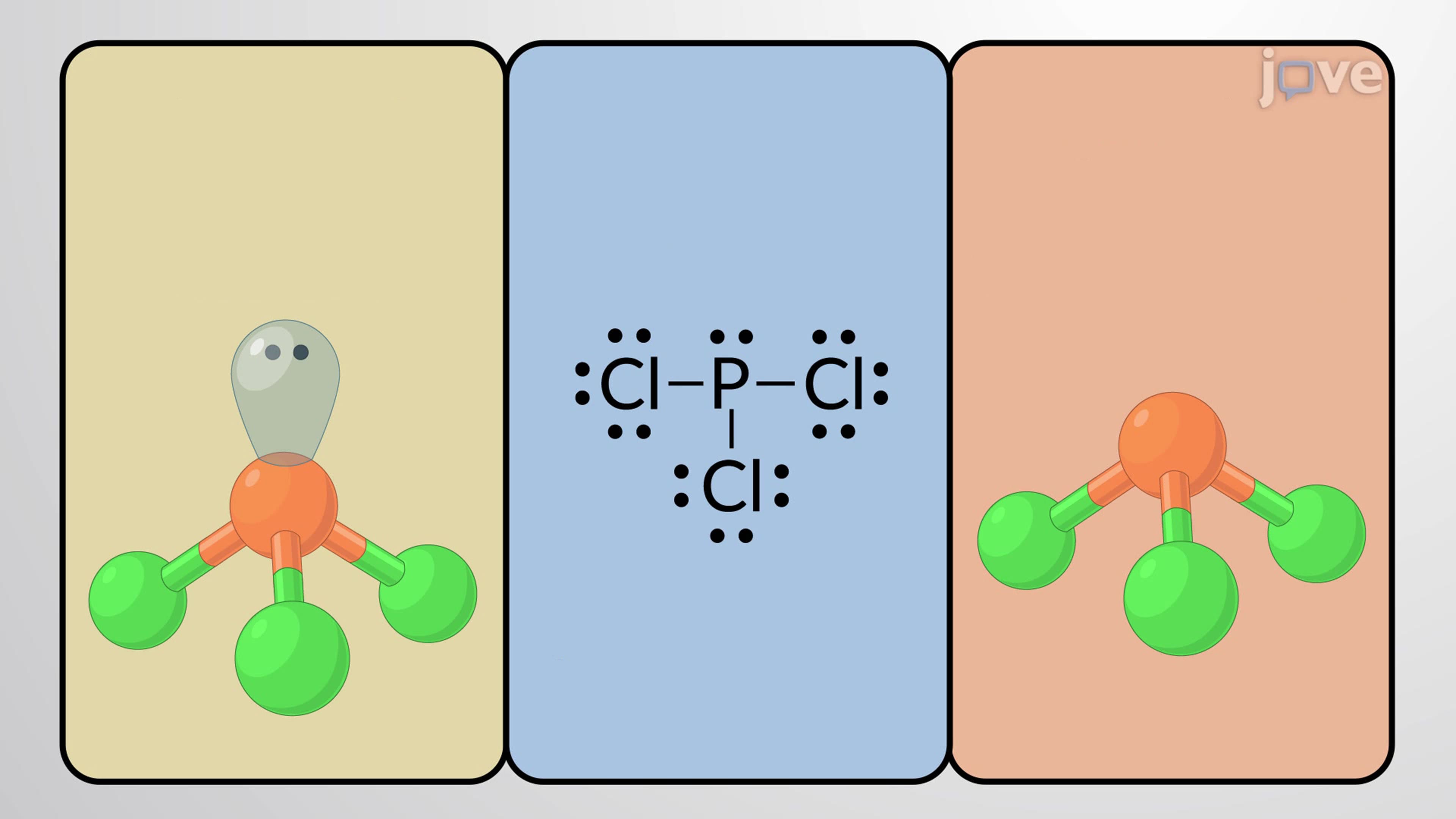
Individual bond polarities combine with three-dimensional molecular geometry to determine overall molecular polarity. Consider carbon dioxide versus water: both contain polar bonds, yet CO₂ remains nonpolar while H₂O is highly polar. The linear CO₂ geometry allows equal and opposite C=O dipoles to cancel, while water's bent geometry prevents H-O dipole cancellation. This principle applies across all molecular geometries-symmetrical arrangements often produce nonpolar molecules despite containing polar bonds.
Understanding molecular polarity enables prediction of crucial chemical behaviors. The "like dissolves like" principle governs solubility: polar solvents dissolve polar solutes, while nonpolar solvents dissolve nonpolar compounds. This explains why ionic compounds dissolve in water but not in hexane, and why oil spills persist on ocean surfaces. In biological systems, this principle determines cell membrane permeability and drug distribution throughout the body.
Mastering molecular shape and polarity concepts proves essential for success in AP Chemistry, SAT Subject Tests, and college organic chemistry courses. The MCAT extensively tests these principles in biological contexts, while nursing entrance exams like HESI A2 and TEAS emphasize polarity's role in pharmacology. Students encounter these concepts in laboratory work, where understanding polarity guides solvent selection for extractions and recrystallizations. Professional applications span pharmaceutical development, environmental chemistry, and materials science-making this knowledge valuable beyond academic settings.
Related Micro-courses