Loading video…


 10 Concepts
 222.7K views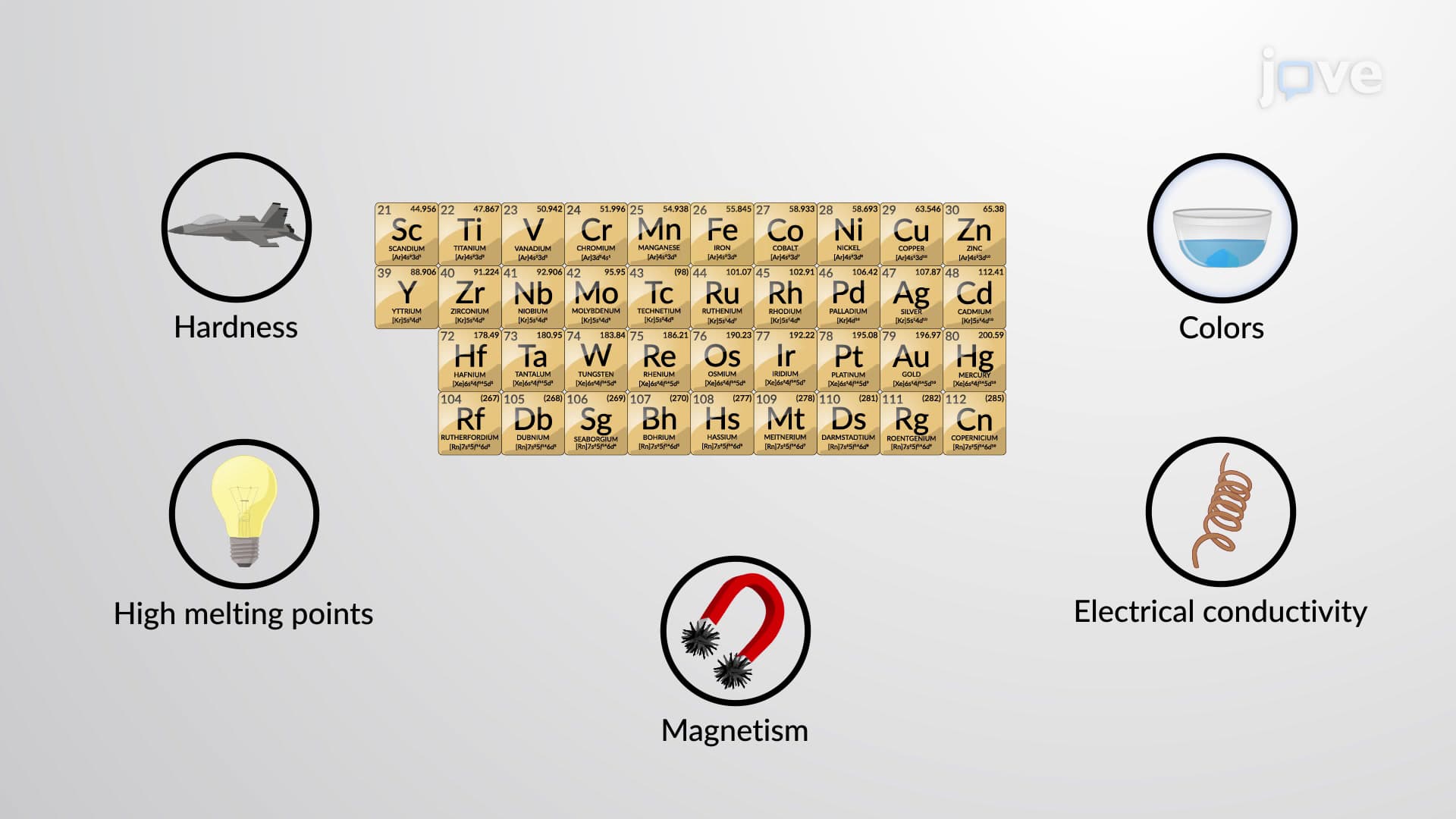

Video Summary: What are Properties of Transition Metals
Ever wondered why copper wires conduct electricity so well while aluminum cookware resists corrosion? The properties of transition metals make these everyday applications possible. From the vibrant blue of copper sulfate used in swimming pools to the magnetic strength of iron in MRI machines, these d-block elements exhibit remarkable characteristics including variable oxidation states, distinctive colors, and exceptional conductivity. Watch the full video on JoVE Coach to master this concept with expert-led visuals and step-by-step explanations.
Transition metals occupy the central d-block of the periodic table, bridging main group elements with their unique combination of metallic and chemical properties. Unlike main group elements that follow predictable trends, transition metals exhibit distinctive characteristics arising from their partially filled d-orbitals. These properties make them indispensable in everything from catalytic converters in automobiles to the steel framework of skyscrapers.
The foundation of transition metal properties lies in their electron configuration. While the Aufbau principle generally governs electron filling, transition metals show notable exceptions. Chromium adopts [Ar]4s¹3d⁵ rather than the expected [Ar]4s²3d⁴ configuration because half-filled d-orbitals provide extra stability. Similarly, copper prefers [Ar]4s¹3d¹⁰ over [Ar]4s²3d⁹ to achieve a completely filled d-subshell. These exceptions frequently appear on AP Chemistry exams and college general chemistry courses, requiring students to understand energy considerations beyond simple orbital filling rules.
Transition metals display unique trends in atomic size, electronegativity, and ionization energy. Unlike main group elements, atomic radii decrease only slightly across a period because d-electrons provide poor shielding of the nuclear charge. The lanthanide contraction significantly affects sixth-period elements like tungsten and gold, making them smaller and denser than expected. This contraction explains why gold (density 19.3 g/cm³) is so much denser than silver (10.5 g/cm³), despite being only one period below it.
Perhaps the most distinctive property of transition metals is their ability to exhibit multiple oxidation states. Iron demonstrates this versatility in biological systems: Fe²⁺ in hemoglobin transports oxygen, while Fe³⁺ in cytochromes facilitates electron transfer during cellular respiration. Manganese shows the widest range, from +1 to +7, exemplified by the deep purple permanganate ion (MnO₄⁻) used in water treatment plants across the United States. This variability makes transition metals excellent catalysts, as seen in the platinum catalysts used in petroleum refining and the vanadium pentoxide catalysts in sulfuric acid production.
Related Micro-courses