Loading subject page…

Micro-course: Mixing, Placing and Curing Concrete
2,661 views
Learn key concepts and earn your certificate.









Mixing Time

00:00
01:19
Video Summary: What Is Mixing Time
Did you know that improperly mixed concrete causes billions in structural damage across US infrastructure annually? Mixing time determines whether a concrete structure will stand strong for decades or fail prematurely. The Florida International University pedestrian bridge collapse in 2018 highlighted how critical proper mixing protocols are in construction. Understanding what is mixing time involves recognizing the precise duration needed to achieve uniform concrete distribution, typically requiring at least one minute for smaller batches and increasing with mixer capacity. Watch the full video on JoVE Coach to master this concept with expert-led visuals and step-by-step explanations.
- Understand what is mixing time and its critical role in concrete quality and structural integrity
- Identify the optimal mixing duration based on mixer capacity, starting with one minute for one cubic yard
- Analyze how inadequate mixing (under 1-1.5 minutes) leads to non-uniform concrete with reduced strength
- Evaluate the water addition sequence: 10% initially, 80% during material loading, 10% in first quarter of mixing
- Recognize factors affecting mixing efficiency: mixer type, rotation speed, and ingredient charging quality
- Apply mixing time calculations for different batch sizes using the 15-second increment rule
- Compare the consequences of under-mixing versus over-mixing on concrete performance
- Explore how prolonged mixing causes water evaporation, aggregate grinding, and decreased workability
Understanding What is Mixing Time in Concrete Production
Mixing time represents the duration required to achieve uniform distribution of all concrete components-cement, aggregates, water, and admixtures-within a mixer. This fundamental concept in materials engineering directly impacts the structural integrity of everything from residential foundations to major infrastructure projects like the Golden Gate Bridge maintenance work.
The Science Behind Optimal Mixing Duration
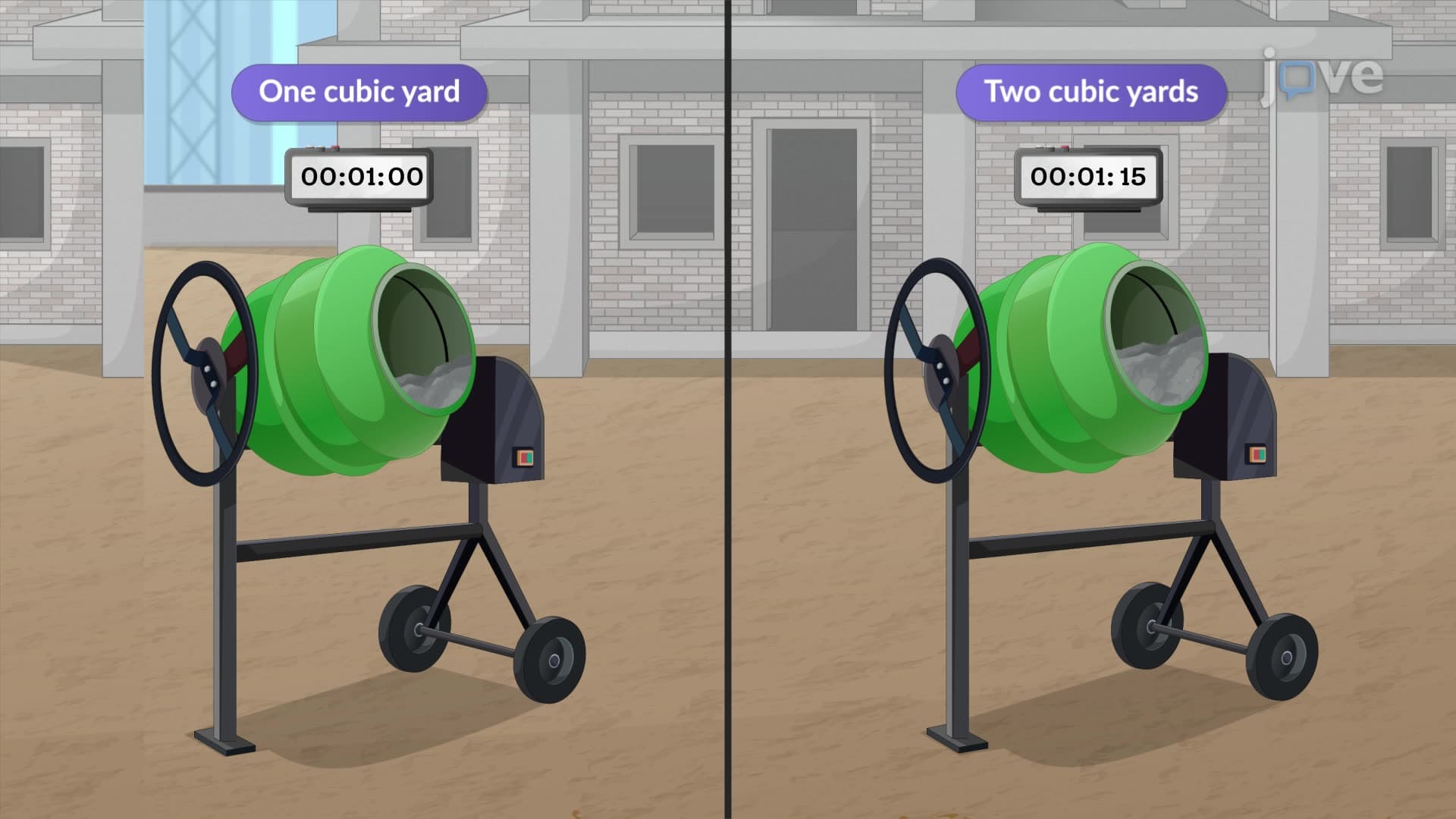
The mixing time definition encompasses both minimum thresholds and capacity-based calculations. Research conducted at universities like MIT and Stanford has established that mixers with up to one cubic yard capacity require a minimum of one minute of mixing. For each additional cubic yard, mixing time increases by fifteen seconds. This systematic approach ensures adequate particle distribution while preventing over-processing.
The water addition sequence plays a crucial role in mixing efficiency. Initially, 10% of total water charges the mixer, followed by solid materials and 80% of remaining water. The final 10% incorporates during the first quarter of total mixing time, optimizing hydration patterns and workability.
Consequences of Improper Mixing Time
When examining what is mixing time in detail, understanding failure modes becomes essential. Under-mixing (less than 1-1.5 minutes) creates non-uniform concrete with compromised strength, potentially leading to structural failures like those seen in some US building collapses. Conversely, over-mixing causes water evaporation, soft aggregate grinding, reduced workability, increased temperature from friction, and decreased air content in air-entrained concrete.
Students preparing for AP Chemistry or college materials science courses should recognize that mixing time optimization involves balancing competing factors: achieving uniformity while preventing degradation.
Practical Applications in US Construction
Major US construction projects, from the Hoover Dam restoration to modern skyscraper foundations, rely on precise mixing time protocols. The mixing time concept extends beyond academic study-it's applied daily by construction engineers, quality control technicians, and project managers across American infrastructure projects.
Frequently Asked Questions
Mixing time is the duration required to achieve uniform distribution of all concrete components in a mixer. It typically starts at one minute for one cubic yard capacity, increasing by fifteen seconds for each additional cubic yard. Proper mixing time ensures structural integrity and concrete strength.
MCAT questions often test mixing time within materials science passages, focusing on optimal duration calculations and failure analysis. AP Chemistry may include mixing time in kinetics problems or materials applications. Students should understand both the mathematical relationships and underlying chemical principles.
Remember: Base time = 1 minute for 1 cubic yard, plus 15 seconds for each additional cubic yard. For example, a 3 cubic yard mixer requires 1 minute + (2 × 15 seconds) = 1.5 minutes minimum mixing time.
The 2018 Florida International University bridge collapse partially involved concrete quality issues, highlighting mixing protocol importance. Inadequate mixing creates weak spots, while over-mixing reduces concrete workability and strength, both contributing to potential structural failures.
No advanced prerequisites are required-basic chemistry and mathematics suffice. Focus on understanding ratios, time calculations, and cause-and-effect relationships. High school chemistry provides adequate background for grasping mixing time principles.
Practice capacity-based calculations using the 15-second increment rule. Create flashcards linking mixing duration to concrete quality outcomes. Work through real-world scenarios involving different mixer sizes and identify optimal mixing parameters.
Consider studying concrete curing kinetics, admixture effects on mixing requirements, and advanced materials like high-performance concrete. These topics build naturally on mixing time fundamentals and appear in upper-level engineering courses.
Related Micro-courses

6 Concepts

12 Concepts
6 Concepts