Loading subject page…


2,661 views

Video Summary: What Is Shotcrete
Ever wondered how concrete can be sprayed onto vertical walls or even ceilings? Shotcrete is a specialized construction technique that propels concrete at high velocity through a hose, allowing it to stick to any surface-even upside down! From reinforcing the tunnels of New York's subway system to stabilizing California's hillside retaining walls, this innovative method revolutionizes how we apply concrete in challenging locations. Watch the full video on JoVE Coach to master this concept with expert-led visuals and step-by-step explanations.
Shotcrete represents a revolutionary concrete placement method that defies gravity through high-velocity application. Unlike traditional concrete pouring, shotcrete uses pneumatic pressure to project concrete mixtures at speeds exceeding 100 feet per second, creating kinetic energy that forces the material to adhere to any surface orientation. This technique transforms construction possibilities, enabling concrete application on vertical walls, overhead surfaces, and complex geometries that would be impossible with conventional methods.
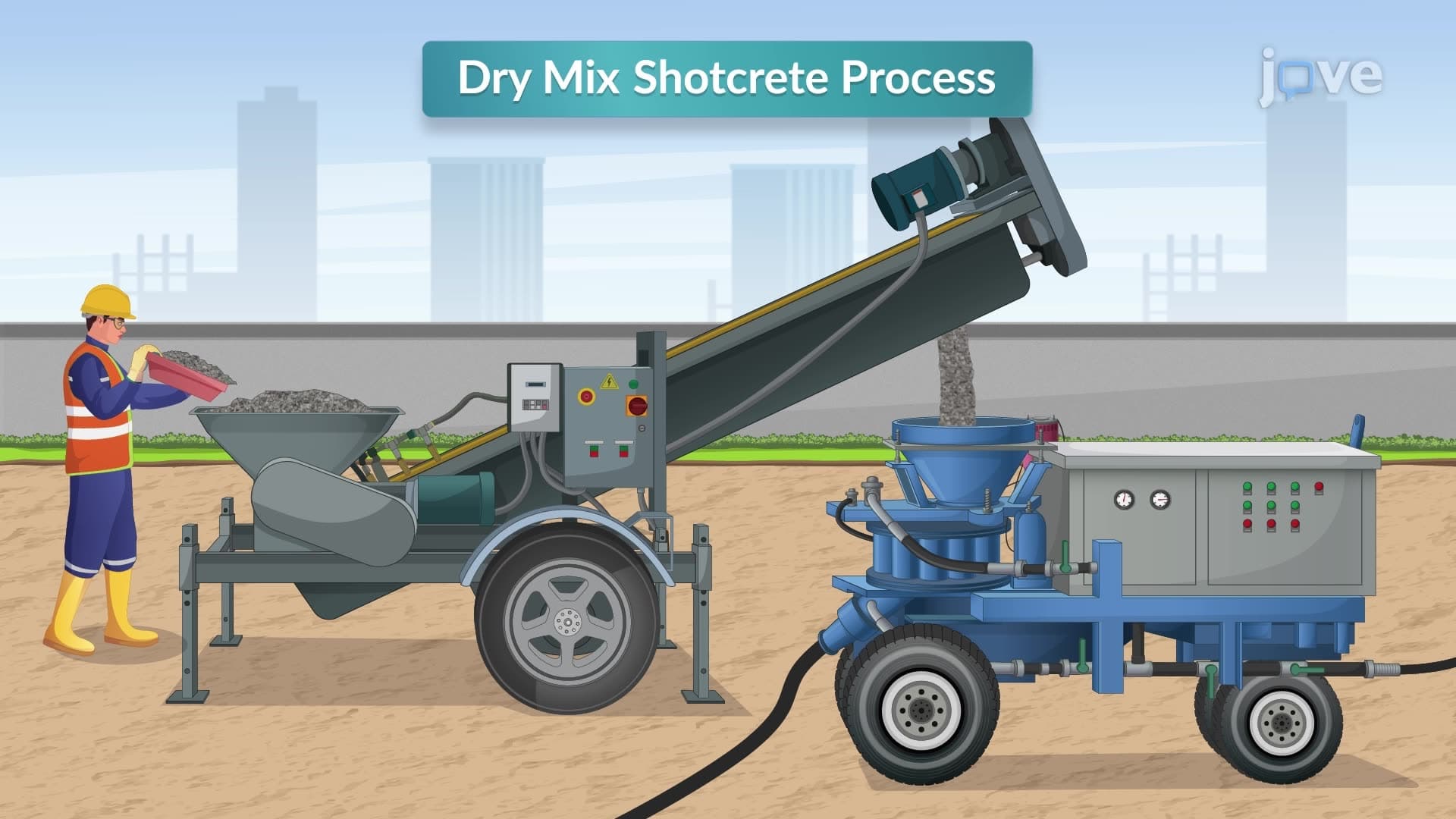
The dry mix method begins with carefully proportioned cement and slightly moist aggregates fed into specialized equipment called a gunite machine. Compressed air propels this dry mixture through delivery hoses at high pressure. The critical moment occurs at the nozzle, where pressurized water jets inject into the dry stream, instantly hydrating the cement and creating wet concrete milliseconds before impact. This precise timing ensures optimal concrete consistency and minimizes material waste, making it ideal for projects like the restoration of the Hoover Dam's concrete surfaces.
Wet mix shotcrete pre-combines all ingredients-cement, aggregates, and water-before entering the delivery system. This thoroughly mixed concrete travels through hoses using pneumatic conveyance, with compressed air introduced at the nozzle to accelerate the mixture's velocity. The wet mix method offers superior quality control and reduced dust generation, making it preferred for enclosed spaces like subway tunnel construction projects throughout major US cities.
Successful shotcrete application requires understanding compaction dynamics and adhesion mechanics. The high-velocity impact creates intimate contact between the concrete and substrate, while simultaneously compacting the mixture to achieve densities comparable to conventionally placed concrete. Operators must master nozzle positioning, maintaining optimal distances of 3-6 feet from the target surface while building layers incrementally to achieve the specified 4-inch thickness. This skill-intensive process directly impacts structural integrity, making operator certification essential for projects meeting American Concrete Institute (ACI) standards.
Students preparing for AP Environmental Science or college-level construction management courses should recognize shotcrete's applications in slope stabilization, tunnel lining, and swimming pool construction-topics frequently appearing on standardized exams testing practical engineering knowledge.
Related Micro-courses