Loading…
Loading video…

1,284 views
Why do massive concrete pours at construction sites like Los Angeles International Airport's recent terminal expansion sometimes fail spectacularly? The design example managing concrete workability demonstrates how environmental factors can make or break large-scale projects. When pouring a raft foundation under scorching Nevada desert conditions, engineers discovered their concrete mix was losing workability faster than expected, threatening structural integrity and project timelines. Watch the full video on JoVE Coach to master this concept with expert-led visuals and step-by-step explanations.
Design example managing concrete workability represents a critical engineering challenge that bridges theoretical knowledge with real-world construction demands. Workability refers to concrete's ease of mixing, transporting, placing, and compacting without segregation. In the United States, where construction projects range from Florida's humid coastal developments to Arizona's desert infrastructure, managing workability becomes essential for structural integrity and project success.
The concept extends beyond simple mix design to encompass environmental adaptation, quality control, and systematic problem-solving. Students preparing for AP Chemistry or college-level materials engineering courses encounter this topic as it demonstrates practical applications of thermodynamics, chemical kinetics, and materials science principles.
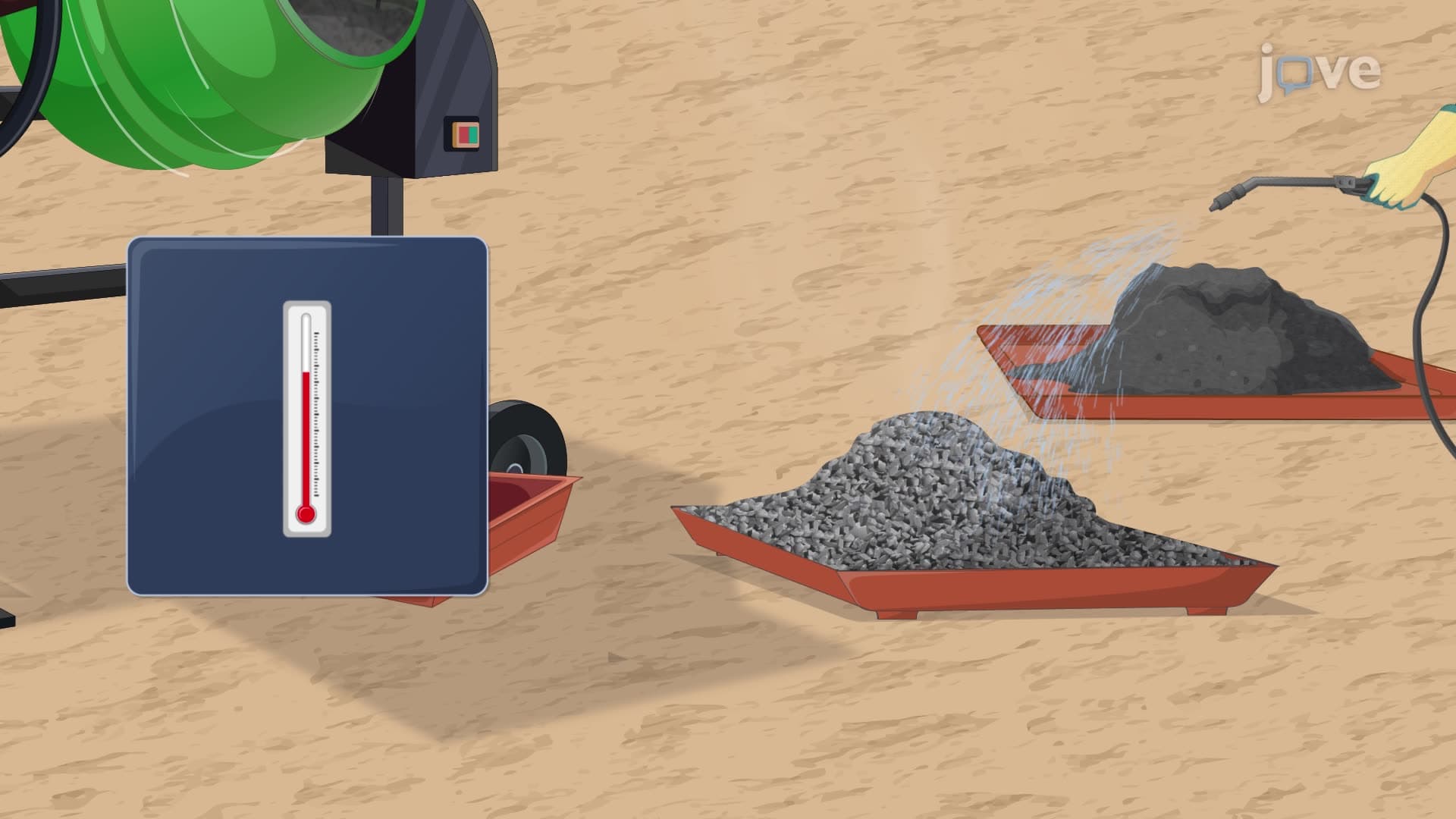
Temperature plays the dominant role in workability management. Hot aggregate materials, common in states like Texas and Nevada during summer construction seasons, accelerate cement hydration and increase water evaporation rates. This phenomenon creates a cascade effect: rapid water loss reduces workability, making placement difficult and potentially compromising structural quality.
Real-world applications include major infrastructure projects such as the California High-Speed Rail construction, where engineers must account for temperature variations across different regions. The systematic approach demonstrated in workability management—identify problem, test hypothesis, implement solution, verify results—mirrors scientific methodology taught in AP courses and reinforces critical thinking skills essential for MCAT preparation.
Effective workability management employs a hierarchical approach to problem-solving. Initial interventions focus on physical modifications, such as cooling aggregates through water spraying or shade provision. These methods address immediate temperature concerns while maintaining original mix proportions.
When physical interventions prove insufficient, chemical admixtures become necessary. Retarders like sugar (though commercial retarders are preferred in professional practice) slow cement hydration, extending working time. This chemical approach demonstrates principles relevant to students studying for standardized tests, where understanding cause-and-effect relationships in material behavior proves crucial.
Large-scale projects like airport runway construction or hospital foundation work require precise workability control. The Las Vegas Strip's recent casino developments exemplify challenges where concrete placement occurs continuously over hours, demanding consistent workability throughout the operation. Understanding these real-world applications helps students connect classroom theory with professional practice, essential for those pursuing engineering careers or preparing for graduate school applications.
Frequently Asked Questions
Design example managing concrete workability is the systematic approach to maintaining concrete's ease of handling during placement and compaction. It's crucial because poor workability leads to construction delays, increased costs, and potentially compromised structural integrity in major projects.
AP Chemistry tests often include questions about material properties, chemical reactions, and environmental effects on substances. Concrete workability demonstrates principles of thermodynamics, reaction kinetics, and solution chemistry that frequently appear in free-response questions.
Engineering exams test your ability to analyze multiple variables simultaneously—temperature, time, chemical interactions, and practical constraints. Students must demonstrate understanding of both theoretical principles and practical problem-solving strategies.
Major contractors use specialized techniques including pre-cooling aggregates, scheduling pours during cooler hours, using chemical admixtures, and employing rapid placement equipment. Companies like Sundt Construction have developed protocols specifically for desert construction conditions.
Not necessarily. While chemistry helps, the core concepts build on high school chemistry and physics principles. Understanding basic thermodynamics, reaction rates, and material properties provides sufficient foundation for introductory study.
Focus on understanding the systematic problem-solving approach rather than memorizing specific solutions. Practice identifying cause-and-effect relationships, and work through step-by-step analysis of real construction scenarios to build critical thinking skills.
This concept integrates materials science, thermodynamics, fluid mechanics, and quality control principles. It provides excellent preparation for advanced courses in structural engineering, construction management, and materials characterization.
Related Micro-courses
Related Subjects
 Electrical Engineering 33 micro-courses›Mechanical Engineering 28 micro-courses›