Loading subject page…


2,165 views


Video Summary: What are Vertical Curves
Ever wondered how engineers ensure your car doesn't launch off highway hills like a roller coaster? Vertical curve problem solving is the mathematical foundation that keeps vehicles safely grounded on roads with changing grades. For instance, the Interstate 80 climb through the Sierra Nevada mountains in California requires hundreds of precisely calculated vertical curves to maintain safe driving conditions. What are vertical curves becomes critical knowledge for understanding how parabolic transitions connect different road grades, ensuring proper sight distance and passenger comfort. Watch the full video on JoVE Coach to master this concept with expert-led visuals and step-by-step explanations.
What are vertical curves represents a fundamental concept in transportation engineering where parabolic curves provide smooth transitions between roadway segments with different slopes or grades. Unlike the abrupt grade changes that would create dangerous conditions, vertical curves ensure gradual elevation transitions that maintain vehicle control and passenger comfort. The parabolic shape is mathematically optimal because it provides constant rate of grade change, distributing acceleration forces evenly across the transition zone.
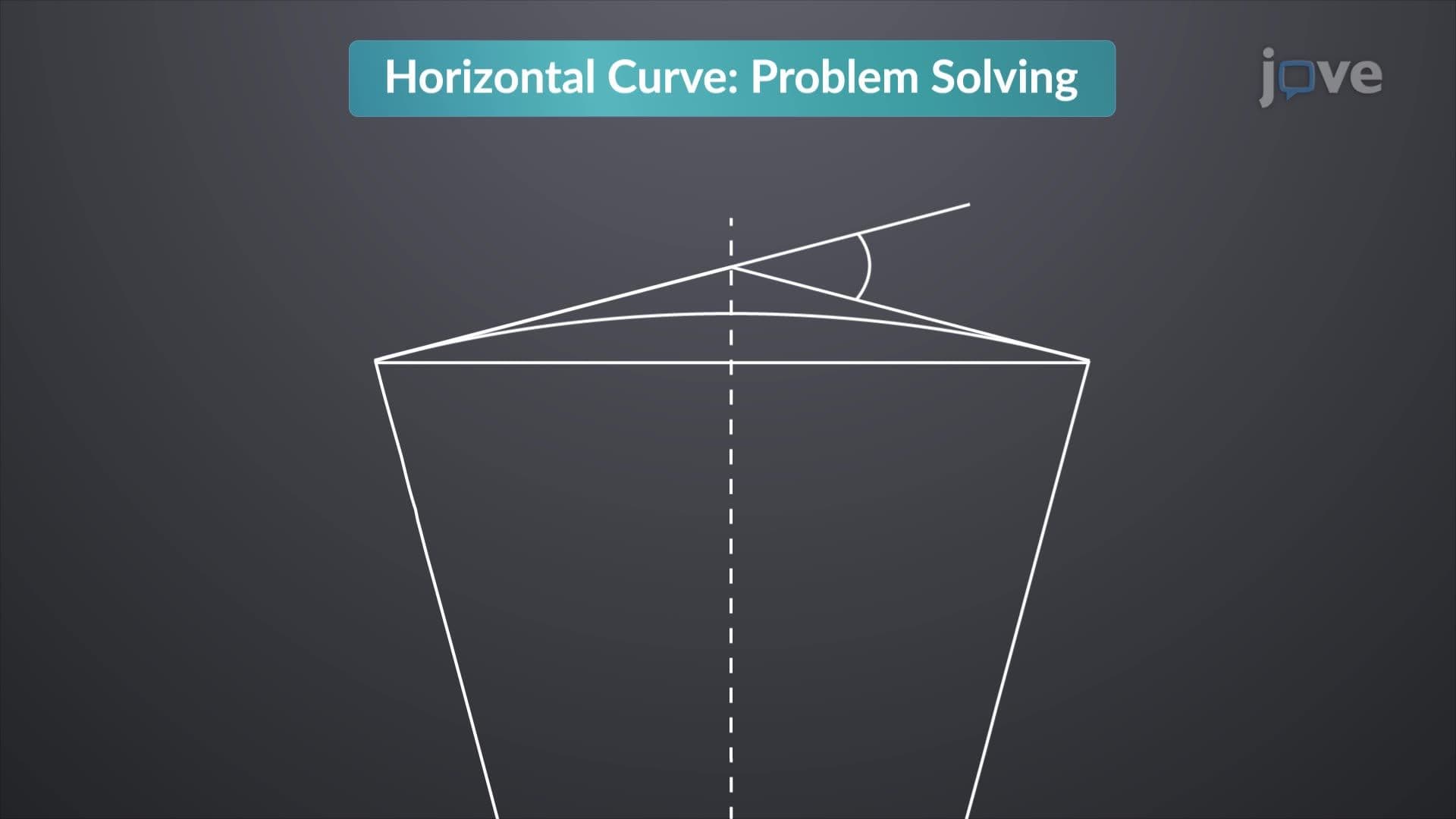
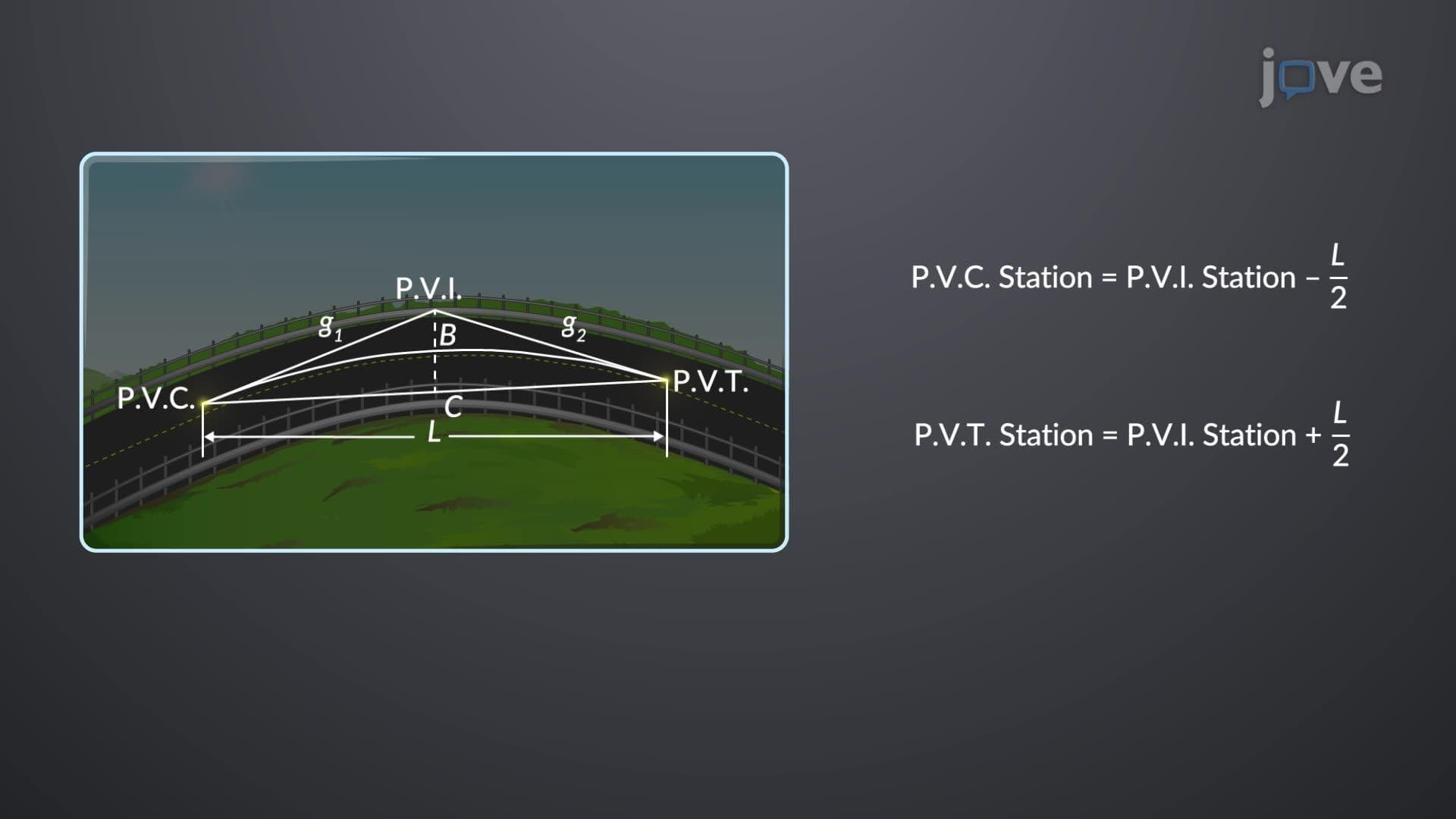
The geometry of vertical curves centers on three essential points that define the curve's boundaries and characteristics. The Point of Vertical Curvature (PVC) marks where the incoming tangent (back tangent) begins transitioning into the curve. The Point of Vertical Intersection (PVI) represents the theoretical intersection of the back and forward tangents if extended, serving as the curve's apex or vertex. Finally, the Point of Vertical Tangency (PVT) indicates where the curve transitions back to straight alignment with the outgoing tangent (forward tangent).
These points are crucial for vertical curve problem solving in engineering applications. Students preparing for AP Physics or college-level statics courses encounter these concepts when analyzing motion along inclined planes with varying slopes. The tangent offset method allows engineers to calculate elevations at any point along the curve using the parabolic equation y = ax², where 'a' represents the curve's rate parameter.
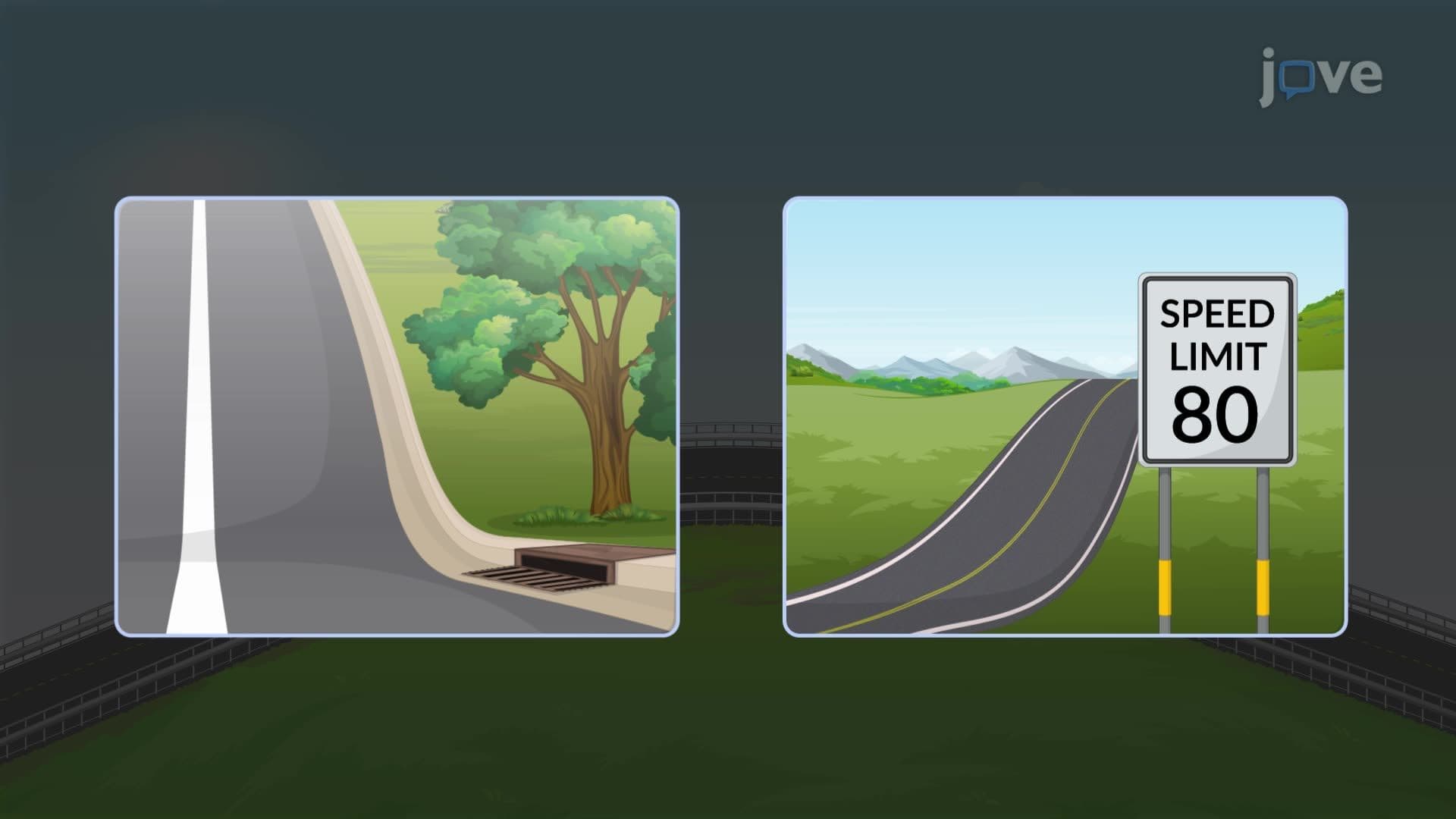
Vertical curves are classified as either crest curves (connecting an upward grade to a downward grade) or sag curves (connecting a downward grade to an upward grade). Crest curves, like those found on Interstate 5 through the Grapevine in California, require careful sight distance analysis to ensure drivers can see oncoming traffic or obstacles. Sag curves, common in valley crossings such as those on Highway 1 along California's coast, must account for headlight illumination distance and drainage considerations.
Symmetrical vertical curves have equal tangent lengths on both sides of the PVI, while nonsymmetrical curves have unequal tangent lengths. The choice depends on terrain constraints, construction costs, and operational requirements. Engineering students studying for the Fundamentals of Engineering (FE) exam must understand how curve length affects passenger comfort, with longer curves providing gentler transitions but requiring more construction area.
In professional practice, vertical curve problem solving involves balancing multiple factors: sight distance requirements, earthwork economics, and geometric constraints. The American Association of State Highway and Transportation Officials (AASHTO) provides design standards that specify minimum curve lengths based on design speed and grade change. For example, a 4% grade change at 70 mph requires a minimum 400-foot curve length to meet sight distance standards.
Students encountering these concepts in SAT Subject Tests or college transportation engineering courses should focus on the mathematical relationships governing curve elevations and the practical implications of design decisions on highway safety and construction costs.
Related Micro-courses