Loading subject page…


2,165 views

Video Summary: What Is Vertical Curve Problem Solving
Ever wonder how engineers ensure your car doesn't become airborne when driving over hills on Interstate highways? The elevation of intermediate points on vertical curves determines the smooth, safe transitions you experience daily on roads like California's Highway 101. What is Vertical Curve Problem Solving involves calculating precise elevations at multiple stations along curved sections where two different road grades meet, preventing dangerous bumps or dips that could cause accidents. Watch the full video on JoVE Coach to master this concept with expert-led visuals and step-by-step explanations.
What is Vertical Curve Problem Solving represents a fundamental civil engineering process that ensures safe, comfortable vehicle transitions on highways, airport runways, and railroad tracks across the United States. When engineers design roads like the Pennsylvania Turnpike or California's Pacific Coast Highway, they must carefully calculate how to connect sections with different slopes-for example, transitioning from a 3% uphill grade to a 1% downhill grade without creating dangerous bumps or sudden changes that could cause vehicles to lose control.
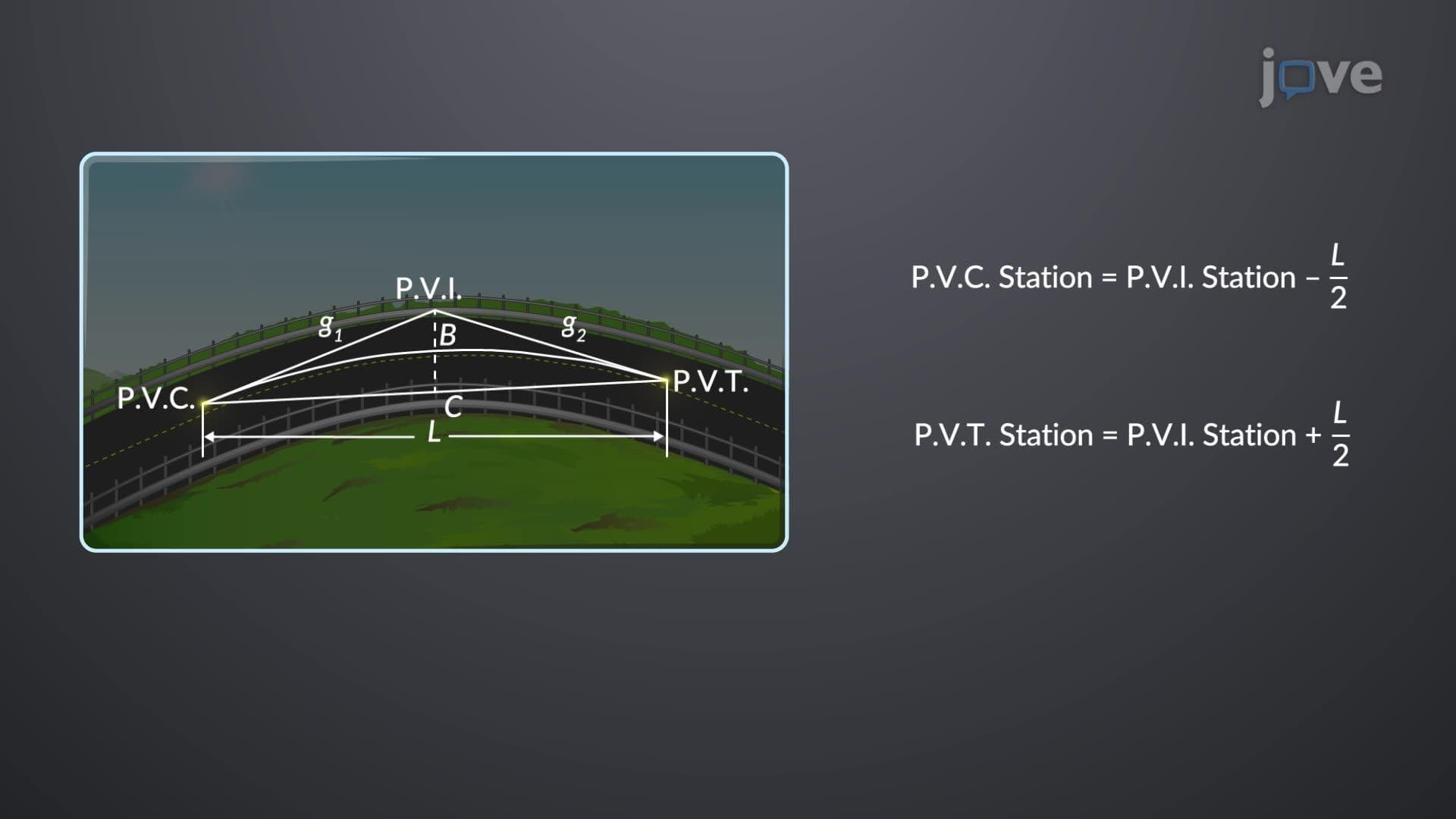
The elevation of intermediate points on vertical curves relies on three critical reference points. The Point of Vertical Intersection (P.V.I.) marks where two grade lines would theoretically meet if extended. The Point of Vertical Curvature (P.V.C.) indicates where the curve begins, while the Point of Vertical Tangency (P.V.T.) shows where it ends. Engineers calculate P.V.C. and P.V.T. stations by subtracting and adding half the curve length to the P.V.I. station, respectively. This systematic approach ensures consistent methodology whether designing sections of Interstate 95 in Florida or mountain highways in Colorado.
Understanding how elevation of intermediate points on curves work requires mastering grade line calculations and tangent offsets. Engineers first determine theoretical elevations along straight grade lines, then calculate how much the actual curved road deviates from these theoretical positions. The tangent offset-the vertical distance between the straight grade line and the curved road-follows a parabolic relationship based on the horizontal distance squared. This mathematical relationship ensures smooth acceleration changes that meet Federal Highway Administration standards for driver comfort and safety.
This elevation of intermediate points on concept appears frequently in Civil Engineering courses at institutions like MIT, Stanford, and the University of California system. Students encounter these problems in Surveying, Highway Design, and Transportation Engineering courses. The methodology also appears on the Fundamentals of Engineering (FE) exam and Professional Engineering (PE) licensing exams. Beyond academics, transportation agencies like Caltrans and the Texas Department of Transportation use these calculations daily when designing new highways or rehabilitating existing infrastructure, making this knowledge essential for aspiring civil engineers.
Related Micro-courses