Loading subject page…

- Civil Engineering
- Finite Control Volume Analysis
- Design Example: Forces in Sluice Gate
Micro-course: Finite Control Volume Analysis
9,767 views
Learn key concepts and earn your certificate.



Design Example: Forces in Sluice Gate

00:00
01:11
Video Summary: What Is Design Example Forces
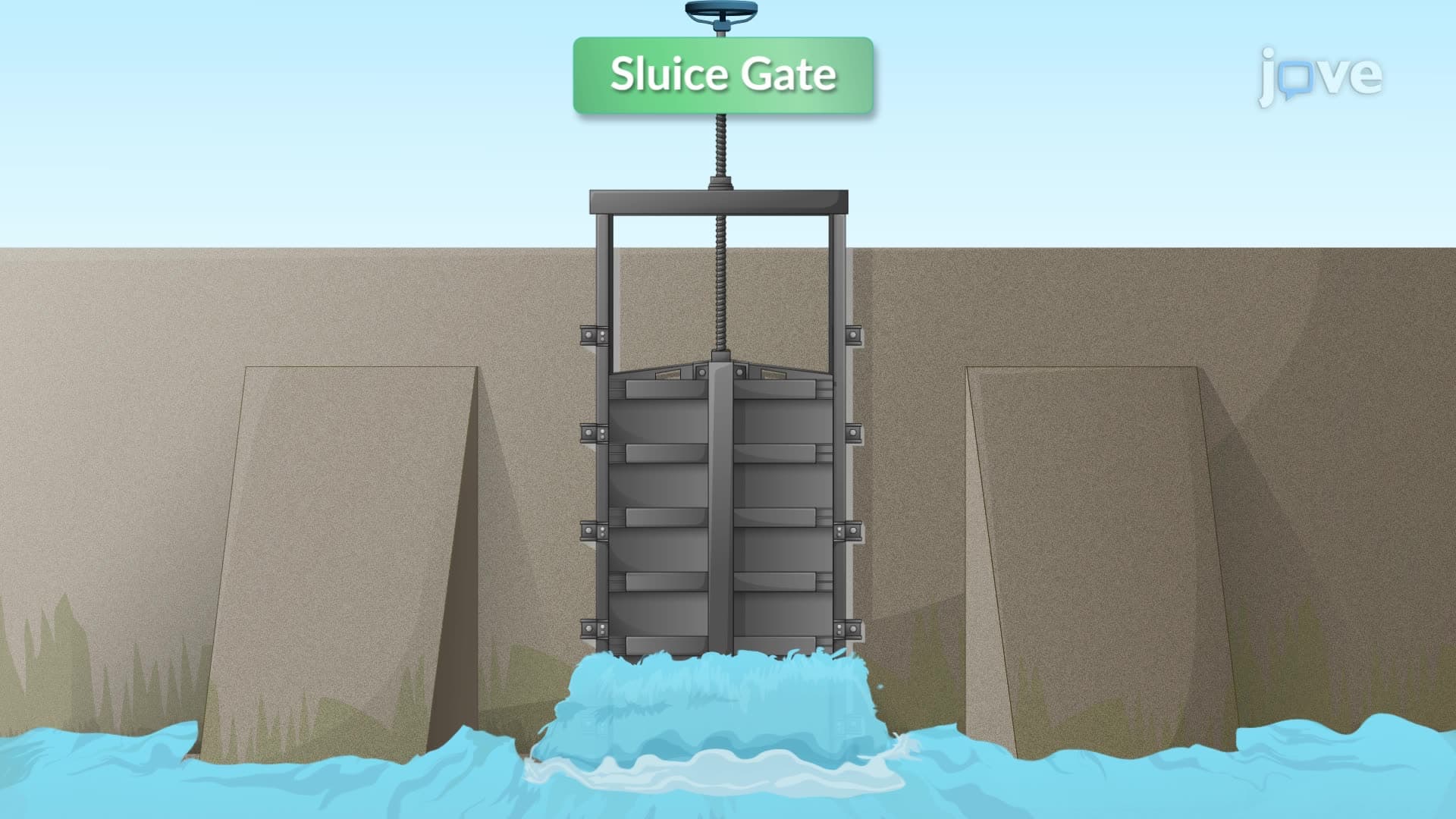
Ever wondered how the Hoover Dam's massive gates withstand millions of gallons of water pressure? Understanding Euler's equations of motion reveals the fascinating physics behind hydraulic structures like sluice gates. These vertical barriers control water flow in channels by balancing upstream and downstream forces. When water depths differ on either side, pressure variations create measurable forces that engineers must calculate using fundamental fluid mechanics principles. The Colorado River's flow control systems demonstrate these Design Example Forces in action daily. Watch the full video on JoVE Coach to master this concept with expert-led visuals and step-by-step explanations.
- Understand how Design Example Forces apply to real hydraulic engineering problems involving sluice gates and water flow control
- Identify the relationship between upstream and downstream water depths and their impact on net force calculations
- Analyze pressure differences using Euler's equations of motion to determine hydrostatic forces on vertical barriers
- Apply Bernoulli's principle to calculate water velocity under gates based on pressure differentials and height drops
- Evaluate how gate positioning affects reaction forces and the required anchoring strength for structural stability
- Compare force magnitudes between closed and open gate positions to understand operational engineering requirements
- Recognize the practical applications of Euler's equations of motion examples in US water management infrastructure
- Explore step-by-step Euler's equations of motion problem-solving techniques for hydraulic force analysis
Understanding Design Example Forces in Hydraulic Systems
Euler's equations of motion form the theoretical foundation for analyzing forces in fluid mechanics, particularly when examining hydraulic structures like sluice gates. These equations describe how fluid particles accelerate under various force conditions, making them essential for understanding Design Example Forces in engineering applications.
Pressure Distribution and Hydrostatic Forces
When water encounters a sluice gate, the Euler's equations of motion basics reveal how pressure varies with depth and creates measurable forces. The hydrostatic pressure at any depth follows the relationship P = ρgh, where ρ represents water density, g is gravitational acceleration, and h indicates depth below the surface. On the upstream side with depth z₁, the total hydrostatic force equals (1/2)ρg(z₁)² per unit width. Similarly, the downstream force with depth z₂ equals (1/2)ρg(z₂)². The net force becomes F(net) = (1/2)ρg(z₁² - z₂²), demonstrating how Euler's equations of motion examples apply to real engineering problems.
Velocity Calculations Using Bernoulli's Principle
The Euler's equations of motion step by step approach incorporates Bernoulli's equation to determine water velocity under the gate. When water accelerates from rest upstream to velocity V₂ downstream, energy conservation requires: (1/2)ρ(V₂)² + ρgz₂ = ρgz₁. This simplifies to V₂ = √(2g(z₁ - z₂)), showing how height differences drive flow velocity. Students preparing for AP Physics or college fluid mechanics courses frequently encounter these calculations on exams.
Engineering Applications in US Infrastructure
Major US water projects demonstrate these principles daily. The Tennessee Valley Authority operates hundreds of sluice gates using Euler's equations of motion concepts for flood control and power generation. During Hurricane Katrina, New Orleans' floodgate systems relied on precise force calculations to withstand storm surge pressures. California's Central Valley Project uses similar hydraulic engineering principles to manage irrigation water throughout the state's agricultural regions.
Gate Operation and Force Variations
As gates open, the understanding of Euler's equations of motion explains why anchoring forces decrease. When z₂ approaches z₁, the pressure difference diminishes, reducing the net hydrostatic force. This relationship helps engineers design appropriate anchoring systems and predict operational requirements. Students studying for the Fundamentals of Engineering (FE) exam must master these force calculations, as they appear frequently in the fluid mechanics section.
Frequently Asked Questions
Design Example Forces refers to the practical application of Euler's equations of motion in analyzing real engineering problems, particularly hydraulic structures like sluice gates. These forces result from pressure differences created when water flows around barriers, demonstrating fundamental fluid mechanics principles. Engineers use these calculations to design safe, effective water control systems in dams, levees, and irrigation channels.
These equations frequently appear in free-response questions involving fluid statics and dynamics on AP Physics C exams and college midterms. Students typically calculate hydrostatic forces, apply Bernoulli's principle, and analyze pressure variations in containers or flowing systems. Practice problems often involve dams, tanks, or pipe systems similar to the sluice gate example.
Focus on the hydrostatic pressure equation P = ρgh, Bernoulli's equation, and continuity equation A₁V₁ = A₂V₂. The MCAT emphasizes conceptual understanding over complex derivations, so practice identifying how pressure changes with depth and how flow velocity relates to cross-sectional area. These principles appear in cardiovascular system questions and basic fluid flow scenarios.
Major applications include the Corps of Engineers' flood control systems along the Mississippi River, California's State Water Project aqueducts, and hydroelectric facilities throughout the Pacific Northwest. These systems require precise force calculations to ensure structural integrity during extreme weather events and normal operations.
Not necessarily - high school applications focus on simplified scenarios using basic algebra and geometry. You'll work with static fluid problems and straightforward applications of Bernoulli's principle rather than complex differential equations. The mathematical complexity increases significantly in college-level fluid mechanics courses.
Practice systematic problem-solving: identify known variables, draw clear diagrams showing pressure distributions, apply appropriate equations step-by-step, and check units carefully. The FE exam emphasizes practical calculations rather than theoretical derivations, so focus on applying formulas correctly to realistic engineering scenarios.
Understanding basic hydrostatic forces provides the foundation for computational fluid dynamics (CFD), turbulence modeling, and advanced hydraulic engineering. Graduate coursework extends these principles to three-dimensional flow fields, unsteady conditions, and complex boundary interactions in aerospace and environmental engineering applications.
Related Micro-courses

10 Concepts


13 Concepts