Loading video…


 9 Concepts
 9.8K views


Video Summary: What Is Moment of Momentum Equation
Ever wonder how massive wind turbines generate electricity from moving air? Energy conservation in control volumes governs this process through the moment of momentum equation, which calculates the torque produced by rotating turbine blades. At installations like the Altamont Pass Wind Farm in California, engineers use this fundamental equation to optimize blade design and maximize power output. The moment of momentum equation applies Newton's second law to fluid particles, relating torque to angular momentum changes as air flows through the turbine's control volume. Watch the full video on JoVE Coach to master this concept with expert-led visuals and step-by-step explanations.
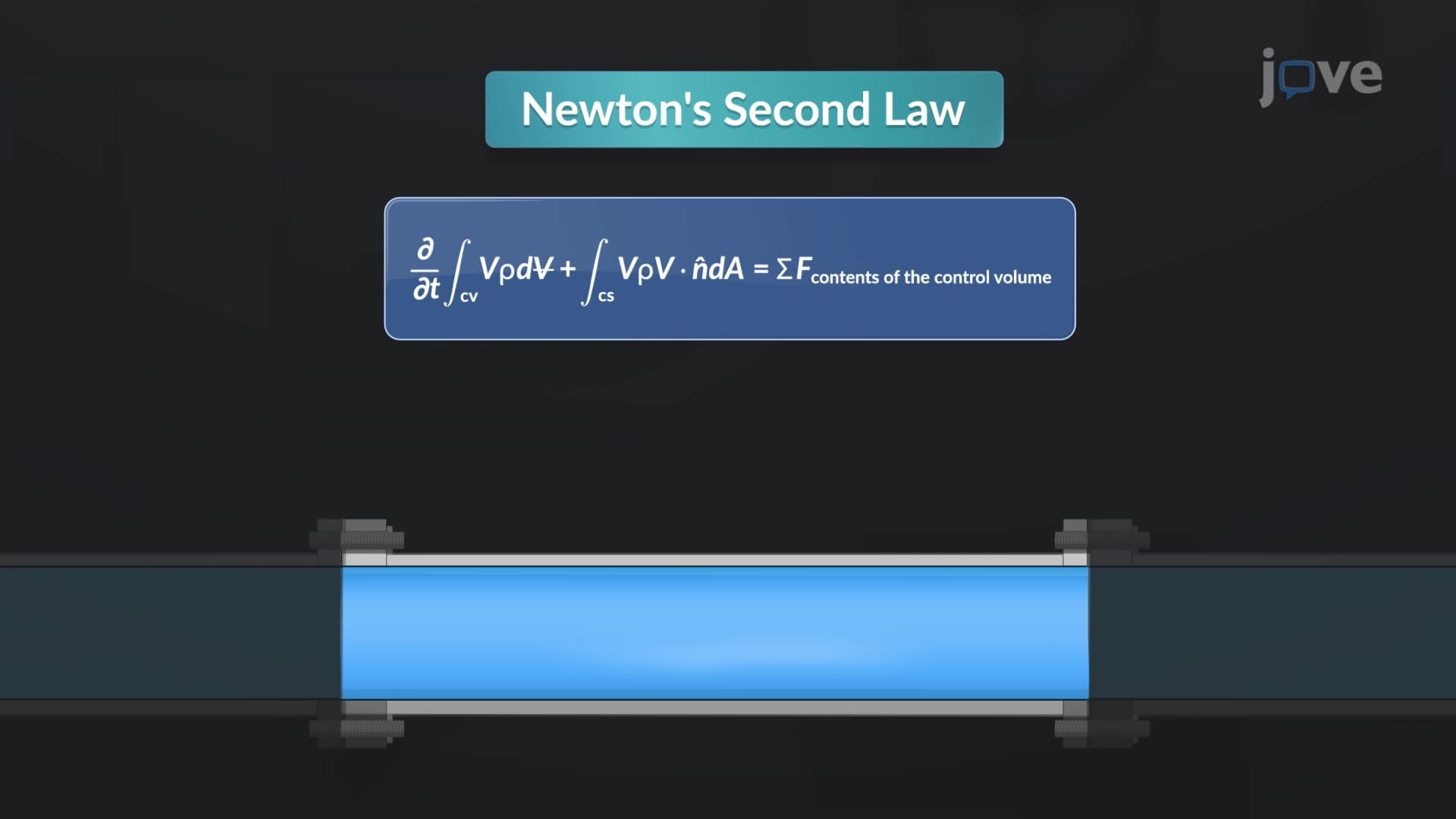
The moment of momentum equation serves as a cornerstone principle in fluid mechanics, particularly for analyzing rotating machinery like turbines, pumps, and compressors. This equation emerges from applying Newton's second law to fluid particles within a defined control volume, establishing the fundamental relationship between torque and angular momentum changes.
When engineers at General Electric design jet engines or Vestas develops wind turbines, they rely on this equation to predict performance and optimize blade geometry. The mathematical foundation begins with Newton's second law: the rate of change of linear momentum equals the external force. However, for rotating systems, we need the rotational equivalent-relating torque to angular momentum changes.
The derivation process involves calculating the moment of force by considering each fluid particle's position relative to the rotation axis. Engineers multiply the position vector by the external force to determine the torque acting on individual particles. This cross-product relationship captures how distance from the rotation center amplifies force effects-explaining why longer turbine blades generate more torque from the same wind speed.
The mathematical expansion includes time derivatives that separate into two distinct components. The first represents angular momentum changes due to fluid velocity variations, while the second accounts for spatial movement of fluid particles through the control volume. This separation proves crucial for practical calculations in devices like the hydroelectric turbines at Hoover Dam.
The complete moment of momentum equation emerges through integration over the entire control volume, connecting local particle behavior to overall system performance. This integration process transforms point-wise calculations into practical engineering tools for analyzing complex machinery.
Students preparing for the AP Physics C exam or college fluid mechanics courses should recognize that this equation appears frequently in problems involving pumps, turbines, and propellers. The equation typically takes the form: Torque = (Angular momentum out) - (Angular momentum in) + (Body force contributions). Understanding each term's physical meaning helps solve both theoretical problems and real-world design challenges.
Modern computational fluid dynamics software used by companies like Boeing and Lockheed Martin implements these principles to simulate aircraft propeller performance and optimize fuel efficiency. The moment of momentum equation provides the theoretical foundation for these advanced simulation tools.
Related Micro-courses