Loading subject page…

- Electrical Engineering
- Transient and Steady State Response Analysis
- Routh-Hurwitz Criterion II
Micro-course: Transient and Steady-state Response Analysis
2,329 views
Learn key concepts and earn your certificate.

Routh-Hurwitz Criterion II

00:00
01:19
Video Summary: What Is Routh Hurwitz Criterion Ii
Ever wonder why some control systems in NASA's spacecraft remain stable while others become dangerously unstable? The control system problem of stability analysis becomes critical when engineers encounter special cases in the Routh-Hurwitz criterion. What is Routh Hurwitz Criterion II addresses two complex scenarios: handling zeros in the first column and managing entire rows of zeros, techniques essential for analyzing Boeing's flight control systems and automotive cruise control stability. Watch the full video on JoVE Coach to master this concept with expert-led visuals and step-by-step explanations.
- Understand What is Routh Hurwitz Criterion II and its two special case scenarios in stability analysis
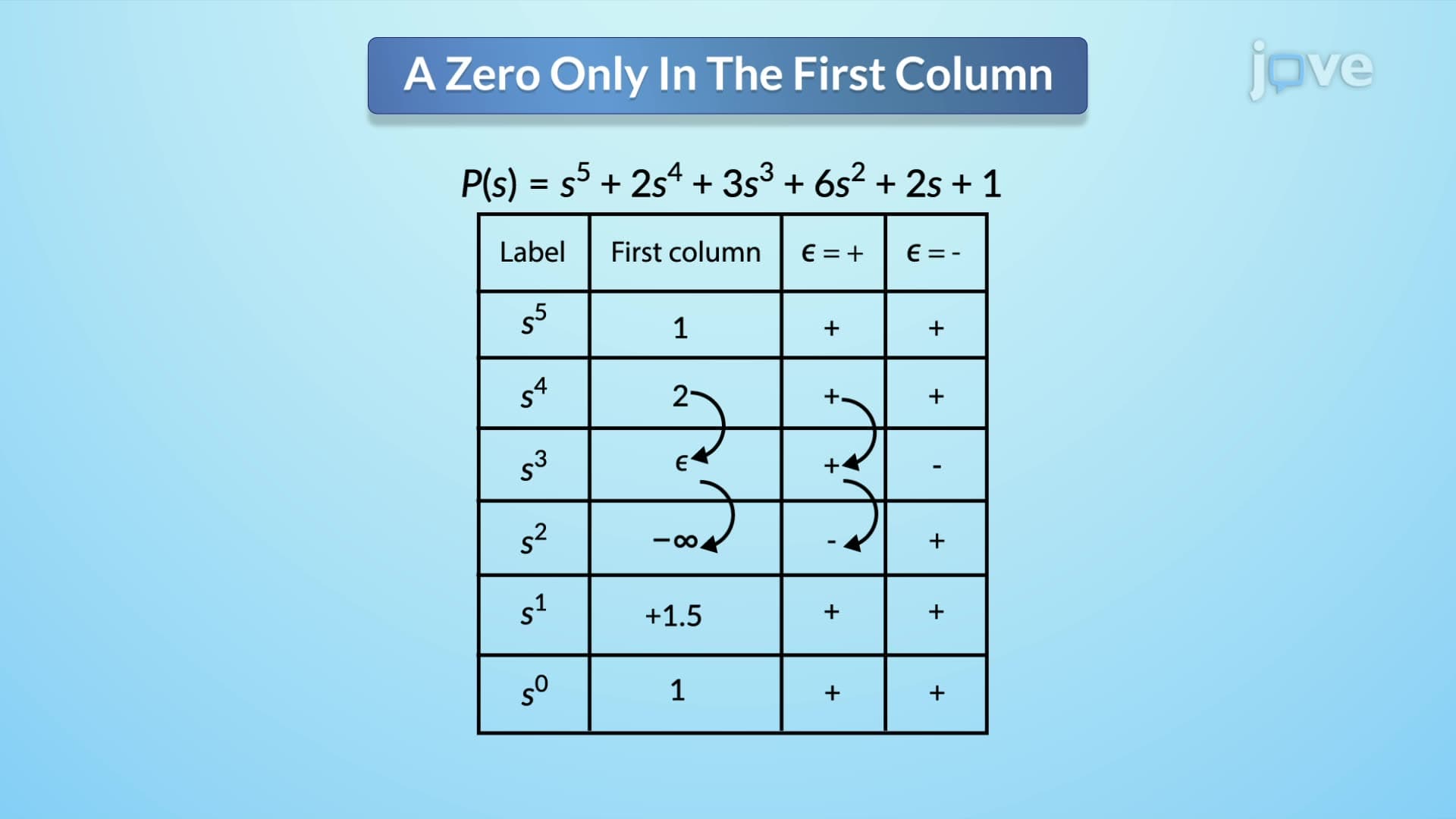
- Identify when division by zero problems occur in the first column of Routh tables
- Analyze the epsilon substitution method for resolving singular zeros in control system stability
- Recognize entire zero rows and their connection to even polynomial factors
- Apply auxiliary polynomial formation techniques using coefficients from the row above zeros
- Evaluate system stability by interpreting sign changes after epsilon substitution
- Compare even and odd polynomial contributions to right-half-plane pole counts
- Explore differentiation methods for replacing zero rows in Routh table construction
Understanding What is Routh Hurwitz Criterion II
The control system problem becomes significantly more complex when standard Routh-Hurwitz analysis encounters special mathematical situations. What is Routh Hurwitz Criterion II specifically addresses two critical scenarios that can derail basic stability analysis: singular zeros in the first column and complete zero rows. These situations frequently appear in real engineering applications, from Tesla's autopilot systems to General Electric's power grid controllers.
Special Case 1: Singular Zero in First Column
When a zero appears exclusively in the first column of a Routh table, it creates a mathematical impossibility-division by zero. This control system problem definition scenario requires the epsilon (ε) substitution technique. Engineers replace the problematic zero with a small positive or negative value (epsilon) and proceed with the analysis.
The beauty of this method lies in its definitive conclusions. Whether you assume epsilon is positive or negative, if the analysis reveals sign changes in the first column, the system is unstable with poles in the right half-plane. This technique proved crucial during the Space Shuttle program, where NASA engineers used Routh-Hurwitz analysis to verify flight control stability under various atmospheric conditions.
Special Case 2: Entire Zero Row Analysis
The second scenario-an entire row of zeros-indicates something profound about the system's mathematical structure. This situation reveals that an even polynomial is a factor of the original characteristic polynomial. Rather than abandoning the analysis, engineers form an auxiliary polynomial using coefficients from the row immediately above the zero row.
This control system problem overview technique involves differentiating the auxiliary polynomial and using those derivative coefficients to replace the zero row. Companies like Ford Motor Company regularly encounter this scenario when analyzing multi-input vehicle stability systems, where complex polynomial structures naturally arise from interconnected subsystems.
Practical Applications and Exam Relevance
Understanding what is control system problem in detail becomes essential for AP Physics students and electrical engineering undergraduates. The Routh-Hurwitz Criterion II frequently appears on college midterms and professional engineering exams. Students should practice both epsilon substitution and auxiliary polynomial methods, as these techniques distinguish advanced control system analysis from basic stability checks.
The control system problem concept extends beyond academic exercises into real-world engineering. Boeing's 787 Dreamliner flight control computers continuously perform these calculations to maintain stable flight, while Amazon's automated warehouse robots use similar stability analysis for precise movement control.
Frequently Asked Questions
Routh Hurwitz Criterion II handles two special cases in stability analysis that standard methods cannot address. You need it when zeros appear in the first column of your Routh table or when an entire row becomes zero. These situations occur frequently in complex control systems like automotive stability control or aerospace flight management systems.
A control system problem in this context refers to mathematical obstacles that prevent standard Routh table completion. The two main problems are singular zeros causing division by zero and complete zero rows indicating even polynomial factors. Both require specialized techniques to determine system stability accurately.
Exam questions typically present characteristic polynomials that naturally lead to special cases, testing your ability to recognize and solve them. You'll need to demonstrate epsilon substitution for singular zeros and auxiliary polynomial formation for zero rows. Many college midterms include these scenarios in 15-20 point stability analysis problems.
While MCAT focuses more on biological systems, engineering graduate school exams like the GRE Subject Test in Physics frequently include these problems. Professional engineering licensing exams also test these concepts, particularly for electrical and aerospace engineering candidates.
NASA uses these techniques for spacecraft attitude control analysis, Tesla applies them in autopilot stability verification, and power companies like ConEd use them for grid stability assessment. Any system with multiple feedback loops or complex polynomial characteristics requires these advanced stability analysis methods.
You only need basic differentiation skills and polynomial manipulation knowledge typically covered in high school calculus or college algebra. The mathematical complexity lies more in systematic application than advanced calculus techniques, making it accessible to motivated high school students.
Practice identifying special cases first, then master the systematic approaches for each scenario. Create a checklist: check for first-column zeros, look for entire zero rows, then apply appropriate techniques. Work through multiple examples from different engineering contexts to build pattern recognition skills.
Progress to root locus techniques, which provide graphical stability analysis methods that complement Routh-Hurwitz algebraic approaches. State-space analysis and Nyquist stability criterion offer alternative perspectives on the same fundamental stability questions, expanding your control systems toolkit significantly.
Related Micro-courses