Loading…
Loading video…

3,323 views
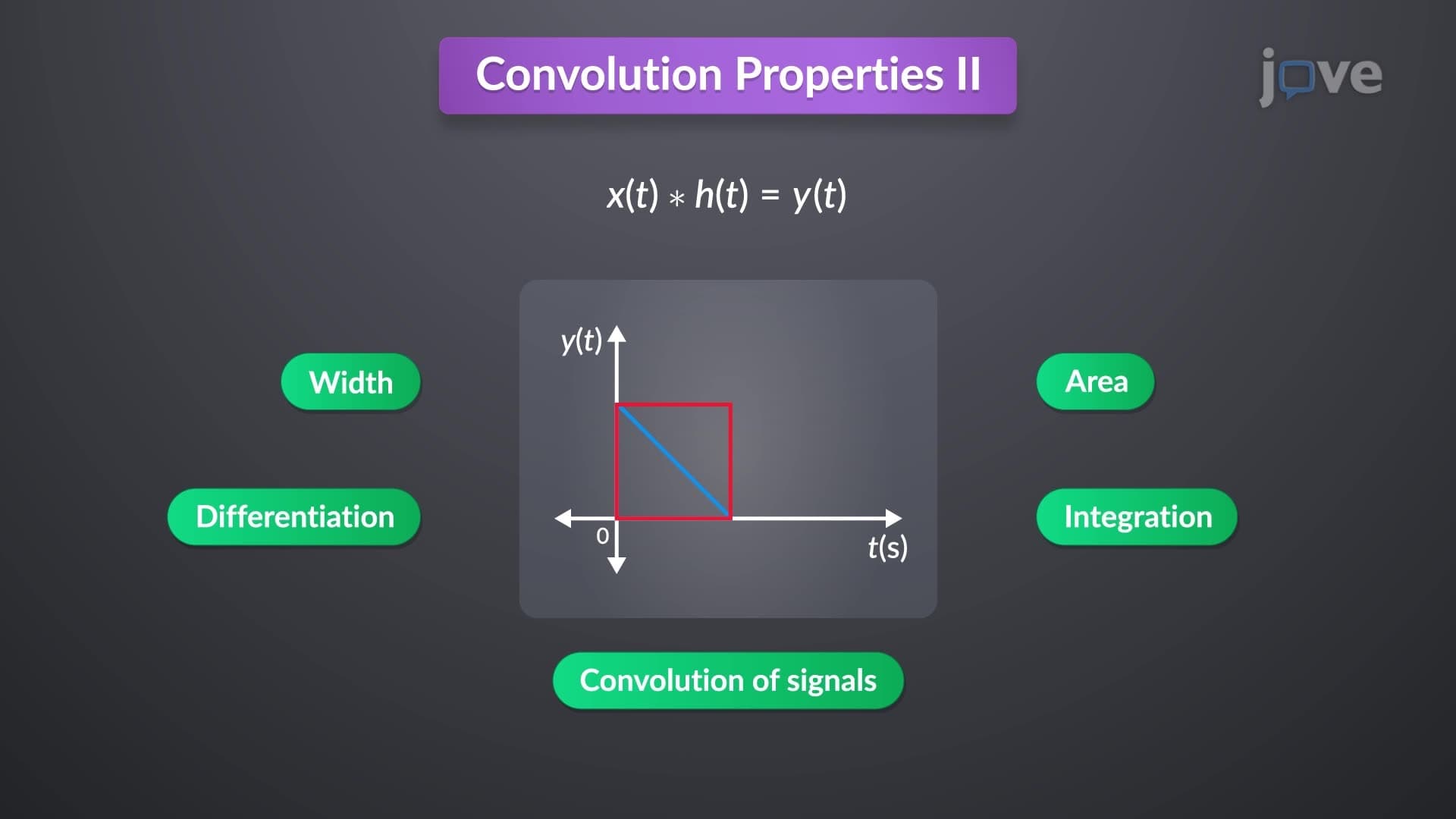
Ever wondered how noise-canceling headphones eliminate background chatter while preserving your music? The answer lies in deconvolution and understanding What is Convolution Properties II. This advanced signal processing technique reverses convolution operations, allowing engineers at companies like Bose to separate mixed audio signals. Key convolution properties—including width, area, differentiation, and integration—form the mathematical foundation for deconvolution algorithms used in medical imaging, audio processing, and telecommunications across the United States. Watch the full video on JoVE Coach to master this concept with expert-led visuals and step-by-step explanations.
Deconvolution represents the inverse process of convolution, essentially "undoing" the mixing of signals that occurs during convolution operations. To master deconvolution techniques, students must first comprehend the four fundamental convolution properties that govern how signals combine and interact. These properties form the mathematical backbone for sophisticated deconvolution definition applications used throughout American industries, from NASA's satellite communications to Stanford Medical Center's MRI imaging systems.
The width property provides a crucial deconvolution overview by establishing that output signal duration always equals the sum of input signal durations, regardless of signal shapes. When engineers at Texas Instruments design audio processors, they rely on this property to predict how long processed signals will be. For example, convolving a 2-second audio clip with a 1-second filter response always produces a 3-second output signal. This predictability becomes essential for understanding deconvolution because it helps determine the original signal lengths when working backward from convolution results.
The area property states that convolution area equals the product of individual signal areas, providing a fundamental tool for deconvolution basics. This principle enables biomedical engineers at Mayo Clinic to reconstruct medical images from convolved sensor data. Meanwhile, differentiation and integration properties offer powerful mathematical relationships: the derivative of a convolution equals the convolution of derivatives, and integration transforms LTI systems into ideal integrators when combined with step functions.
These convolution properties appear frequently in Advanced Placement Physics courses, college-level electrical engineering programs, and MCAT physics sections. Students at MIT and Caltech regularly encounter these concepts in signal processing laboratories. The deconvolution concept proves particularly valuable for understanding how Spotify's audio compression algorithms work or how radiologists at Johns Hopkins separate overlapping tissue signals in medical scans. This deconvolution study guide foundation prepares students for advanced coursework in digital signal processing, communications engineering, and biomedical imaging—fields experiencing rapid growth in the American technology sector.
Frequently Asked Questions
Convolution Properties II encompasses four fundamental mathematical principles (width, area, differentiation, and integration properties) that describe how signals combine through convolution operations. These properties provide the theoretical foundation for deconvolution, which reverses convolution to separate mixed signals. Understanding these properties is essential for applications in audio processing, medical imaging, and telecommunications engineering.
AP Physics C and college engineering exams frequently test convolution properties through signal processing problems and LTI system analysis questions. Students encounter these concepts in mechanical and electrical engineering coursework at universities like UC Berkeley and Georgia Tech. MCAT physics sections may include related signal analysis problems in experimental design contexts.
The width property offers a straightforward calculation method that appears in multiple-choice questions on college midterms and engineering qualifying exams. Students can quickly determine output signal duration by adding input durations, making it a reliable problem-solving tool for time-pressured exam situations.
Radiologists at Cleveland Clinic and Mass General Hospital use deconvolution algorithms to enhance MRI and CT scan image quality by removing blurring effects. These techniques help separate overlapping tissue signals, improving diagnostic accuracy for conditions ranging from brain tumors to cardiac abnormalities.
While convolution properties involve calculus concepts, motivated high school students can grasp the fundamental principles through visual examples and practical applications. Many AP Physics students successfully learn these concepts when presented with real-world contexts like audio processing and medical imaging.
Focus on practicing width property calculations with different signal shapes, memorizing the area property formula, and working through differentiation/integration examples step-by-step. Create visual diagrams showing how rectangular pulses convolve, and practice identifying these properties in engineering problem contexts.
Students should progress to studying Fourier transforms, z-transforms, and digital filter design—topics covered in advanced engineering programs at schools like Stanford and Carnegie Mellon. These concepts build directly on convolution property foundations and appear in graduate-level signal processing courses.
These mathematical principles explain how noise-canceling headphones work, how Netflix compresses video streams, and how GPS systems process satellite signals. Understanding convolution properties provides insight into the signal processing algorithms that power smartphones, medical devices, and communication systems throughout American industries.
Related Micro-courses
Related Subjects
 Civil Engineering 30 micro-courses›Mechanical Engineering 28 micro-courses›