Loading subject page…

- Finance
- Time Value of Money
- Future Value and Compounding
Micro-course: Time Value of Money
16,631 views
Learn key concepts and earn your certificate.







Future Value and Compounding

00:00
01:14
Video Summary: What Is Future Value and Compounding
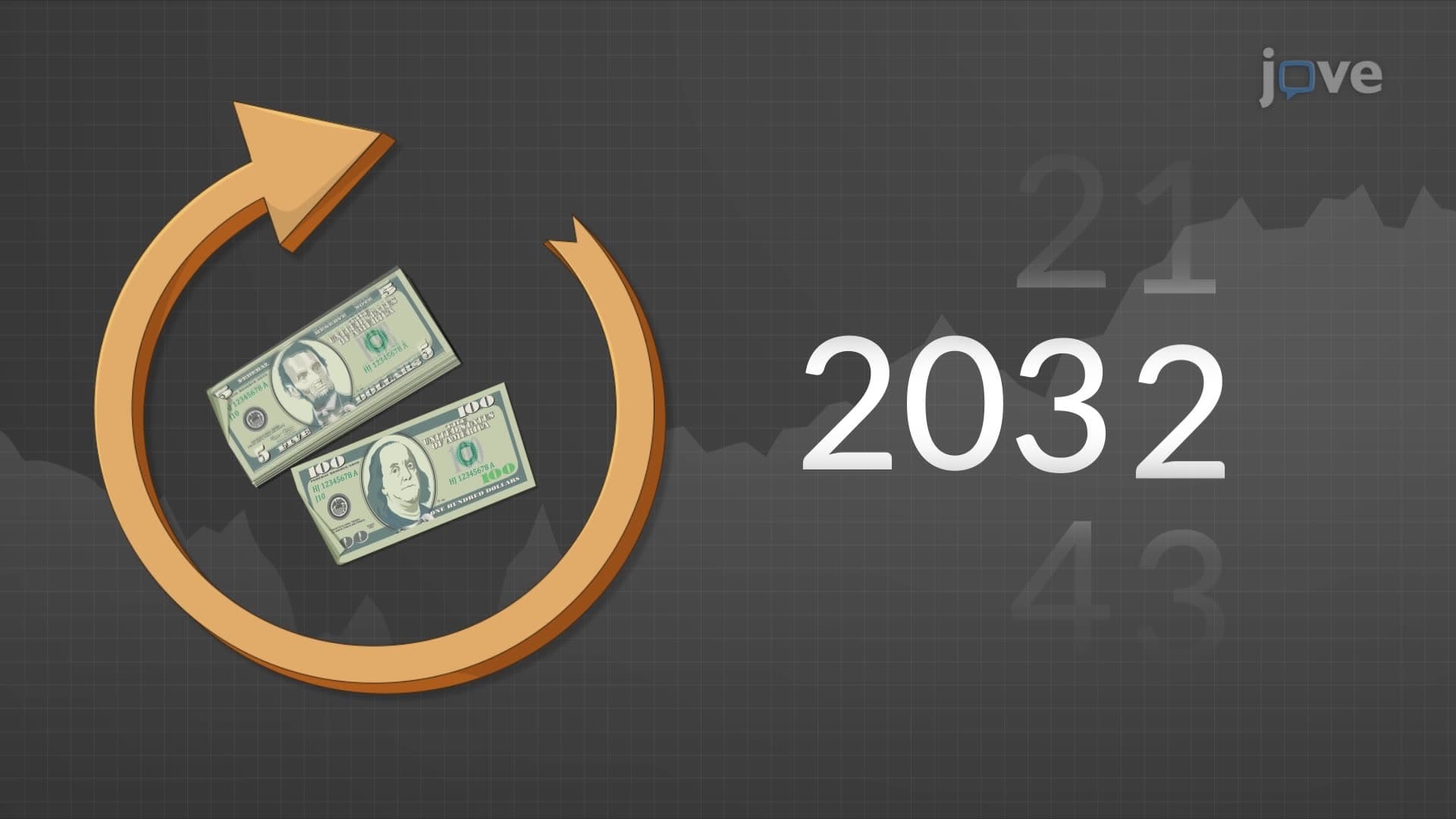
Understanding future value compounding is critical for executives making capital allocation decisions and professionals building long-term wealth strategies. Companies like JPMorgan Chase rely on these principles when advising clients on retirement planning and investment portfolios. The concept of What is Future Value And Compounding demonstrates how initial investments grow exponentially through compound interest over time, as illustrated through a 30-year retirement scenario showing $20,000 growing to over $86,000. Watch the full video on JoVE Coach to master this concept with expert-led visuals and step-by-step explanations.
- Apply future value calculations to evaluate long-term investment opportunities and business expansion projects with multi-year payback periods
- Analyze the compounding effect when presenting retirement benefit packages to employees or justifying company 401(k) matching programs
- Implement time-value-of-money principles in strategic planning sessions to demonstrate the cost of delayed investment decisions
- Evaluate competing capital projects by comparing their future value potential across different time horizons and growth rates
- Leverage compounding concepts to communicate the importance of early investment to clients, stakeholders, or team members
- Assess the impact of different growth rates on long-term business valuations and acquisition targets
- Identify optimal timing for major financial decisions using future value projections and sensitivity analysis
- Compare investment alternatives by calculating their respective future values under various market scenarios
Understanding What is Future Value And Compounding in Business Context
When Berkshire Hathaway's Warren Buffett emphasizes "time in the market beats timing the market," he's referencing the fundamental power of compound growth that drives both personal wealth and corporate value creation. Future value compounding represents the exponential growth potential of money invested today, accounting for both the initial principal and accumulated returns reinvested over time.
Strategic Applications in Corporate Finance
Future value calculations form the backbone of capital budgeting decisions across Fortune 500 companies. When Amazon evaluates a new fulfillment center investment, finance teams project cash flows years into the future, applying compounding principles to determine net present value. The formula Future Value = Present Value × (1 + growth rate)^time periods helps quantify how today's $50 million facility investment might generate $200 million in cumulative value over a decade.
Corporate treasury departments at companies like Microsoft use these principles when managing cash reserves and pension obligations. A 5% annual return compounded over 20 years transforms $100 million in excess cash into $265 million, providing substantial flexibility for future acquisitions or dividend distributions.
Personal Financial Strategy for Executives
High-earning professionals often underestimate compounding's impact on retirement planning. A 35-year-old manager contributing $19,500 annually to a 401(k) with 7% average returns will accumulate approximately $1.37 million by age 65, with compound growth contributing over $700,000 of that total. This understanding drives executive compensation negotiations around equity participation and deferred compensation structures.
Risk Management and Scenario Planning
Sophisticated organizations model multiple growth scenarios to stress-test their assumptions. Goldman Sachs might project client portfolio values under 4%, 6%, and 8% annual return scenarios, demonstrating how seemingly small rate differences compound into dramatic wealth variations over decades. This analysis informs asset allocation recommendations and helps clients understand the relationship between risk tolerance and long-term financial goals.
Frequently Asked Questions
Future value compounding calculates how much an investment will be worth after growing at a specific rate over time. It accounts for earning returns not just on your original investment, but also on all previously earned returns that get reinvested. This creates exponential rather than linear growth over long time periods.
Present multiple scenarios showing how different growth rates and time horizons affect outcomes. For example, demonstrate how a $10 million R&D investment growing at 12% annually becomes $31 million over 10 years, while 8% growth yields only $21.6 million. This helps directors visualize the long-term impact of strategic decisions.
Use compounding calculations when discussing retirement planning, college savings, or long-term investment strategies with clients. Show specific dollar amounts rather than percentages, "$500,000 becomes $1.6 million over 20 years" resonates more than "compound annual growth rate of 6%." Always include multiple time horizons to demonstrate early-start advantages.
Apple applies compounding thinking to their ecosystem strategy, where each product purchase increases the likelihood of future purchases. A customer buying an iPhone today has a compounding probability of purchasing MacBooks, iPads, and services over time, creating exponential customer lifetime value that justifies premium pricing and massive R&D investments.
No advanced degree required, the core concept builds on basic multiplication and percentages. Most business calculators and Excel functions handle the mathematics. Focus on understanding the business implications rather than manual calculations. The key insight is recognizing how time amplifies investment returns.
This knowledge enhances your credibility in strategic planning meetings, client presentations, and budget discussions. You'll make more persuasive arguments for long-term investments, better evaluate vendor proposals with multi-year contracts, and provide more sophisticated financial guidance to team members planning their careers and compensation.
Study present value and net present value calculations, which work in reverse to determine today's worth of future cash flows. These concepts are essential for merger and acquisition analysis, capital budgeting decisions, and bond pricing. Understanding both future and present value creates a complete time-value-of-money framework for business decision-making.
Related Micro-courses