Loading video…


 15 Concepts
 4.2K views

Video Summary: What are Market Challenger Strategies
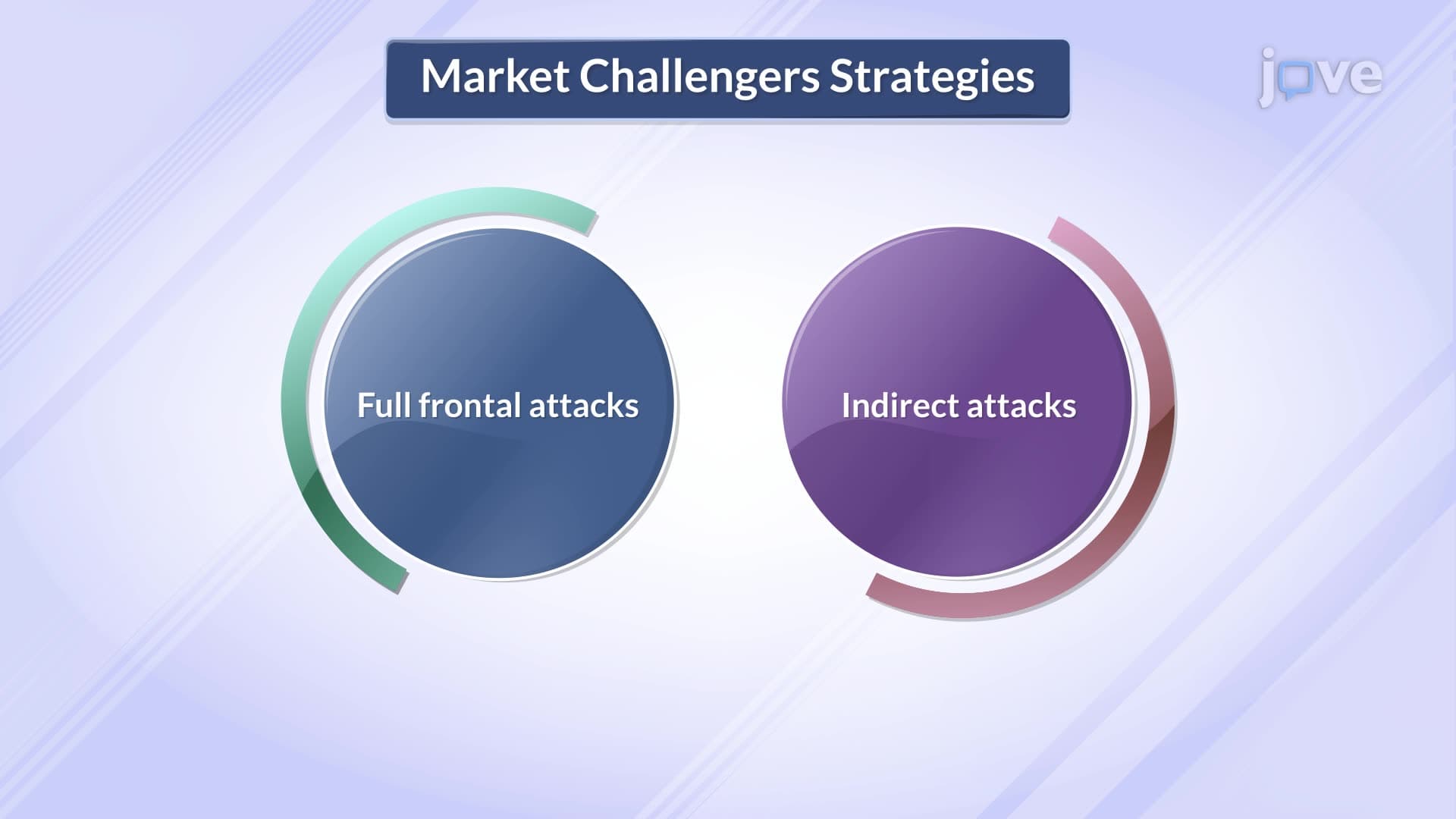
Market disruption requires strategic precision as challenger brands compete for share against industry giants. Market challenger strategies provide proven frameworks for unseating market leaders through targeted competitive moves. Companies like PepsiCo demonstrate how challengers can execute Full Frontal Attacks against dominant players like Coca-Cola through aggressive pricing and marketing investments. Alternatively, Airbnb exemplifies Indirect Attack strategies by identifying market gaps and creating new value propositions. Watch the full video on JoVE Coach to master this concept with expert-led visuals and step-by-step explanations.
When Netflix decided to challenge traditional cable providers and movie rental chains, CEO Reed Hastings faced a classic challenger dilemma: attack the established players directly or find an entirely new approach. This scenario illustrates the fundamental choice every challenger brand confronts when entering competitive markets dominated by entrenched leaders.
Full Frontal Attack strategies represent the most aggressive form of market challenge, requiring companies to match or exceed the market leader's value proposition across all competitive dimensions. This approach demands substantial financial resources, operational excellence, and sustained commitment to competitive warfare.
PepsiCo's decades-long rivalry with Coca-Cola exemplifies masterful Full Frontal Attack execution. The company consistently matches Coca-Cola's pricing strategies, mirrors its distribution networks, and invests heavily in marketing campaigns that directly challenge Coke's brand positioning. During the "Pepsi Challenge" campaigns of the 1970s and 1980s, PepsiCo invested hundreds of millions in blind taste tests and comparative advertising, forcing Coca-Cola to respond with New Coke-a strategic misstep that ultimately strengthened Pepsi's competitive position.
Indirect Attack strategies focus on identifying and exploiting gaps in market coverage, unmet customer needs, or operational weaknesses that market leaders have overlooked or abandoned. This approach often proves more cost-effective and sustainable than direct confrontation.
Airbnb's disruption of the hospitality industry demonstrates brilliant Indirect Attack execution. Rather than competing directly with established hotel chains on traditional metrics like location and amenities, Airbnb identified an entirely new value proposition: authentic, local experiences in residential properties. The company targeted price-sensitive travelers and experience-seekers who felt underserved by standardized hotel offerings, creating a multi-billion-dollar market segment that traditional hospitality companies initially ignored.
Successful challenger strategies require careful market analysis, resource allocation, and timing. Full Frontal Attacks work best when challengers possess comparable resources and can sustain prolonged competitive battles. Indirect Attacks prove more effective when market leaders have become complacent or when technological disruption creates new competitive opportunities.
The choice between these approaches often determines long-term market positioning and profitability. Companies must evaluate their competitive advantages, resource constraints, and market dynamics before committing to challenger strategies that can reshape entire industries.
Related Micro-courses