Loading subject page…

- Marketing
- Creating Customer Value: Product to Experience
- Services Marketing I
Micro-course: Creating Customer Value: Product to Experience
17,060 views
Learn key concepts and earn your certificate.






Services Marketing I

00:00
01:26
Video Summary: What Is Services Marketing I
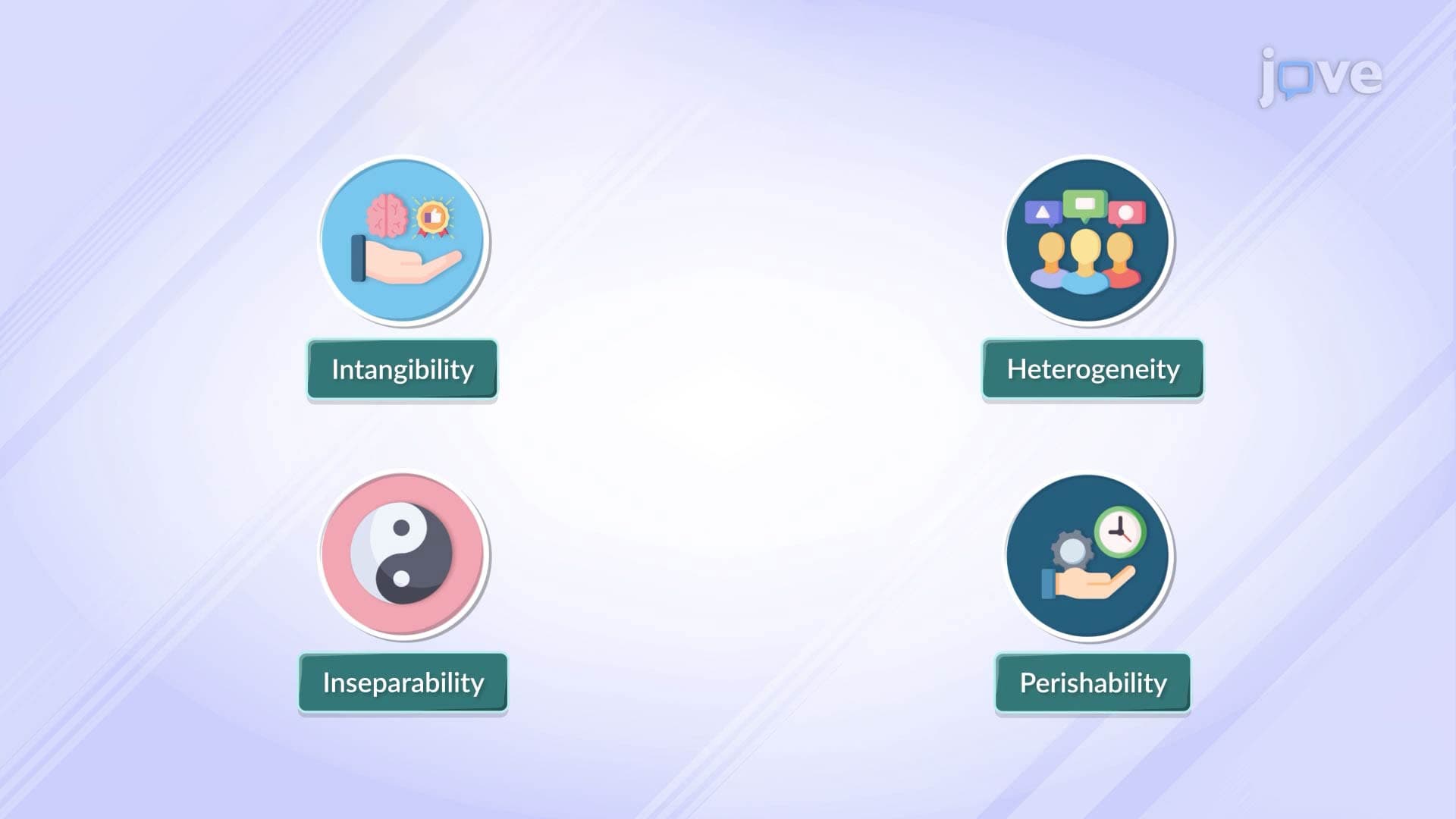
Understanding services marketing principles drives competitive advantage in today's service-dominated economy, where over 80% of US GDP comes from service sectors. Companies like JPMorgan Chase leverage these foundational concepts to differentiate their financial advisory services from competitors through strategic positioning of intangible offerings. What is Services Marketing I explores four critical characteristics-intangibility, inseparability, heterogeneity, and perishability-that distinguish service businesses from product-based operations. Watch the full video on JoVE Coach to master this concept with expert-led visuals and step-by-step explanations.
- Apply the four service characteristics framework to evaluate competitive positioning strategies for your organization's service offerings
- Analyze how intangibility affects customer decision-making processes and design marketing communications that build trust pre-purchase
- Implement quality control measures that address service heterogeneity across multiple touchpoints and service delivery teams
- Leverage inseparability principles to optimize customer experience design and frontline employee training programs
- Assess perishability impact on revenue management, pricing strategies, and capacity utilization decisions
- Evaluate service marketing challenges versus traditional product marketing approaches when presenting to executive leadership
- Identify opportunities to create sustainable competitive advantages through superior service design and delivery execution
- Compare service business models against product-based alternatives when making strategic investment or portfolio decisions
Understanding What is Services Marketing I in Business Context
When Marriott International's executive team evaluates expansion strategies, they must navigate fundamentally different marketing challenges than manufacturers like General Motors. Service businesses operate under unique constraints that require specialized marketing approaches, making services marketing knowledge essential for leaders across healthcare, financial services, hospitality, and consulting sectors.
The Four Pillars of Service Differentiation
Intangibility creates the most significant marketing challenge for service businesses. Unlike Apple's iPhone, which customers can examine before purchase, Goldman Sachs' wealth management services require clients to make substantial financial commitments based on reputation, testimonials, and advisor credentials alone. This dynamic forces service marketers to invest heavily in brand building, thought leadership content, and proof points that demonstrate expertise and results.
Heterogeneity introduces quality control complexities that can make or break customer relationships. Starbucks addresses this challenge through rigorous training protocols and standardized operating procedures, yet still faces variability in service quality across 34,000 locations. Smart service leaders implement mystery shopping programs, customer feedback loops, and performance management systems that minimize negative variance while allowing for positive service differentiation.
Inseparability means production and consumption occur simultaneously, creating unique operational challenges. When McKinsey consultants deliver strategic recommendations, they cannot separate the expertise from the consultant delivering it. This reality requires service businesses to invest extensively in human capital, maintain optimal staffing levels, and develop succession planning that preserves client relationships through personnel changes.
Strategic Implications for Revenue Management
Perishability demands sophisticated revenue optimization strategies that product companies rarely face. Delta Airlines cannot store unsold seats for future flights, forcing dynamic pricing models that maximize revenue per available seat mile. Service leaders must master capacity planning, demand forecasting, and pricing elasticity to optimize financial performance.
These four characteristics create compound complexity when developing go-to-market strategies. Successful service marketers develop integrated approaches that address each characteristic while maintaining cohesive brand positioning and customer experience standards.
Frequently Asked Questions
Services marketing focuses on intangible offerings that customers cannot evaluate before purchase, unlike physical products. It requires specialized strategies to address challenges like quality variability, simultaneous production-consumption, and inability to inventory unused capacity. Service businesses must invest more heavily in reputation building and customer experience design.
Frame the discussion around P&L impact and competitive positioning rather than theoretical concepts. Use specific examples like how Deloitte's consulting revenue depends on consultant availability (perishability) versus how Nike can manufacture inventory in advance. Highlight how service characteristics affect pricing power, customer acquisition costs, and retention strategies.
Services marketing principles directly impact resource allocation priorities, particularly human capital investment and technology infrastructure. Understanding service characteristics helps leaders make informed decisions about capacity expansion, pricing strategies, and competitive positioning that drive sustainable revenue growth.
American Express leverages all four service characteristics in their premium card offerings. They address intangibility through exclusive benefits and status recognition, manage heterogeneity via consistent global service standards, optimize inseparability through personalized concierge services, and combat perishability by maintaining 24/7 availability and relationship continuity across customer touchpoints.
No specialized marketing background is required, though business acumen helps. These concepts apply broadly across industries and functions-operations leaders use them for capacity planning, finance teams for revenue forecasting, and executives for strategic positioning. The frameworks translate directly to practical business decisions regardless of your functional expertise.
Services marketing knowledge becomes increasingly valuable as the US economy shifts toward service-based industries. Leaders who understand how to market intangible offerings, manage service quality, and optimize capacity utilization are well-positioned for senior roles in consulting, financial services, healthcare, and technology sectors where service excellence drives competitive advantage.
Consider studying service blueprinting for process optimization, customer journey mapping for experience design, and service recovery strategies for relationship management. These advanced concepts build on the four characteristics framework to create comprehensive service marketing strategies that drive measurable business results.
Related Micro-courses


