Loading subject page…


445 views


Video Summary: Exponential Functions with Base E and Natural Growth
Ever wonder why your morning coffee cools down so quickly at first, then barely changes temperature after sitting for an hour? This phenomenon perfectly demonstrates exponential functions with base e and natural growth in action. The mathematical constant e (approximately 2.718) naturally models continuous processes like cooling coffee, population growth, and radioactive decay. From Newton's Law of Cooling describing your coffee's temperature drop to modeling early virus transmission patterns, these functions appear everywhere in real-world scenarios. Watch the full video on JoVE Coach to master this concept with expert-led visuals and step-by-step explanations.
The mathematical constant e stands as one of the most important numbers in mathematics, rivaling π in its significance. Unlike other bases such as 2 or 10, the base e emerges naturally from calculus and represents the unique base where the exponential function's derivative equals itself. This property makes e the perfect choice for modeling continuous growth and decay processes in nature, finance, and science.
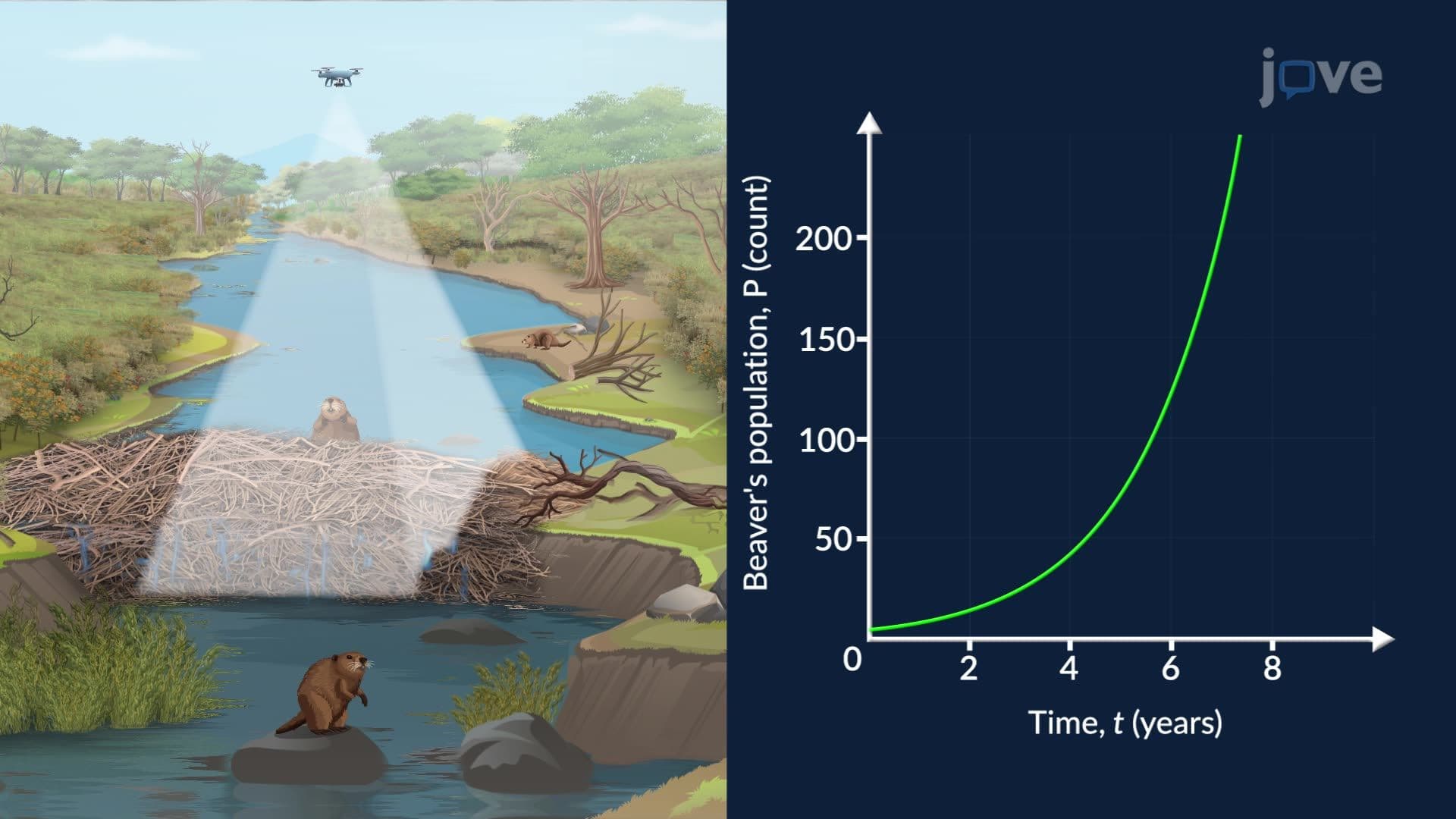
Exponential functions with base e follow the general form f(t) = A × e^(kt), where A represents the initial quantity, k determines the rate of growth or decay, and t represents time. When k > 0, we observe exponential growth; when k < 0, we see exponential decay. The beauty of this formulation lies in its ability to model processes that change continuously rather than in discrete steps.
For high school students preparing for AP Calculus or college-bound students taking precalculus, understanding this function's behavior proves crucial. The SAT Math Level 2 Subject Test frequently includes questions about exponential growth and decay, while AP Calculus examines the derivative and integral properties of e^x.
Consider the Federal Reserve's models for economic growth, which often employ exponential functions with base e to project GDP changes or inflation rates. In epidemiology, the CDC uses these functions to model disease transmission during early outbreak phases. The 2020 COVID-19 pandemic provided a stark real-world example of exponential growth, where cases initially doubled every few days before intervention measures flattened the curve.
Financial applications include continuous compound interest, where the formula A = P × e^(rt) calculates investment growth. This model appears in retirement planning scenarios and college savings plans like 529 accounts. Unlike simple or annual compound interest, continuous compounding represents the theoretical maximum return possible.
A defining characteristic of exponential decay functions is their approach to horizontal asymptotes. In Newton's Law of Cooling, T(t) = T(room) + (T(initial) - T(room)) × e^(-kt), the coffee temperature approaches room temperature but never quite reaches it mathematically. This asymptotic behavior explains why your coffee stops cooling noticeably after extended time periods.
Understanding these limit behaviors helps students tackle calculus concepts like limits at infinity and provides practical insight into equilibrium states in chemistry and physics. College chemistry courses extensively use exponential decay when studying reaction kinetics and half-life calculations for radioactive materials.
Related Micro-courses