Loading subject page…

445 views

Video Summary: What are Exponential Equations
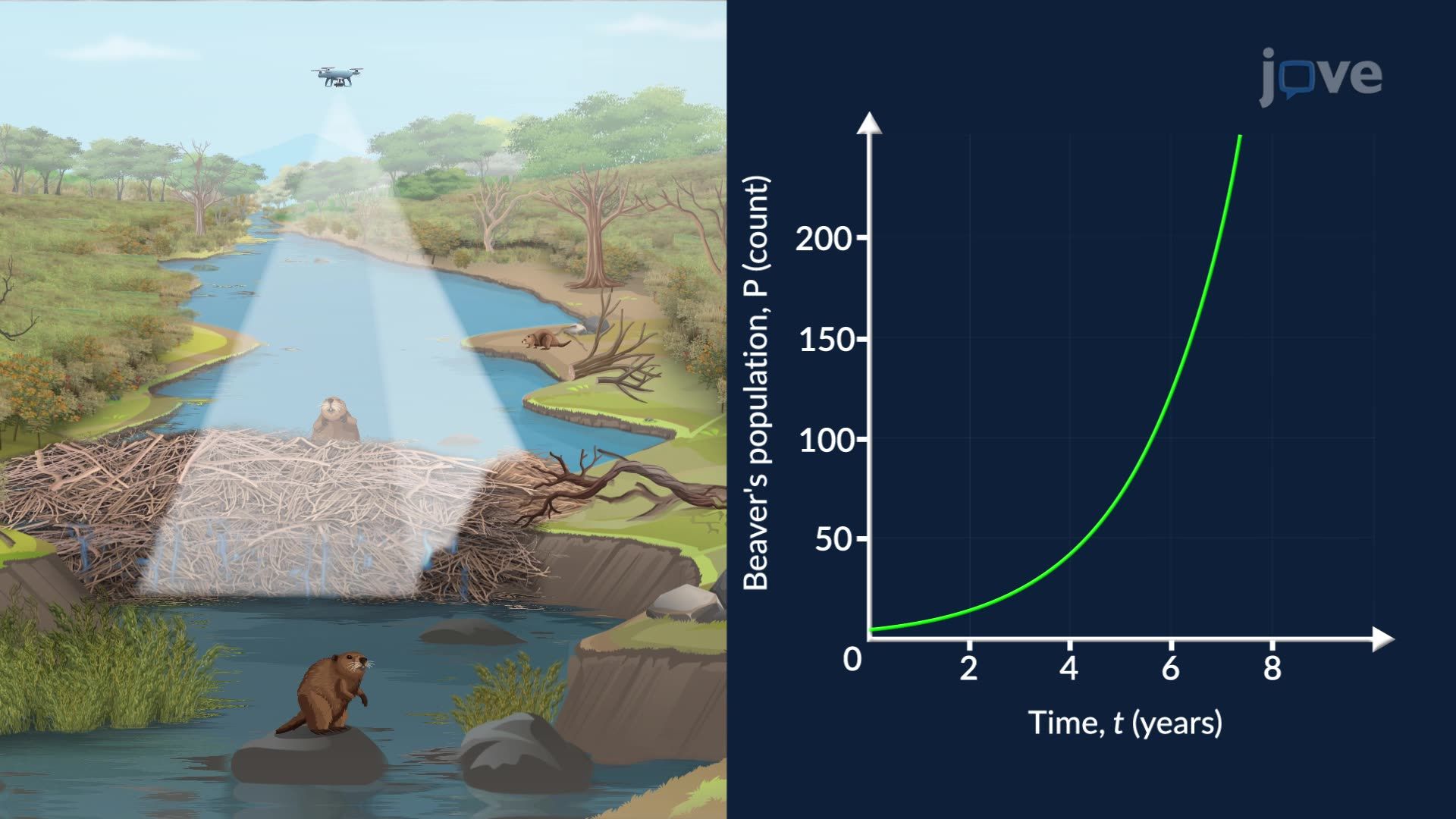
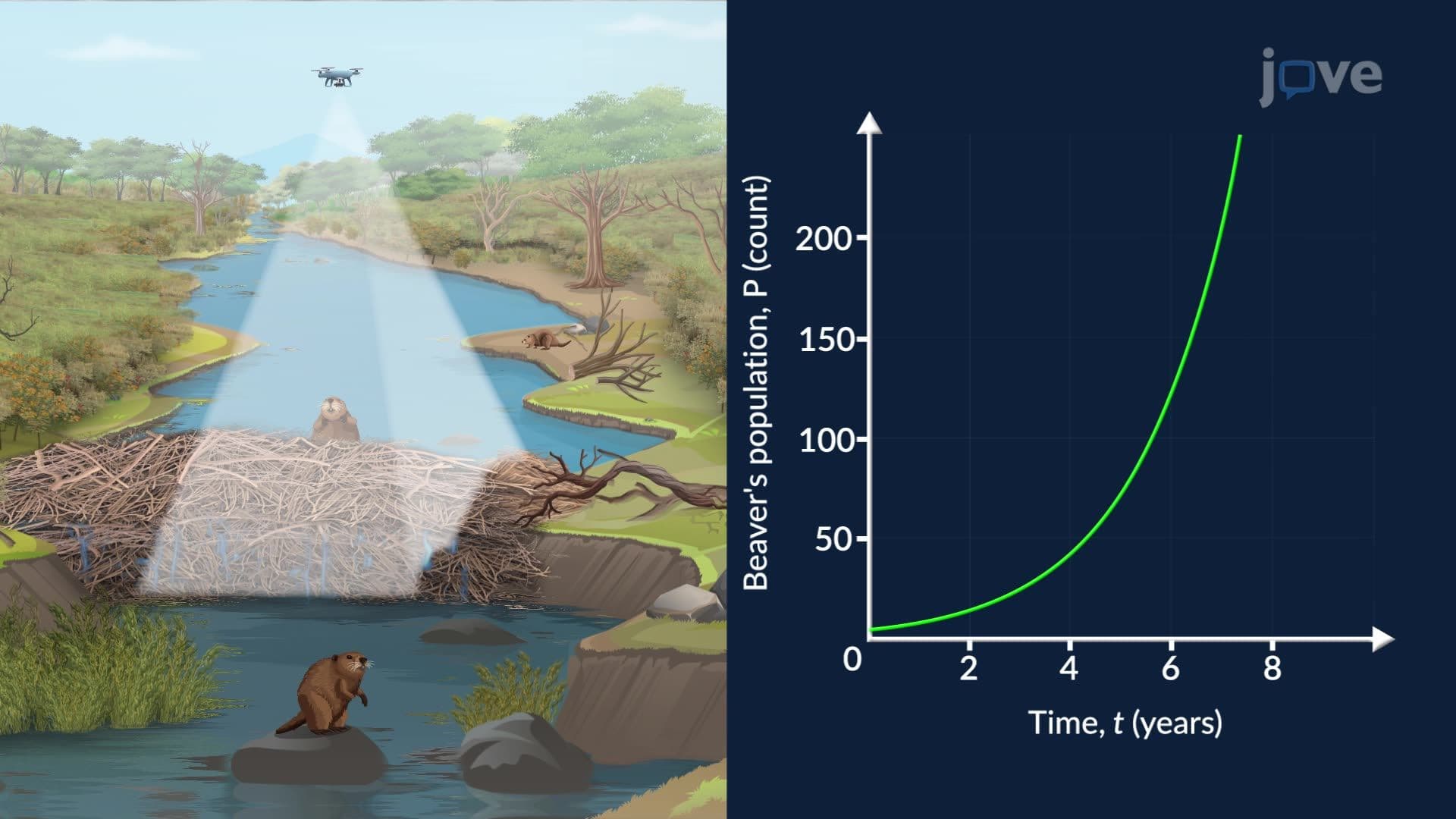
Did you know that exponential equations can predict when a disease outbreak will peak or when your investment will double? Exponential equations model situations where quantities grow or decay at rates proportional to their current size. These mathematical tools are essential for understanding population dynamics, like tracking beaver colonies in Yellowstone National Park, where researchers use exponential models to predict wildlife population changes over time. What are exponential equations becomes clearer when you see how they transform complex growth patterns into solvable mathematical problems. Watch the full video on JoVE Coach to master this concept with expert-led visuals and step-by-step explanations.
Exponential equations are mathematical expressions where the variable appears in the exponent, typically written in the form y = ab^x or y = ae^(kx). Unlike linear equations where variables are multiplied by constants, exponential equations involve variables as powers, creating curves that grow or shrink at accelerating rates.
The most common types of exponential equations include growth models (a > 0, b > 1), decay models (a > 0, 0 < b < 1), and natural exponential functions using Euler's number e. In AP Calculus and college algebra courses, students encounter compound interest problems where A = P(1 + r/n)^(nt), epidemiological models for disease spread, and radioactive decay equations used in nuclear medicine. The Federal Reserve uses exponential models to predict inflation rates, while the Centers for Disease Control employs them to track vaccination effectiveness over time.
The key to solving exponential equations lies in understanding that logarithms are the inverse operations of exponentials. When faced with an equation like 2^x = 16, students can apply logarithms to both sides: log(2^x) = log(16), which simplifies to x·log(2) = log(16). This technique, essential for SAT Subject Tests and college placement exams, transforms exponential equations into linear forms that are much easier to solve.
Successful problem-solving with exponential equations requires identifying the initial value, growth or decay rate, and time variable. Whether calculating how long it takes for a bacterial culture to reach a certain size in a university microbiology lab or determining when a pharmaceutical drug reaches half its original concentration in clinical trials, the process follows consistent steps: substitute known values, isolate the exponential term, apply logarithms, and solve for the unknown variable.
Related Micro-courses