Loading subject page…

280 views

Video Summary: What Is Partial Fractions
Ever wondered how Netflix's recommendation algorithm processes millions of user preferences simultaneously? The secret lies in breaking complex mathematical expressions into simpler components-a technique called partial fractions. This powerful algebraic method transforms intimidating rational expressions into manageable pieces, much like how engineers at companies like Boeing decompose complex aerodynamic equations into solvable parts. Understanding what is partial fractions opens doors to advanced calculus, differential equations, and real-world problem-solving. Watch the full video on JoVE Coach to master this concept with expert-led visuals and step-by-step explanations.
Partial fractions represent one of algebra's most elegant problem-solving techniques, transforming complex rational expressions into simpler, more manageable components. This mathematical process mirrors how complex problems in engineering, economics, and physics are often solved by breaking them into smaller, solvable pieces.
At its core, partial fraction decomposition takes a single complicated fraction and expresses it as a sum of simpler fractions. Think of it like dismantling a complex machine to understand its individual components-each piece serves a specific purpose and can be analyzed independently.
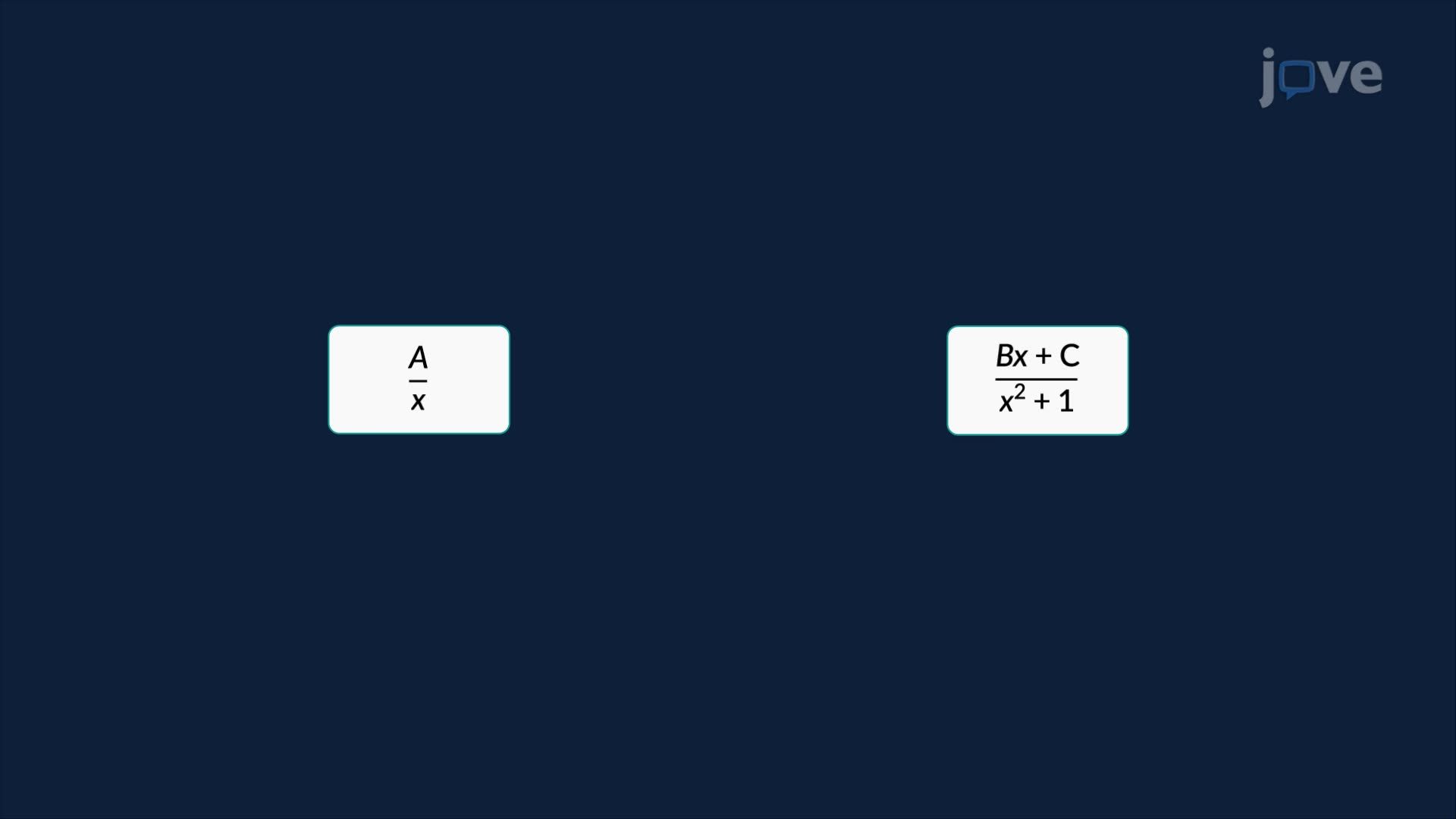
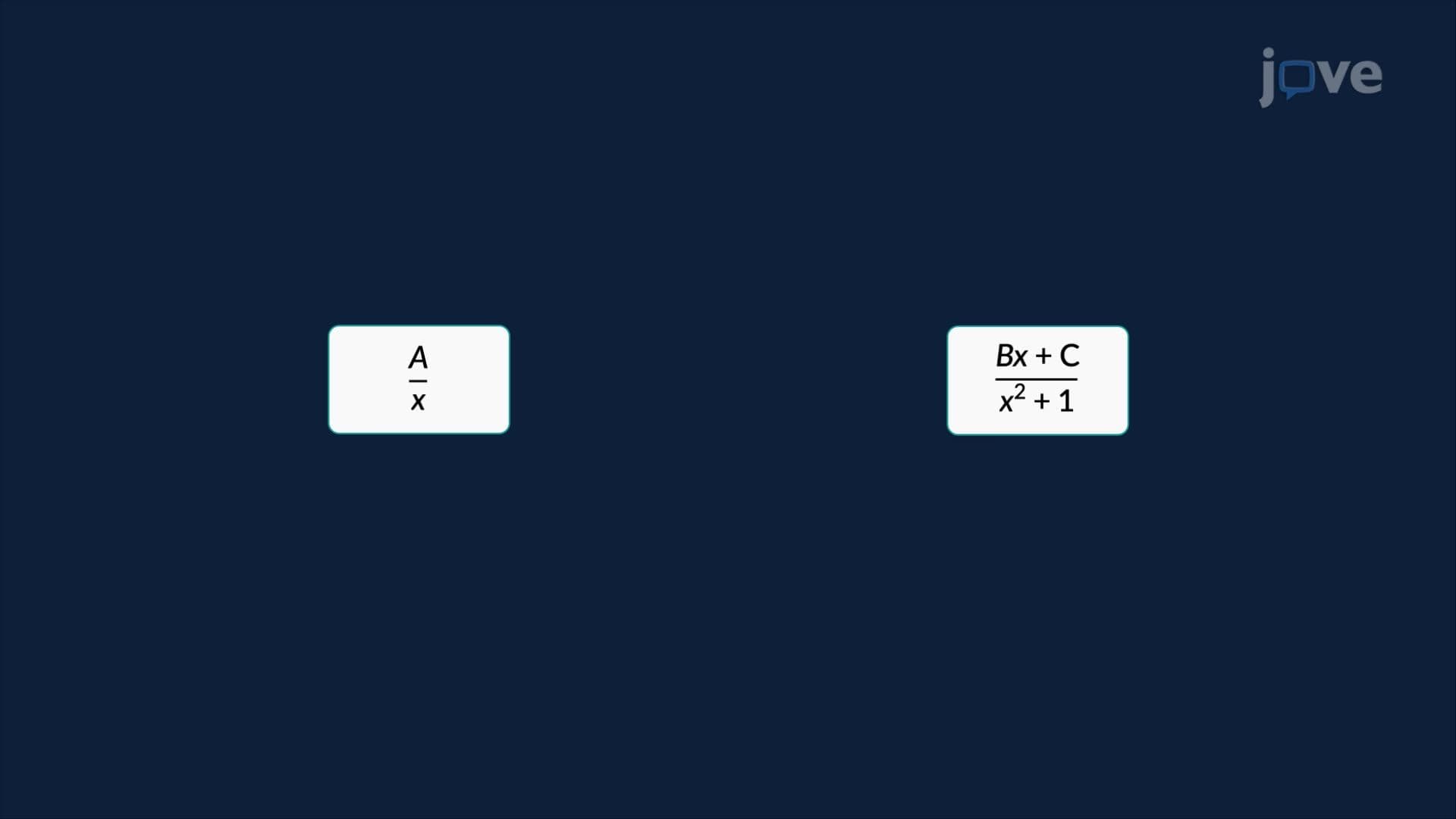
The partial fractions definition encompasses a methodical approach beginning with complete factorization of the denominator. This critical first step determines the entire structure of your decomposition. Linear factors like (x - 2) contribute simple terms with constant numerators, while irreducible quadratic factors such as (x² + x + 5) require linear numerators to match their complexity.
For students preparing for AP Calculus or college-level mathematics, mastering this factorization step proves essential. Repeated factors add layers of complexity-if (x - 3) appears squared in your denominator, you'll need separate terms for both (x - 3) and (x - 3)².
Once you've established the proper form, determining the unknown constants becomes a systematic process. The most reliable method involves expanding everything to a common denominator, then comparing coefficients of like powers on both sides of the equation.
Consider how NASA engineers use similar decomposition techniques when analyzing spacecraft trajectories-complex orbital mechanics equations become manageable when broken into component forces and influences. This same principle applies whether you're tackling SAT Subject Test problems or preparing for engineering coursework at institutions like MIT or Stanford.
Understanding what is partial fractions in detail extends far beyond classroom exercises. Electrical engineers use these techniques to analyze circuit responses, while economists employ similar methods in market analysis models. In medical physics programs, partial fractions help simplify radioactive decay calculations and pharmacokinetic modeling.
For immediate academic success, partial fractions appear frequently on standardized tests and college entrance exams. The College Board regularly includes these problems on AP Calculus exams, while many state university placement tests feature partial fraction questions to assess algebraic readiness for advanced coursework.
Related Micro-courses