Loading subject page…


1,807 views

Video Summary: Unsymmetric Loading of Thin Walled Members Explained
Why do airplane wings sometimes twist unexpectedly during flight, potentially compromising aircraft safety? Unsymmetric loading of thin walled members occurs when forces applied to non-symmetrical structural cross-sections create both bending and twisting effects simultaneously. Consider how Boeing engineers must carefully analyze wing loading to prevent catastrophic structural failure during turbulence. Understanding Unsymmetric Loading of Thin Walled Members Explained is crucial for predicting stress distributions and preventing structural deformation in critical applications. Watch the full video on JoVE Coach to master this concept with expert-led visuals and step-by-step explanations.
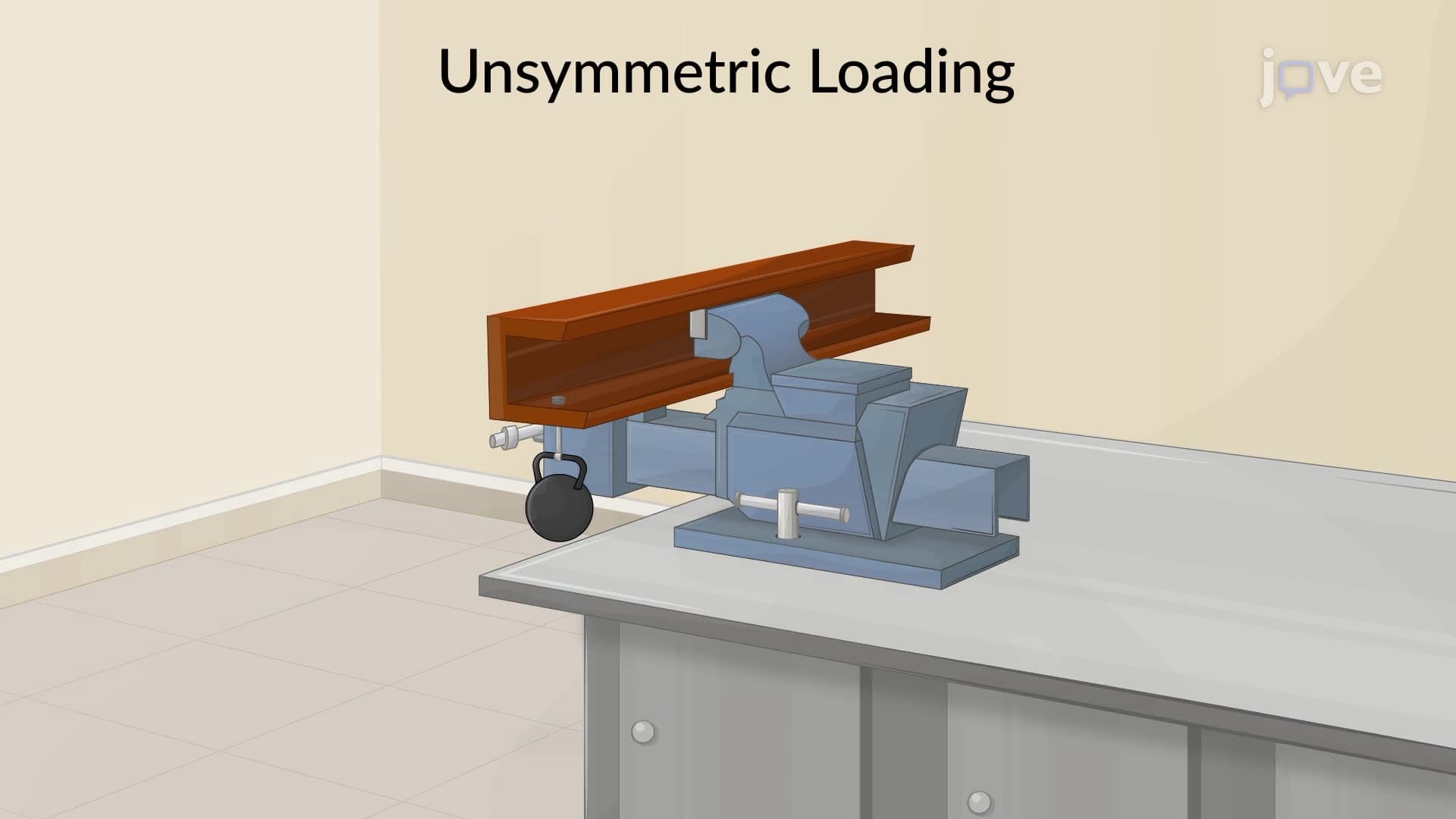
Unsymmetric loading of thin walled members represents a complex structural engineering phenomenon that occurs when external forces are applied to structural elements with non-symmetrical cross-sections. Unlike symmetric loading scenarios where forces create predictable bending patterns, unsymmetric loading introduces a coupling effect between bending and torsional (twisting) responses that can significantly complicate structural analysis and design.
When thin-walled members experience unsymmetric loading, the structural response involves simultaneous bending and twisting deformations. This occurs because the applied load creates both a bending moment about the neutral axis and a torque about the longitudinal axis of the member. The magnitude and distribution of these effects depend heavily on the geometry of the cross-section and the location where the load is applied.
In practical applications, this phenomenon is critical in aerospace engineering. For example, aircraft wing structures often feature thin-walled construction with complex, non-symmetrical cross-sections. During flight operations, aerodynamic loads can create unsymmetric loading conditions that must be carefully managed to prevent structural failure. The Federal Aviation Administration (FAA) requires extensive analysis of these loading conditions during aircraft certification processes.
The shear center emerges as the most critical concept in managing unsymmetric loading effects. This special point within a cross-section represents the location where applied transverse loads will produce only bending deformation without inducing any twisting. When loads are applied directly at the shear center, the coupling between bending and torsion is eliminated, dramatically simplifying the structural response.
For students preparing for AP Physics C or introductory engineering mechanics courses, understanding shear center location becomes essential for solving complex loading problems. The shear center does not necessarily coincide with the geometric centroid of the cross-section, particularly for open thin-walled sections like C-channels or L-angles commonly used in construction.
Engineers employ various strategies to manage unsymmetric loading effects in real-world applications. Load decomposition techniques allow complex loading scenarios to be broken down into symmetric and unsymmetric components, each analyzed separately using superposition principles. This approach is particularly valuable in structural analysis software used by firms like Skidmore, Owings and Merrill for designing complex building systems.
Bridge engineering provides another excellent example where unsymmetric loading analysis is crucial. The Tacoma Narrows Bridge failure in 1940, while primarily attributed to aerodynamic flutter, also involved complex interactions between bending and torsional modes that modern engineers must consider when designing suspension bridge decks with thin-walled box girder cross-sections.
Related Micro-courses