Loading subject page…

- Mechanical Engineering
- Shearing Stresses in Beams and Thin Walled Members
- Plastic Deformations
Micro-course: Shearing Stresses in Beams and Thin-Walled Members
1,807 views
Learn key concepts and earn your certificate.

Plastic Deformations

00:00
01:19
Video Summary: What Is Plastic Deformations
When the iconic Golden Gate Bridge flexes under heavy winds, it demonstrates the difference between elastic and plastic deformations-one recovers, the other permanently changes the structure. Plastic deformations occur when materials like steel beams exceed their yield strength and cannot return to their original shape, creating permanent changes that engineers must carefully consider in structural design. Understanding what plastic deformations means is crucial for analyzing how cantilever beams develop plastic hinges at failure points, as seen in real construction projects across the United States. Watch the full video on JoVE Coach to master this concept with expert-led visuals and step-by-step explanations.
- Understand what plastic deformations are and how they differ from elastic deformations in structural materials
- Identify the critical point where normal stress exceeds yield strength in cantilever beam loading scenarios
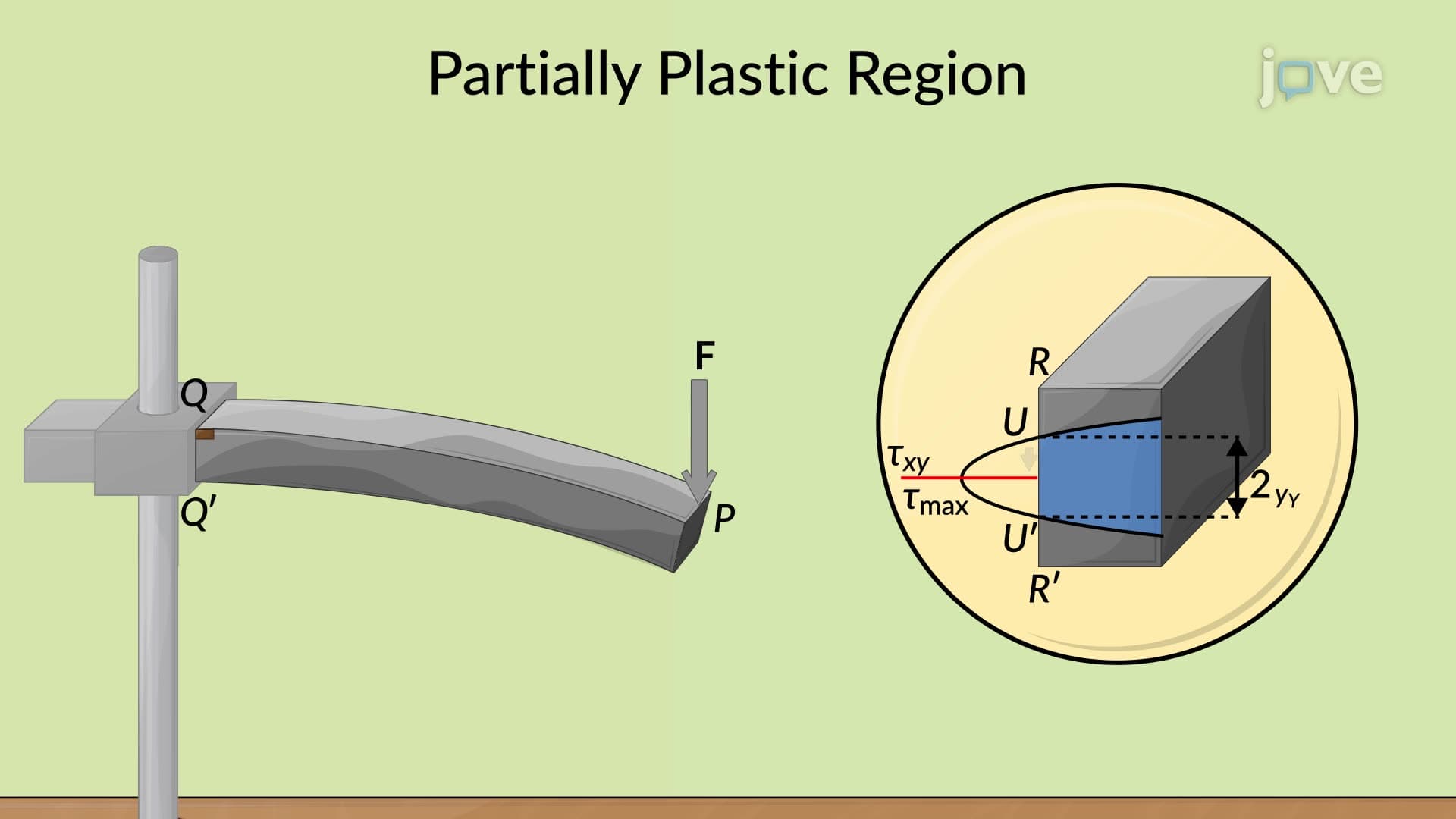
- Analyze the formation of plastic hinges at fixed ends when bending moments surpass elastic limits
- Recognize the boundary conditions between elastic and plastic zones using half-thickness measurements
- Evaluate stress distribution patterns in partially plastic cross-sections under maximum loading conditions
- Apply concepts of shearing stress redistribution as elastic portions decrease in beam structures
- Compare elastic core behavior with fully plastic section characteristics during progressive loading
- Explore ultimate failure mechanisms when maximum shearing stress reaches material yield strength
Understanding What is Plastic Deformations in Structural Engineering
Plastic deformations represent a fundamental concept in materials science and structural engineering, describing the permanent changes that occur when materials exceed their elastic limits. Unlike elastic deformation where materials return to their original shape after load removal, plastic deformations create irreversible changes that permanently alter the structure's geometry and load-bearing capacity.
The Physics Behind Plastic Deformations in Cantilever Systems
The plastic deformations concept becomes particularly evident in cantilever beam analysis, a cornerstone topic in AP Physics C and college-level mechanics courses. When engineers design structures like highway overpasses or building extensions, they must understand how cantilever beams respond to loading. The maximum bending moment occurs at the fixed end, where the beam connects to its support structure. As loading increases, normal stress approaches the material's yield strength-the critical threshold where plastic deformations begin.
This plastic deformations definition extends beyond simple material failure. The transition from elastic to plastic behavior creates distinct zones within the beam cross-section. The elastic core maintains its original properties while surrounding material enters the plastic region. Students preparing for engineering fundamentals exams or the MCAT often encounter this concept when analyzing biological structures like bone loading under stress.
Plastic Hinge Formation and Ultimate Load Capacity
Understanding plastic deformations in detail requires examining plastic hinge formation-the point where a cross-section becomes fully plastic. This mechanism represents the maximum load-carrying capacity of the structural element. In real-world applications, from the construction of sports stadiums to the design of aircraft wings, engineers must predict when plastic hinges will form to ensure structural safety.
The plastic deformations study guide emphasizes how stress distribution changes as loading progresses. In partially plastic sections, normal stresses reach uniform distribution equal to the yield strength. Meanwhile, shearing forces redistribute entirely to the remaining elastic portion, creating higher stress concentrations that ultimately contribute to structural failure.
Practical Applications in US Engineering and Exam Preparation
This plastic deformations overview connects directly to professional engineering practice across the United States. From seismic design in California buildings to hurricane-resistant structures in Florida, understanding plastic behavior helps engineers create safer infrastructure. Students encounter these concepts in courses ranging from high school AP Physics to graduate-level structural analysis, making this knowledge essential for academic success and professional competency.
Frequently Asked Questions
Plastic deformations are permanent changes in material shape that occur when stress exceeds the yield strength, unlike elastic deformation which reverses when load is removed. This fundamental difference determines whether structures can recover their original form or suffer permanent damage. Understanding this distinction is crucial for engineering design and material selection in construction projects.
AP Physics C typically tests plastic deformations through beam bending problems and stress-strain relationship questions. Students must identify yield points, calculate maximum loads before plastic hinge formation, and analyze stress distribution in partially plastic sections. Practice problems often involve cantilever beams with concentrated loads, similar to real engineering scenarios.
The MCAT Physical Sciences section includes plastic deformations in biomechanics contexts, particularly bone and tissue stress analysis. Test-takers encounter questions about yield strength in biological materials, stress distribution in loaded bones, and the transition from elastic to plastic behavior in medical implants. These concepts connect physics principles to biological systems.
Plastic deformations occur in earthquake-damaged buildings in California, hurricane-bent structures in coastal regions, and overloaded bridges during heavy traffic. Highway guardrails demonstrate controlled plastic deformation by absorbing crash energy through permanent bending. These real-world examples help students understand the practical importance of material behavior analysis.
High school algebra and basic trigonometry are sufficient for understanding plastic deformations fundamentals. While advanced calculus helps with detailed stress analysis, the core concepts rely on force equilibrium and simple stress-strain relationships. Students can master the essential principles using standard high school mathematics skills.
Focus on identifying yield points in stress-strain diagrams, practicing cantilever beam calculations, and memorizing key formulas for bending moment and normal stress. Create concept maps linking elastic limits to plastic hinge formation, and work through progressively loaded beam problems. Drawing stress distribution diagrams helps visualize the transition from elastic to plastic regions.
Advanced studies include fatigue analysis, creep behavior, fracture mechanics, and nonlinear material modeling. Graduate courses explore finite element analysis of plastic regions, advanced failure theories, and dynamic plastic response. These topics are essential for structural engineering, aerospace design, and materials research careers.
Related Micro-courses
10 Concepts

4 Concepts

9 Concepts