Loading subject page…


4,328 views


Video Summary: What Is Input Efficiency Iii
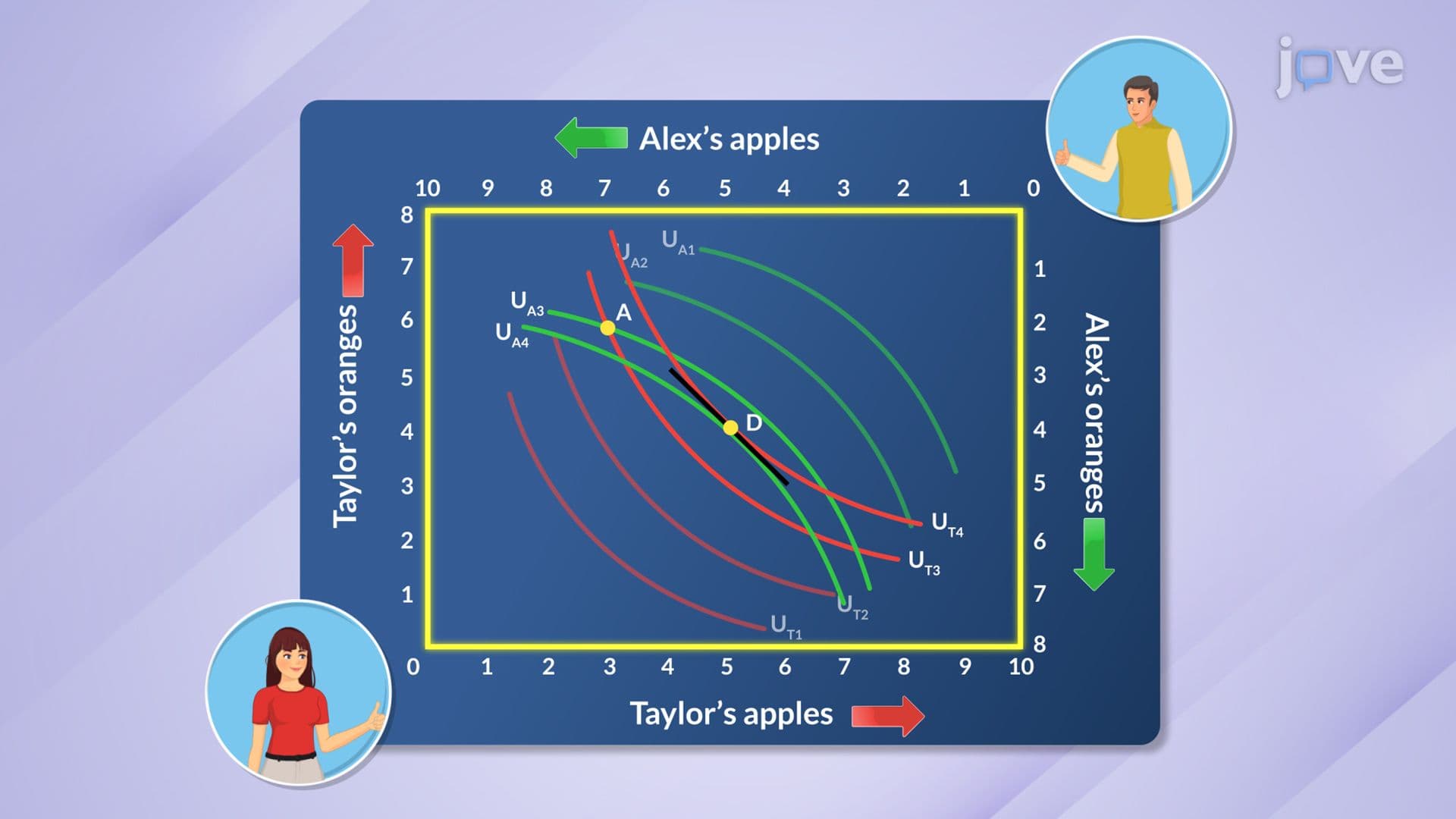
Why do some farmers produce more corn per acre than others using the same inputs? Input efficiency occurs when resources like labor and capital are allocated optimally across different producers. Consider two Iowa corn farmers: when their Marginal Rate of Technical Substitution (MRTS) values are equal, they've achieved the most productive distribution of workers and machinery. What is Input Efficiency III demonstrates this critical economic principle through mathematical relationships and tangent isoquants. Watch the full video on JoVE Coach to master this concept with expert-led visuals and step-by-step explanations.
Input efficiency III represents the sophisticated economic principle where resources are distributed across multiple producers to maximize overall output. This concept builds on fundamental microeconomic theory, showing how rational decision-making by individual firms contributes to broader economic efficiency.
The core mathematical relationship in input efficiency involves the Marginal Rate of Technical Substitution (MRTS). For any producer, MRTS equals the absolute value of the marginal product of labor divided by the marginal product of capital: |MP(L)/MP(K)|. When two producers achieve input efficiency, their MRTS values must be identical.
Consider two manufacturing plants in Detroit producing automotive parts. Plant A might initially use more automated machinery (capital-intensive), while Plant B relies heavily on skilled workers (labor-intensive). Input efficiency is achieved when both plants adjust their input mix until their MRTS values converge, meaning neither plant can improve overall production by trading workers for machines with the other.
In competitive markets, input efficiency emerges naturally through price signals. When both producers face identical input prices-the same wage rates for workers and rental rates for capital equipment-cost minimization drives them toward identical MRTS values. This explains why similar businesses in the same geographic area often adopt comparable production methods.
Agricultural cooperatives exemplify this principle. Nebraska wheat farmers sharing equipment and labor often achieve input efficiency by coordinating resource allocation based on each farm's marginal productivity. Those with higher labor productivity specialize in labor-intensive tasks, while farms with superior capital utilization focus on equipment-heavy operations.
AP Microeconomics and college intermediate microeconomics courses frequently test input efficiency through graphical analysis and mathematical optimization. Students encounter problems requiring them to identify efficient allocations using isoquant diagrams, where tangent isoquants indicate equal MRTS values.
Common exam scenarios include calculating optimal input distributions between firms, determining when reallocation improves efficiency, and analyzing how price changes affect input efficiency conditions. Mastering these applications requires understanding both the geometric interpretation through isoquants and the algebraic relationships between marginal products and input prices.
Related Micro-courses