Loading subject page…


4,328 views


Video Summary: What Is Output Efficiency Mrt
Ever wonder why Tesla can't simultaneously maximize both car and battery production at their factories? Output efficiency MRT reveals the fundamental trade-offs every producer faces when allocating limited resources between different goods. The Marginal Rate of Transformation shows exactly how many units of one product must be sacrificed to gain one additional unit of another-like how Amazon might reduce warehouse space for electronics to accommodate more clothing inventory. Watch the full video on JoVE Coach to master this concept with expert-led visuals and step-by-step explanations.
The output efficiency MRT definition centers on a critical economic principle: resources are finite, forcing producers to make strategic choices about what to produce. The Marginal Rate of Transformation quantifies these inevitable trade-offs by measuring how many units of Good A must be sacrificed to produce one additional unit of Good B while maintaining total production capacity.
This concept appears frequently on AP Economics exams and college microeconomics courses, where students must demonstrate understanding of production efficiency. The MRT derives directly from the production possibilities frontier's slope, making it a visual and mathematical representation of opportunity cost in action.
Consider Boeing's aircraft manufacturing decisions. When the company shifts engineers and assembly line workers from 737 production to 787 Dreamliner production, the MRT reveals exactly how many 737s must be foregone for each additional Dreamliner. If reallocating resources reduces 737 output by 2 units while increasing Dreamliner production by 1 unit, the MRT equals -2, indicating each Dreamliner costs two 737s in opportunity terms.
Similarly, agricultural producers face constant MRT decisions. A Kansas farm might calculate that converting wheat acreage to corn production yields an MRT of -1.5, meaning 1.5 bushels of wheat are sacrificed for each additional bushel of corn produced. These calculations guide critical planting decisions each season.
For output efficiency MRT concept explained thoroughly, students must grasp three interconnected elements. First, the mathematical relationship: MRT = -(Change in Good A output)/(Change in Good B output). The negative sign reflects the inverse relationship-gaining one good requires losing another.
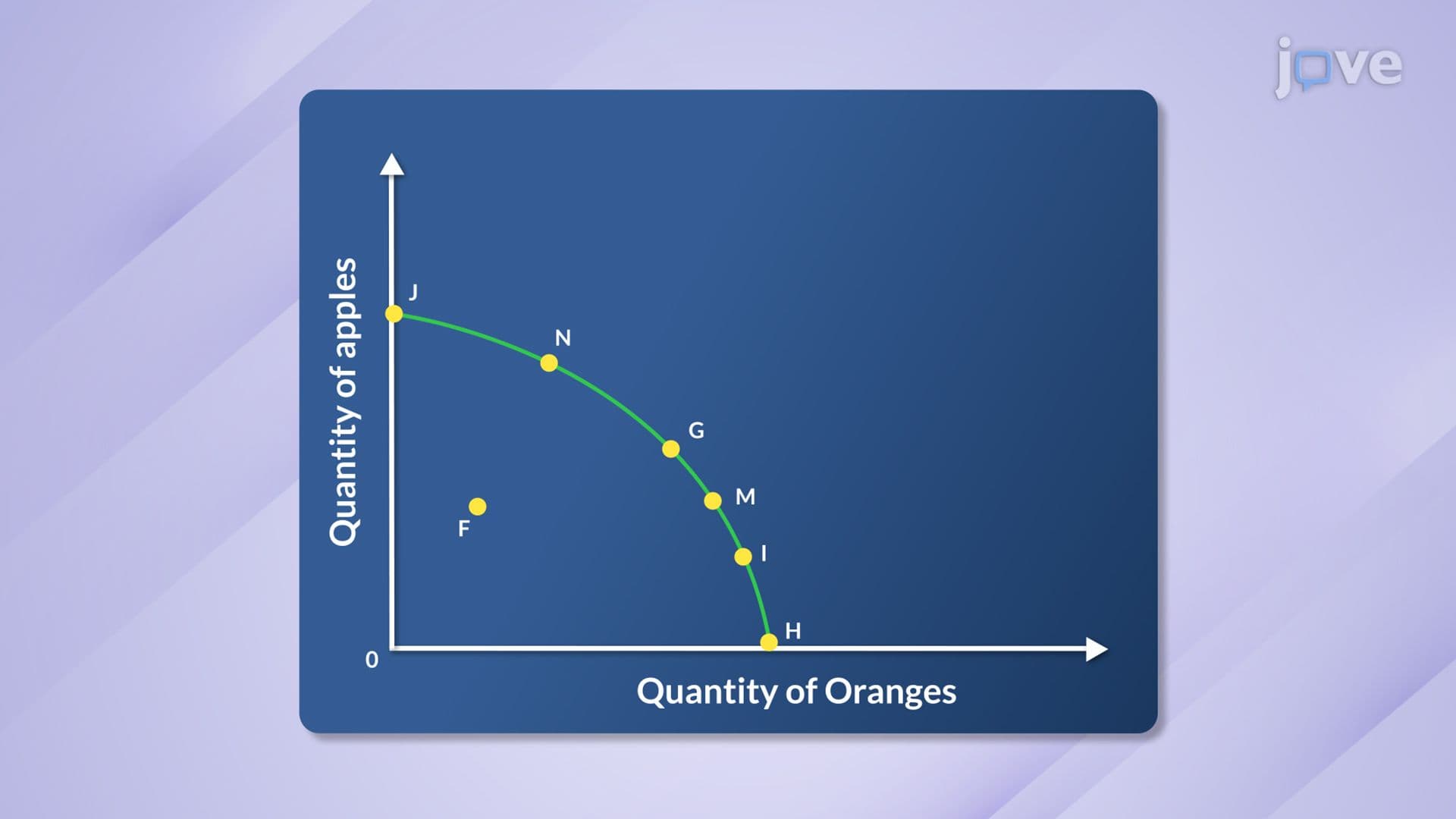
Second, the graphical interpretation links MRT to PPF slope. Steeper slopes indicate higher transformation rates, meaning significant sacrifices of one good for small gains in another. Third, optimal efficiency occurs when MRT equals the Marginal Rate of Substitution (MRS), aligning production decisions with consumer preferences.
College students preparing for economics exams should focus on MRT calculation problems and efficiency analysis. Practice identifying when economies operate inside, on, or beyond their production possibilities frontier. Understanding how technological advances shift PPF curves-and consequently alter MRT values-frequently appears on midterm and final examinations.
The concept also connects to broader economic themes like comparative advantage and international trade, where countries' different MRT values create opportunities for mutually beneficial exchange. This interconnectedness makes output efficiency MRT a foundational concept for advanced economic study.
Related Micro-courses