Loading subject page…


235,001 views


Video Summary: Conformations of Ethane and Propane Explained
Did you know that 99% of ethane molecules in your natural gas stove exist in their most stable shape? Conformations ethane propane represent different spatial arrangements of atoms around rotating carbon-carbon bonds, with staggered forms being 12-14 kJ/mol more stable than eclipsed forms due to minimized electron repulsion. Understanding Conformations of Ethane And Propane Explained helps explain why certain molecular shapes dominate in pharmaceutical drugs and petrochemicals. Watch the full video on JoVE Coach to master this concept with expert-led visuals and step-by-step explanations.
Molecular conformations represent one of the most fundamental concepts in organic chemistry, describing how atoms arrange themselves in three-dimensional space around rotatable bonds. When studying alkanes like ethane and propane, conformational analysis reveals why certain molecular shapes predominate and how energy differences drive molecular behavior. This knowledge proves essential for students tackling AP Chemistry, college organic chemistry courses, and pre-med requirements.
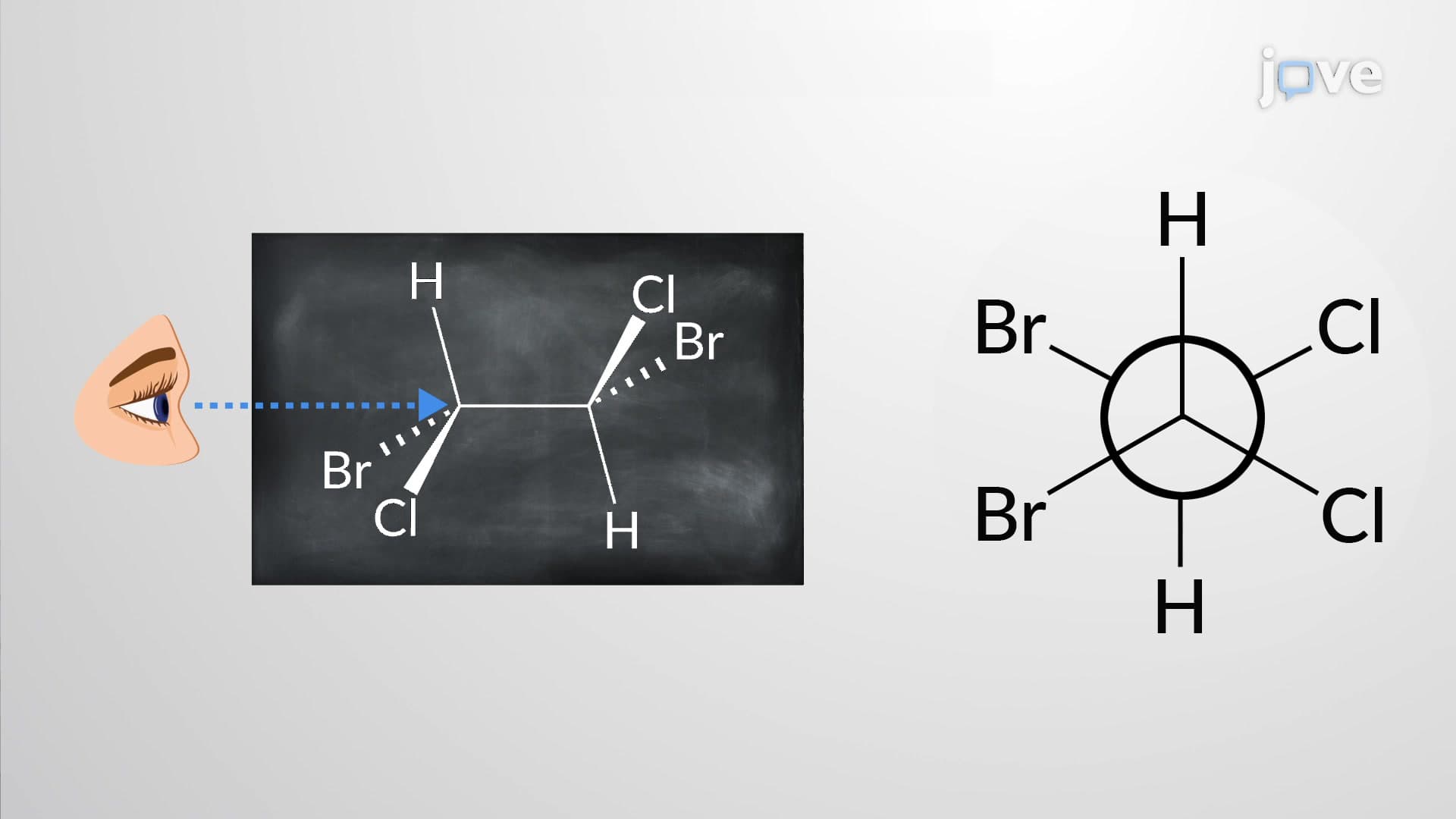
Ethane's conformational landscape centers on rotation around its central C-C bond. The staggered conformation, where C-H bonds maintain 60° dihedral angles, represents the global energy minimum. This stability arises from two key factors: minimized steric repulsion between electron clouds and favorable molecular orbital interactions between bonding and antibonding orbitals.
In contrast, the eclipsed conformation forces C-H bonds into direct alignment, creating significant destabilization worth 12 kJ/mol. This energy penalty, termed torsional strain, results from increased electron-electron repulsion when bonds overlap spatially. Each H-H eclipsing interaction contributes approximately 4 kJ/mol to this destabilization, making eclipsed ethane a high-energy transition state rather than a stable conformer.
Propane introduces conformational complexity through its terminal methyl group. While maintaining the same staggered/eclipsed pattern, propane's eclipsed conformation experiences 14 kJ/mol of torsional strain-2 kJ/mol higher than ethane. This increase stems from the CH3-H eclipsing interaction, which contributes 6 kJ/mol compared to the 4 kJ/mol from H-H interactions.
This difference illustrates a crucial principle: larger substituents create greater steric hindrance, leading to higher energy penalties in eclipsed conformations. Students encounter this concept frequently on MCAT organic chemistry sections and college exams, where understanding substituent effects on molecular stability becomes essential.
Conformational analysis extends far beyond academic exercises. In pharmaceutical development, companies like Pfizer and Merck consider conformational preferences when designing drug molecules, as bioactivity often depends on three-dimensional shape. The petrochemical industry similarly relies on conformational understanding when processing natural gas components like ethane and propane.
For students, mastering conformational analysis provides the foundation for understanding more complex topics like cyclohexane chair conformations, protein folding, and stereochemistry. AP Chemistry students encounter conformational concepts in Unit 2 (Molecular and Ionic Compound Structure), while college organic chemistry courses typically dedicate entire chapters to conformational analysis principles.
Related Micro-courses