Loading subject page…

- Organic Chemistry
- Alkynes
- Electrophilic Addition to Alkynes: Halogenation
Micro-course: Alkynes
143,300 views
Learn key concepts and earn your certificate.

Electrophilic Addition to Alkynes: Halogenation

00:00
02:38
Video Summary: Electrophilic Addition to Alkynes Halogenation Explained
Ever wonder how pharmaceutical companies create complex drug molecules from simple starting materials? Electrophilic addition alkynes halogenation is a fundamental reaction that transforms triple-bonded carbon compounds into valuable intermediates used in manufacturing everything from antibiotics to plastics. This stereospecific process follows predictable patterns, making it essential for organic chemistry students to master. Companies like Pfizer routinely use these reactions in their synthesis pathways. Watch the full video on JoVE Coach to master this concept with expert-led visuals and step-by-step explanations.
- Understand the mechanism of Electrophilic Addition To Alkynes Halogenation Explained and how it differs from alkene halogenation
- Identify the formation of trans-dihalides as major products in single-equivalent additions
- Analyze why alkynes are less reactive than alkenes toward electrophilic addition reactions
- Compare the stability of halonium ion intermediates formed from alkynes versus alkenes
- Evaluate the stereochemistry outcomes and predict product formation patterns
- Apply mechanistic knowledge to solve multi-step synthesis problems
- Recognize the role of cyclic halonium intermediates in determining reaction stereochemistry
- Explore how sequential halogen additions lead to tetrahaloalkane formation
Understanding Electrophilic Addition To Alkynes Halogenation Fundamentals
Electrophilic addition to alkynes represents a cornerstone reaction in organic chemistry, particularly relevant for students preparing for AP Chemistry, MCAT, or college-level organic chemistry courses. Unlike alkenes with one π-bond, alkynes possess two π-bonds, creating unique reactivity patterns that pharmaceutical and materials science industries exploit daily.
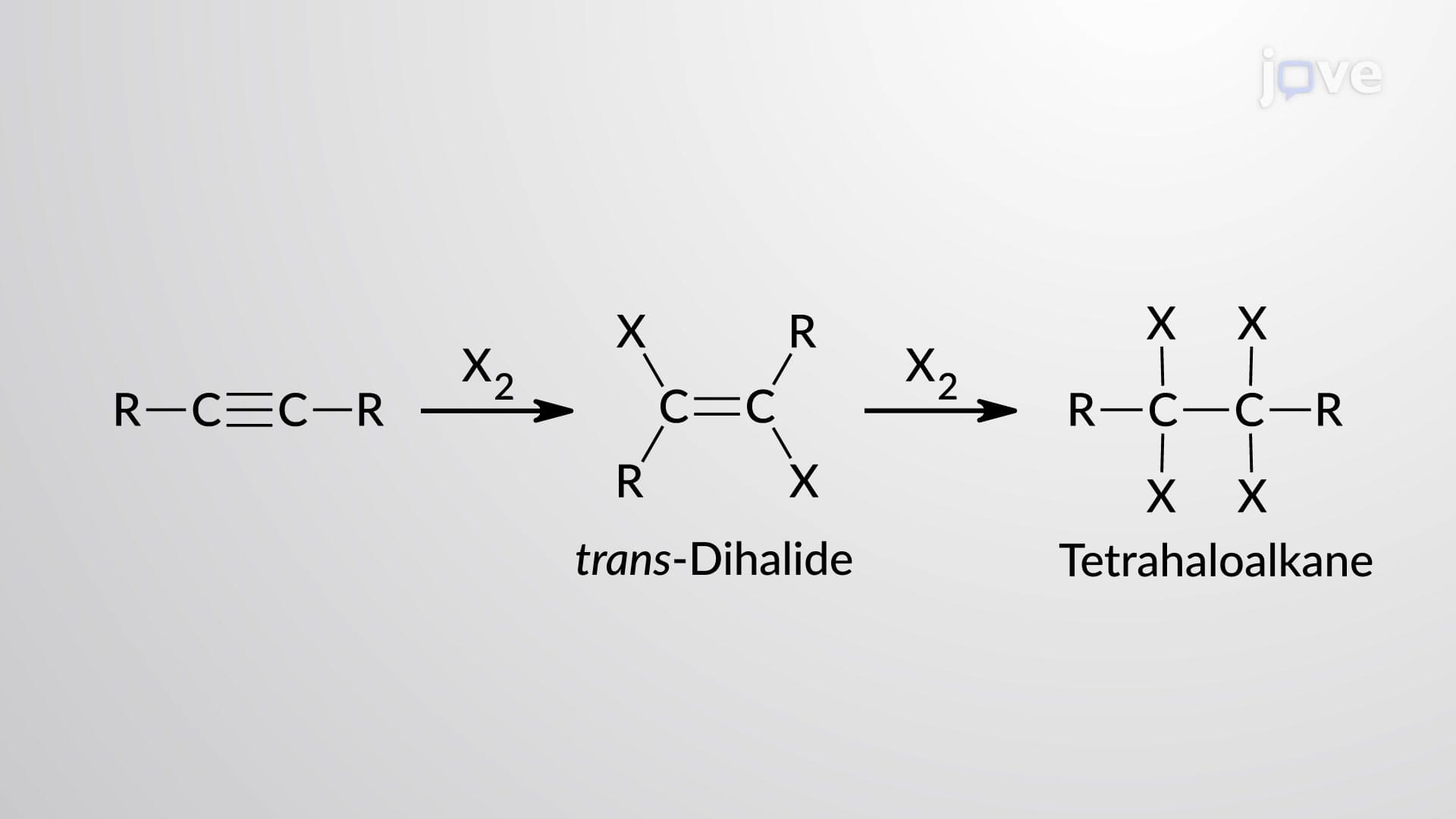
The electron-rich triple bond acts as a nucleophile, attacking polarized halogen molecules (Br2, Cl2) in a process that proceeds through cyclic halonium ion intermediates. This mechanism ensures anti-addition stereochemistry, consistently producing trans-dihalides as major products-a predictability that makes these reactions valuable in synthetic chemistry.
Mechanistic Pathway and Intermediate Formation
The reaction begins when the alkyne's π-electrons attack one halogen atom, causing the X-X bond to polarize and eventually break. The departing halide ion leaves behind a three-membered cyclic halonium ion, similar to alkene halogenation but significantly more strained due to the linear geometry preference of the original alkyne.
This increased strain explains why alkynes react more slowly than alkenes-the halonium intermediate is inherently less stable. Students often encounter this concept on MCAT organic chemistry sections, where understanding relative reactivity helps predict reaction outcomes and rates.
Stereochemical Outcomes and Product Control
The backside attack by the halide ion on the halonium intermediate ensures trans-stereochemistry, producing E-configured dihalides exclusively. For example, when 2-butyne reacts with bromine in acetic acid containing lithium bromide, only E-2,3-dibromo-2-butene forms-never the Z-isomer.
Sequential addition of a second halogen equivalent follows identical mechanistic principles, ultimately yielding tetrahaloalkanes. This two-step process allows chemists to control reaction stoichiometry, stopping at the dihalide stage for specific synthetic applications or proceeding to complete saturation.
Industrial Applications and Synthetic Utility
Major chemical companies utilize alkyne halogenation in manufacturing processes. Dow Chemical and DuPont employ these reactions to create intermediates for polymer production, while pharmaceutical companies use them in drug synthesis pathways. The predictable stereochemistry makes these reactions particularly valuable when specific geometric isomers are required for biological activity.
Students studying for college organic chemistry exams should recognize that alkyne halogenation problems frequently appear on midterms and finals, often combined with subsequent functional group transformations to test comprehensive mechanistic understanding.
Frequently Asked Questions
Electrophilic addition to alkynes halogenation is a reaction where halogens (like Br2 or Cl2) add across alkyne triple bonds through a cyclic halonium ion mechanism. The process converts C≡C bonds into C=C bonds with halogens attached, producing trans-dihalides as major products. This reaction is fundamental in organic synthesis and commonly tested on MCAT and AP Chemistry exams.
MCAT questions often test stereochemistry prediction, asking students to identify trans-products from alkyne halogenation. College exams frequently include mechanism drawing, product prediction with multiple equivalents, and comparison to alkene reactivity. Practice problems typically involve predicting whether one or two halogen equivalents will add based on reaction conditions.
AP Chemistry emphasizes understanding reaction patterns rather than pure memorization. Knowing that alkyne halogenation produces trans-products helps predict outcomes in synthesis sequences and explains why certain pharmaceutical intermediates have specific three-dimensional shapes. This knowledge directly applies to free-response questions about organic reaction mechanisms.
Companies like Merck and Bristol-Myers Squibb use alkyne halogenation to create specific molecular geometries required for drug activity. The predictable trans-stereochemistry allows chemists to control the three-dimensional shape of drug molecules, which determines how they interact with biological targets like enzymes and receptors.
Not at all-the core concept builds naturally from alkene chemistry that most students already know. Focus on the pattern: halogens add across multiple bonds with predictable stereochemistry. Start with simple examples like 2-butyne + Br2, then progress to more complex structures as confidence builds.
Practice drawing the cyclic halonium intermediate and predicting trans-addition outcomes. Create flashcards showing starting alkynes and their halogenation products. Work through problems involving both single and double halogen additions, focusing on how reaction stoichiometry affects final products.
Progress to alkyne hydration reactions, then explore how halogenated products undergo elimination reactions to reform multiple bonds. Study alkyne alkylation reactions and how terminal alkynes behave differently from internal alkynes in various reaction conditions.
Related Micro-courses
12 Concepts
15 Concepts
25 Concepts