Loading subject page…


143,300 views

Video Summary: Structure and Physical Properties of Alkynes Explained
Did you know that the welding torches used to build America's skyscrapers rely on acetylene, the simplest alkyne? The structure and physical properties of alkynes reveal why these triple-bonded hydrocarbons are so powerful-their sp hybridization creates incredibly strong, linear molecules with bond energies far exceeding regular hydrocarbons. From contraceptive medications like ethynylestradiol to industrial welding applications, alkynes demonstrate remarkable versatility through their unique molecular architecture. Watch the full video on JoVE Coach to master this concept with expert-led visuals and step-by-step explanations.
The structure and physical properties of alkynes explained begins with their defining feature: the carbon-carbon triple bond. Unlike alkanes and alkenes, alkynes contain sp hybridized carbons that form remarkably rigid, linear molecular frameworks. This hybridization involves mixing one s orbital with one p orbital, leaving two unhybridized p orbitals available for pi bonding.
The triple bond consists of one sigma bond formed by sp-sp orbital overlap and two pi bonds created through lateral overlap of the remaining p orbitals. This arrangement produces the characteristic 180-degree bond angle, making alkynes the most geometrically constrained hydrocarbons. Students preparing for AP Chemistry or college organic chemistry courses should recognize this linear geometry as a key identifying feature.
The 50% s-character in sp hybrid orbitals significantly impacts alkyne properties. Since s electrons occupy lower energy levels and remain closer to the nucleus than p electrons, this high s-character creates exceptionally strong bonds. Acetylene's C≡C bond length of 1.21 Å and C-H bond length of 1.06 Å are notably shorter than corresponding bonds in alkenes (1.34 Å, 1.08 Å) and alkanes (1.54 Å, 1.09 Å).
This structural rigidity translates into higher bond dissociation energies-approximately 839 kJ/mol for the C≡C triple bond compared to 602 kJ/mol for C=C double bonds. MCAT test-takers should understand these energy differences when analyzing reaction mechanisms and stability patterns.
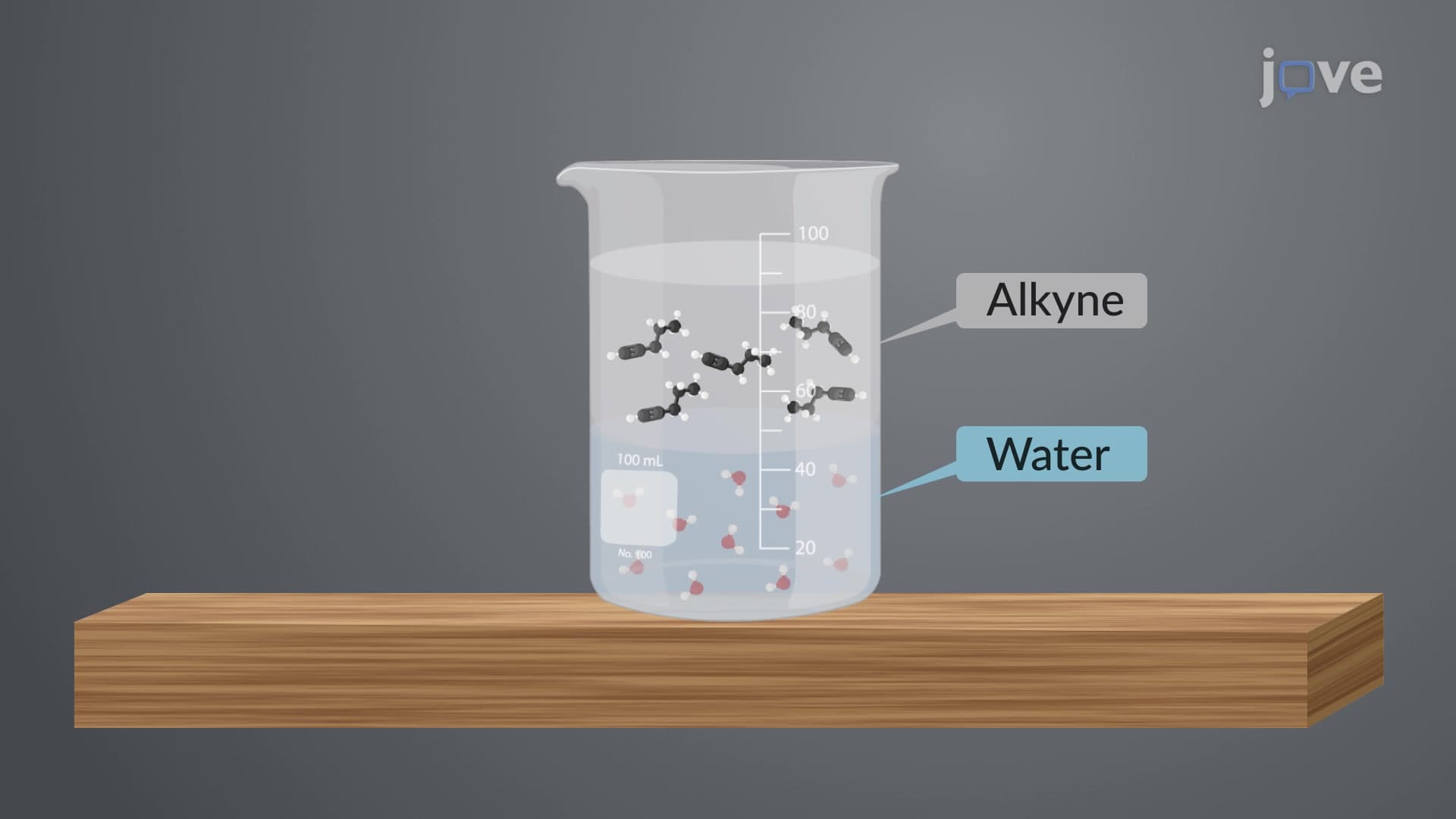
Alkynes exhibit typical nonpolar hydrocarbon behavior, remaining insoluble in water but readily dissolving in organic solvents like benzene or hexane. Their physical states follow predictable molecular weight trends: lower molecular weight alkynes like acetylene (C2H2) exist as gases, medium-weight compounds like 1-octyne (C8H14) are liquids, and higher molecular weight alkynes become solids at room temperature.
Understanding alkyne properties explains their diverse applications. Acetylene's high combustion energy makes it ideal for welding torches reaching temperatures above 3,000°C. In pharmaceuticals, alkyne groups appear in drugs like selegiline (Parkinson's treatment) and ethynylestradiol (oral contraceptives), where the rigid linear structure provides specific molecular recognition properties essential for biological activity.
Related Micro-courses