Loading video…


 12 Concepts
 143.3K views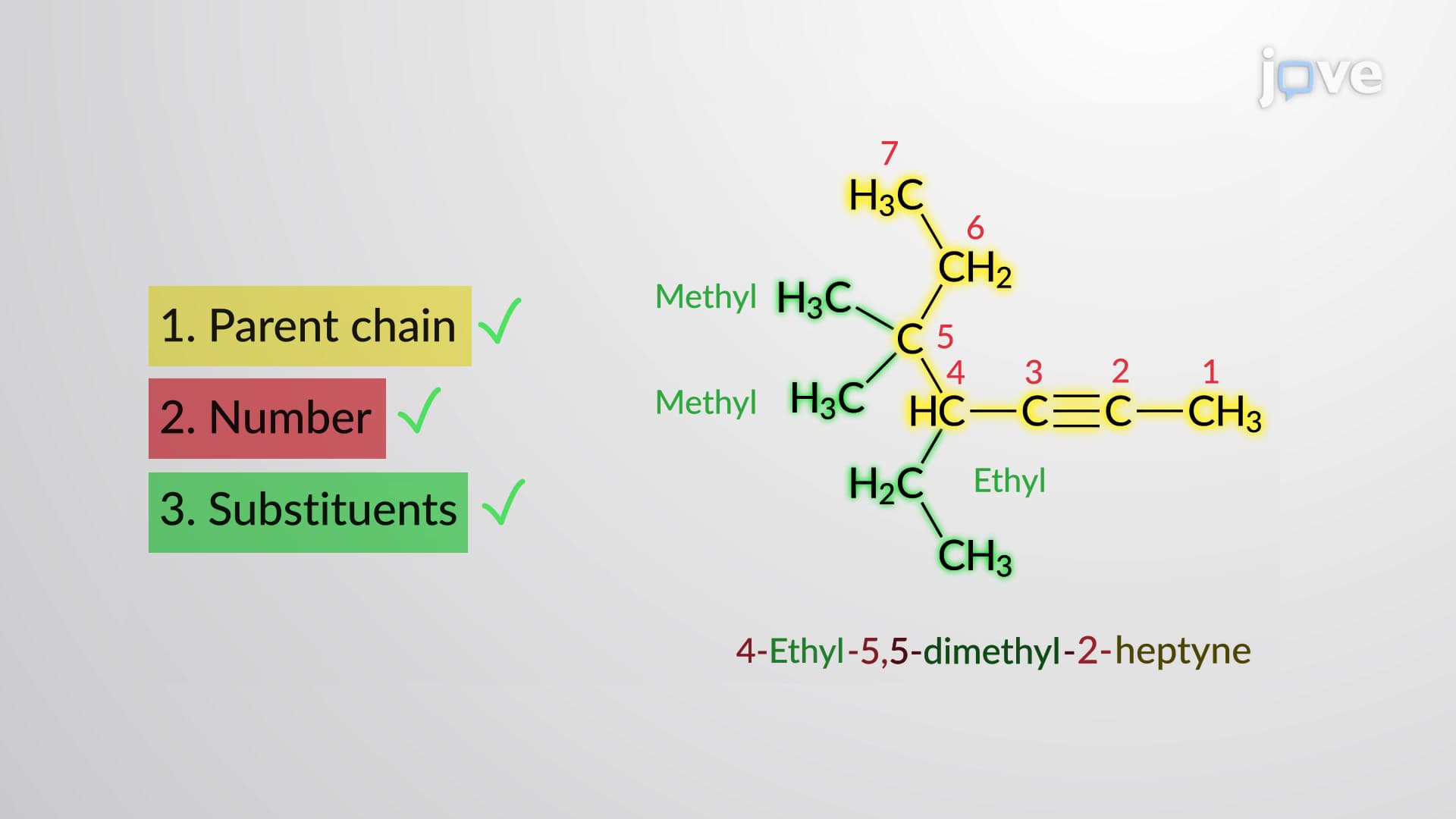

Video Summary: What are Nomenclature of Alkynes
Ever wondered how pharmaceutical companies name complex molecules containing triple bonds? The nomenclature of alkynes follows systematic rules that help chemists worldwide identify these carbon-carbon triple bond compounds precisely. From simple acetylene used in welding torches across American industrial sites to complex pharmaceutical intermediates, mastering alkyne naming conventions is essential for chemistry success. Understanding what are nomenclature of alkynes involves both IUPAC systematic naming and traditional common naming approaches. Watch the full video on JoVE Coach to master this concept with expert-led visuals and step-by-step explanations.
The nomenclature of alkynes represents a fundamental skill in organic chemistry, essential for students preparing for AP Chemistry exams and college-level coursework. Alkynes, characterized by carbon-carbon triple bonds, require specific naming conventions that build upon alkane and alkene nomenclature principles. The systematic approach ensures universal understanding among chemists, from undergraduate students at UCLA to pharmaceutical researchers developing new medications.
The International Union of Pure and Applied Chemistry (IUPAC) system provides the foundation for alkyne naming. The process begins with identifying the longest carbon chain containing the triple bond, which becomes the parent hydrocarbon. The characteristic -yne suffix replaces the -ane ending, creating names like propyne, butyne, or heptyne. Numbering the carbon chain follows a critical rule: triple bond carbons must receive the lowest possible numbers.
For substituted alkynes, systematic naming becomes more complex. Consider 4-ethyl-5,5-dimethyl-2-heptyne, where substituents are listed alphabetically before the parent name. This naming convention appears frequently on MCAT practice exams and college organic chemistry midterms. Students at institutions like MIT and Stanford encounter these naming patterns in introductory chemistry courses, where precision in nomenclature directly impacts problem-solving success.
When alkynes contain multiple triple bonds, the naming system incorporates -diyne, -triyne, or higher numerical prefixes. The compound 9-chloro-4-methoxy-2,6-decadiyne demonstrates this principle. More challenging scenarios arise when molecules contain both double and triple bonds. The alphabetical priority rule dictates that -ene precedes -yne in the name, as seen in 7-bromo-oct-5-ene-2-yne.
Functional group hierarchy becomes crucial when alkynes coexist with higher-priority groups like alcohols, aldehydes, or carboxylic acids. These functional groups receive the lowest numbering, while the alkyne portion maintains its -yn designation. For example, 5-methyl-2-hexyn-1-ol prioritizes the alcohol functionality while acknowledging the triple bond presence.
Traditional common nomenclature uses acetylene as the base name, with substituents added as prefixes. This system appears in industrial chemistry contexts across American manufacturing facilities. Dimethylacetylene (2-butyne) and diisopropylacetylene (2,5-dimethyl-3-hexyne) exemplify this approach. Understanding both systems proves valuable for students pursuing chemistry careers, as industrial literature often employs common names alongside IUPAC terminology.
Terminal versus internal alkyne classification provides additional structural insight. Terminal alkynes feature triple bonds at carbon chain ends, while internal alkynes have triple bonds between carbon atoms. This distinction impacts reactivity patterns studied in advanced organic chemistry courses at universities throughout the United States.
Related Micro-courses