Loading video…

- Organic Chemistry
- Carboxylic Acids
- Preparation of Carboxylic Acids: Hydrolysis of Nitriles
Micro-course: Carboxylic Acids





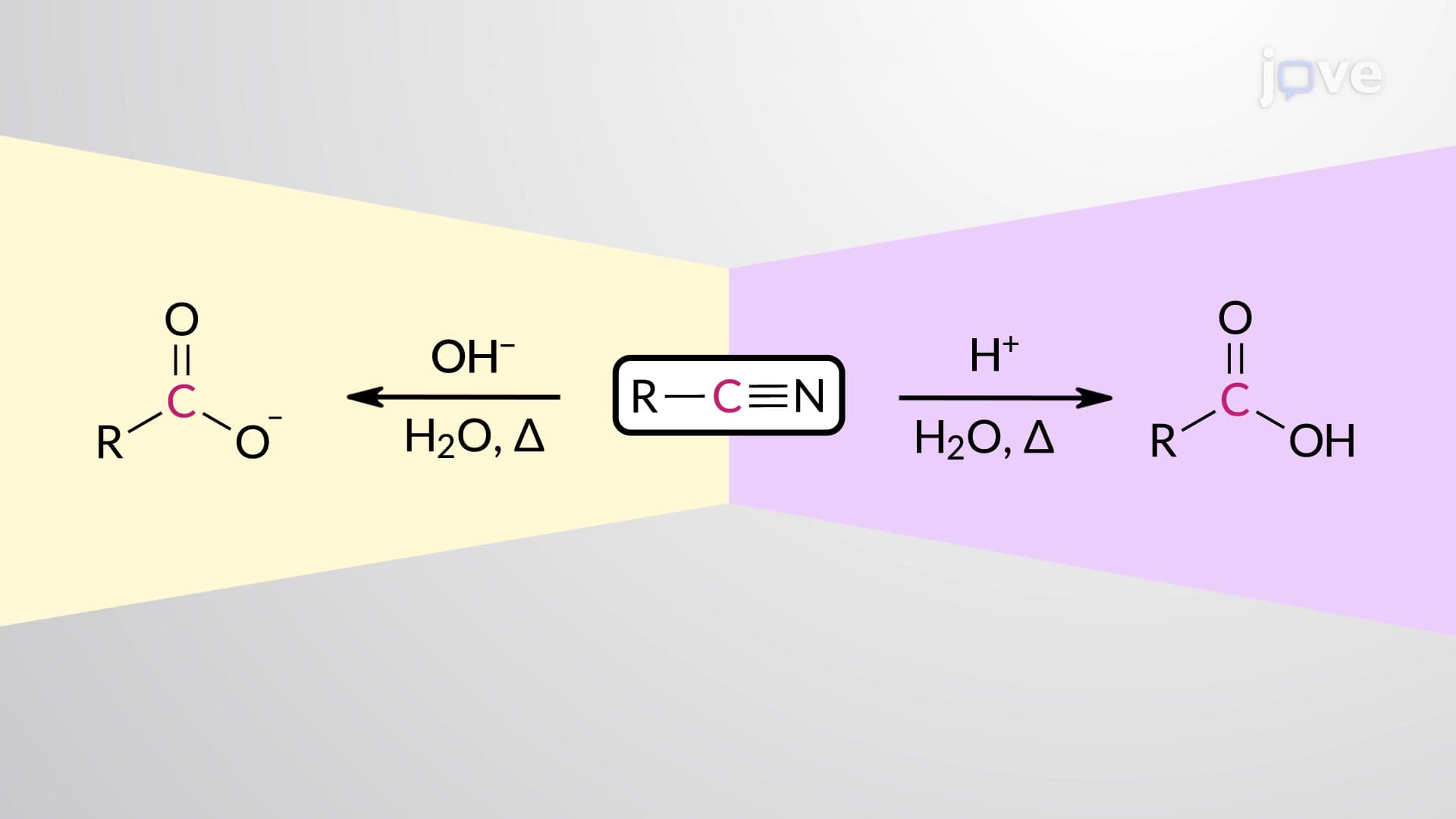
Ever wondered how pharmaceutical companies create life-saving medications like ibuprofen? The preparation of carboxylic acids hydrolysis is a crucial organic chemistry reaction that transforms nitriles into carboxylic acids through strategic water-based reactions. This process involves either acidic or basic conditions, with each pathway following distinct mechanistic steps that determine the final product. Companies like Pfizer and Johnson & Johnson rely on these synthetic pathways to manufacture anti-inflammatory drugs and other essential medications. Watch the full video on JoVE Coach to master this concept with expert-led visuals and step-by-step explanations.
- Understand the fundamental mechanism of preparation of carboxylic acids hydrolysis from nitriles under both acidic and basic conditions
- Identify the key intermediates formed during acid-catalyzed hydrolysis, including imidic acids and their tautomerization to amides
- Analyze why base-catalyzed conditions produce carboxylate anions while acidic conditions yield carboxylic acids directly
- Compare the electrophilicity changes in nitrile carbon atoms when nitrogen is protonated in acidic media
- Evaluate the role of water as a nucleophile in attacking the activated cyano carbon during the hydrolysis process
- Apply knowledge of this reaction to understand two-step conversions of haloalkanes to carboxylic acids with carbon chain extension
- Recognize real-world applications in pharmaceutical synthesis, particularly in ibuprofen production
- Explore the mechanistic differences between imidic acid formation and subsequent amide hydrolysis steps
Understanding Preparation of Carboxylic Acids Hydrolysis Fundamentals
The preparation of carboxylic acids hydrolysis represents one of organic chemistry's most versatile synthetic transformations. This reaction converts nitriles (compounds containing the cyano group, -C≡N) into carboxylic acids through water-mediated bond breaking and formation. Students encountering this topic in AP Chemistry, college organic chemistry courses, or preparing for the MCAT will find this reaction essential for understanding carbonyl chemistry and pharmaceutical synthesis.
Mechanistic Pathways: Acidic vs. Basic Conditions
Under acidic conditions, the mechanism begins with protonation of the nitrile nitrogen, creating a positively charged intermediate that dramatically increases the electrophilicity of the cyano carbon. This activation allows water, typically a weak nucleophile, to successfully attack the carbon center. The resulting intermediate undergoes deprotonation to form an imidic acid, which then tautomerizes through a two-step process involving protonation and subsequent deprotonation to yield a more stable amide intermediate.
Basic conditions follow a different pathway, directly producing carboxylate anions rather than neutral carboxylic acids. This distinction proves crucial in synthetic planning, as the final product's ionization state affects subsequent purification and reaction steps. College students studying for organic chemistry exams should note that the choice of acidic versus basic conditions often depends on the desired final product form and compatibility with other synthetic steps.
Industrial and Pharmaceutical Applications
The pharmaceutical industry extensively utilizes this transformation in drug synthesis. Ibuprofen production, manufactured by companies like Advil and Motrin, demonstrates this reaction's commercial importance. The synthetic route involves forming a nitrile intermediate from a haloalkane precursor, then applying base-catalyzed hydrolysis to generate the final carboxylic acid structure essential for the drug's anti-inflammatory properties.
Strategic Synthetic Considerations
This hydrolysis reaction serves as part of a powerful two-step sequence for converting haloalkanes to carboxylic acids while simultaneously extending the carbon chain by one unit. This transformation proves invaluable when synthesizing compounds requiring specific carbon frameworks, particularly in pharmaceutical and materials chemistry applications that students may encounter in advanced coursework or research experiences.
Frequently Asked Questions
Preparation of carboxylic acids hydrolysis is a fundamental reaction that converts nitriles into carboxylic acids using water under either acidic or basic conditions. This transformation is crucial because it allows chemists to synthesize carboxylic acids while extending carbon chains, making it essential for pharmaceutical manufacturing and organic synthesis. Students studying for AP Chemistry or college organic chemistry exams frequently encounter this reaction as it demonstrates key concepts like nucleophilic attack, tautomerization, and mechanistic pathways.
The MCAT often tests this reaction within broader organic chemistry passages, particularly focusing on mechanism identification and product prediction. Focus on understanding the difference between acidic and basic hydrolysis conditions, recognizing intermediate structures like imidic acids and amides, and predicting final products. Practice drawing complete mechanisms and identifying the role of water as a nucleophile, as these skills translate directly to MCAT success.
Acid-catalyzed hydrolysis produces neutral carboxylic acids as final products, while base-catalyzed hydrolysis generates carboxylate anions (the conjugate base form). The acidic pathway involves protonation of the nitrile nitrogen first, making the carbon more electrophilic, whereas basic conditions directly attack the nitrile and ultimately deprotonate the final carboxylic acid. Understanding this difference is crucial for synthetic planning and predicting reaction outcomes in college organic chemistry courses.
Pharmaceutical companies use this reaction extensively in drug synthesis, with ibuprofen being a prime example manufactured by companies like Pfizer and Johnson & Johnson. The process involves converting a haloalkane to a nitrile, then applying base hydrolysis to create the carboxylic acid group essential for ibuprofen's anti-inflammatory activity. This synthetic route allows for efficient, large-scale production of medications that millions of Americans use daily for pain relief.
This reaction is absolutely accessible to motivated high school students, especially those in AP Chemistry or preparing for college. You need a solid understanding of basic organic chemistry concepts like electronegativity, nucleophiles, and simple mechanisms. The key is practicing mechanism drawing and understanding the logical flow of electron movement, skills that build naturally from foundational chemistry knowledge taught in most US high schools.
Instead of pure memorization, focus on understanding the logical sequence: protonation activates the nitrile, water attacks the activated carbon, and subsequent steps stabilize the intermediate through tautomerization. Practice drawing the mechanism repeatedly while explaining each step's purpose aloud. Create flashcards for key intermediates like imidic acids and understand why each transformation occurs, which helps with both multiple-choice questions and free-response problems on college exams.
Build on this foundation by studying other carbonyl chemistry reactions like ester hydrolysis, amide formation, and Fischer esterification. These reactions share similar mechanistic principles and frequently appear together in college organic chemistry courses. Additionally, explore other nitrile chemistry reactions and multi-step synthesis problems that combine this hydrolysis with other transformations, as these skills prove essential for advanced coursework and standardized exams.
Related Micro-courses
28 Concepts


Related Subjects
 Analytical Chemistry 16 micro-courses›
 Chemistry 21 micro-courses›