Loading video…

 12 Concepts
 109.2K views

Video Summary: What Is Entropy and Solvation
Ever wonder why oil and water refuse to mix, no matter how hard you shake them? The answer lies in entropy solvation, a fascinating phenomenon where molecular chaos drives separation. When pharmaceutical companies at Johnson & Johnson develop new drug formulations, they must understand how entropy changes during solvation affect drug solubility and bioavailability. What is Entropy And Solvation reveals how molecular disorder and energy drive solution formation, explaining everything from drug delivery to environmental cleanup processes. Watch the full video on JoVE Coach to master this concept with expert-led visuals and step-by-step explanations.
Entropy solvation represents the fundamental thermodynamic principle governing how molecules interact in solution. When substances dissolve, entropy changes determine whether the process occurs spontaneously. This concept appears regularly on AP Chemistry exams and MCAT questions, making it essential for pre-med students to master.
The entropy of mixing (S mixing) describes the natural tendency of molecules to disperse and increase disorder. Unlike enthalpy changes that depend on intermolecular forces, entropy changes during mixing arise purely from increased molecular arrangements. Consider what happens when you add salt to water for IV fluid preparation at Mayo Clinic, sodium and chloride ions spontaneously disperse throughout the solution because this arrangement maximizes entropy.
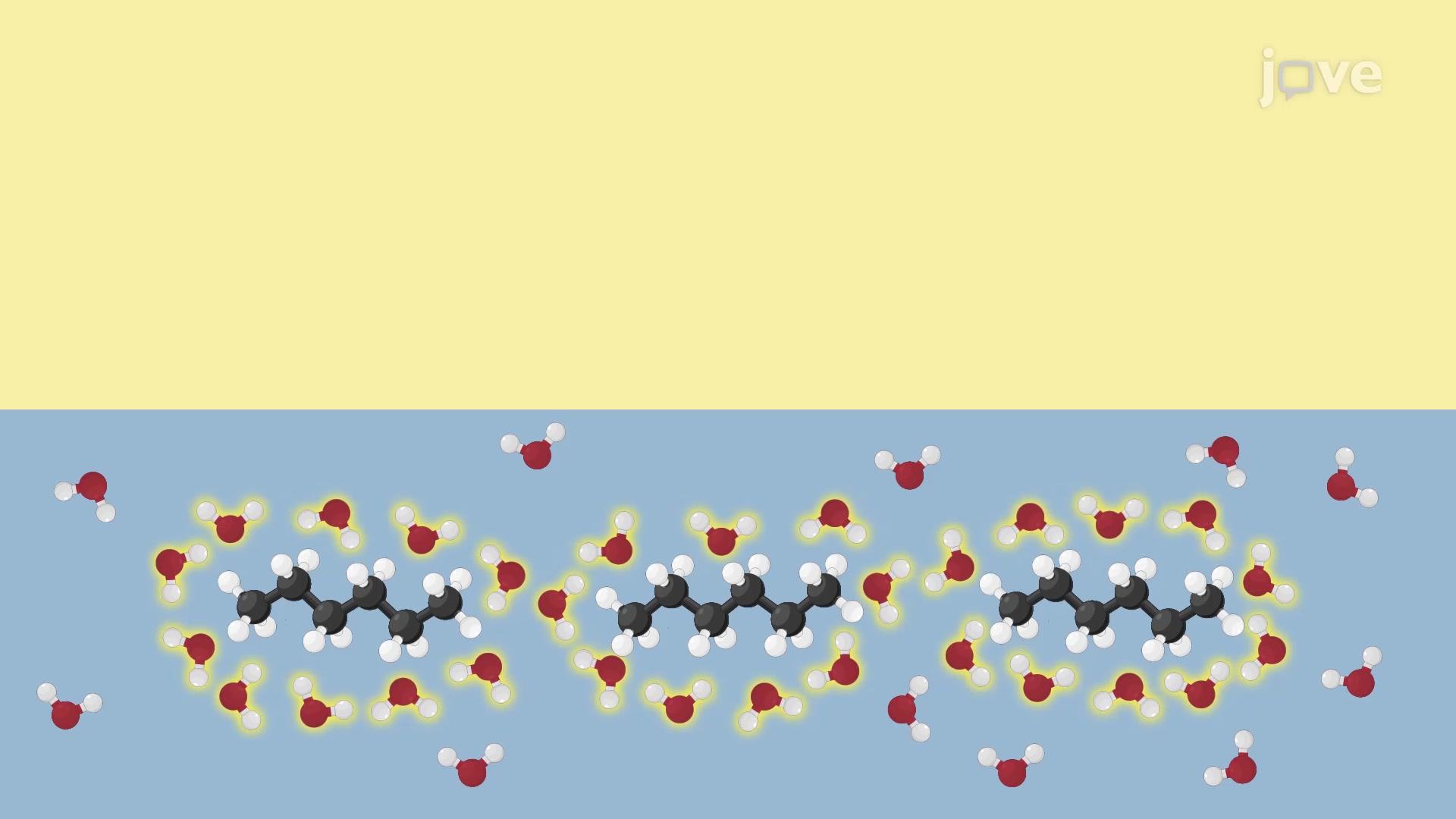
During solution formation, solute molecules gain configurational freedom while becoming surrounded by solvent shells, ordered arrangements of solvent molecules. These solvent cages represent regions of decreased entropy compared to bulk solvent, creating a thermodynamic trade-off that determines solubility.
The hydrophobic effect demonstrates entropy's power in biological systems. When hydrocarbon molecules cluster together in water, they release highly ordered water molecules from their solvent shells back into bulk solution. This entropy increase drives protein folding, cell membrane formation, and drug-target interactions.
Pharmaceutical researchers at Pfizer exploit this principle when designing medications. Hydrophobic drug molecules naturally aggregate, affecting bioavailability and requiring careful formulation strategies. Understanding entropy changes helps predict which drug delivery systems will work most effectively.
Students encounter entropy and solvation concepts across multiple contexts. AP Chemistry students analyze spontaneity using entropy calculations, while college biochemistry courses explore how entropy drives enzyme-substrate interactions. Medical students preparing for USMLE Step 1 must understand how entropy affects drug distribution and membrane transport.
Research laboratories at institutions like Stanford University use these principles to develop new materials, from self-assembling nanoparticles to advanced water purification systems. Environmental engineers apply entropy concepts when designing remediation strategies for contaminated groundwater sites across the United States.
Related Micro-courses