Loading subject page…


80,630 views

Video Summary: Magnetic Field Due to Two Explained
Ever wonder why power lines are carefully spaced apart? The magnetic field due to two parallel conductors creates fascinating interference patterns that electrical engineers must consider when designing transmission systems. When two parallel wires carry current in opposite directions-like in household electrical circuits across America-their magnetic fields interact in predictable ways. The Magnetic Field Due To Two Explained concept reveals how these fields add vectorially at different points, creating stronger fields between the conductors and weaker fields at distant points. Watch the full video on JoVE Coach to master this concept with expert-led visuals and step-by-step explanations.
The magnetic field due to two conductors represents a fundamental application of electromagnetic superposition principles. When two infinitely long, parallel conductors carry current, each generates its own magnetic field following Ampère's law. The net field at any point results from the vector sum of individual field contributions, making this concept essential for AP Physics students and college-level electromagnetic courses.
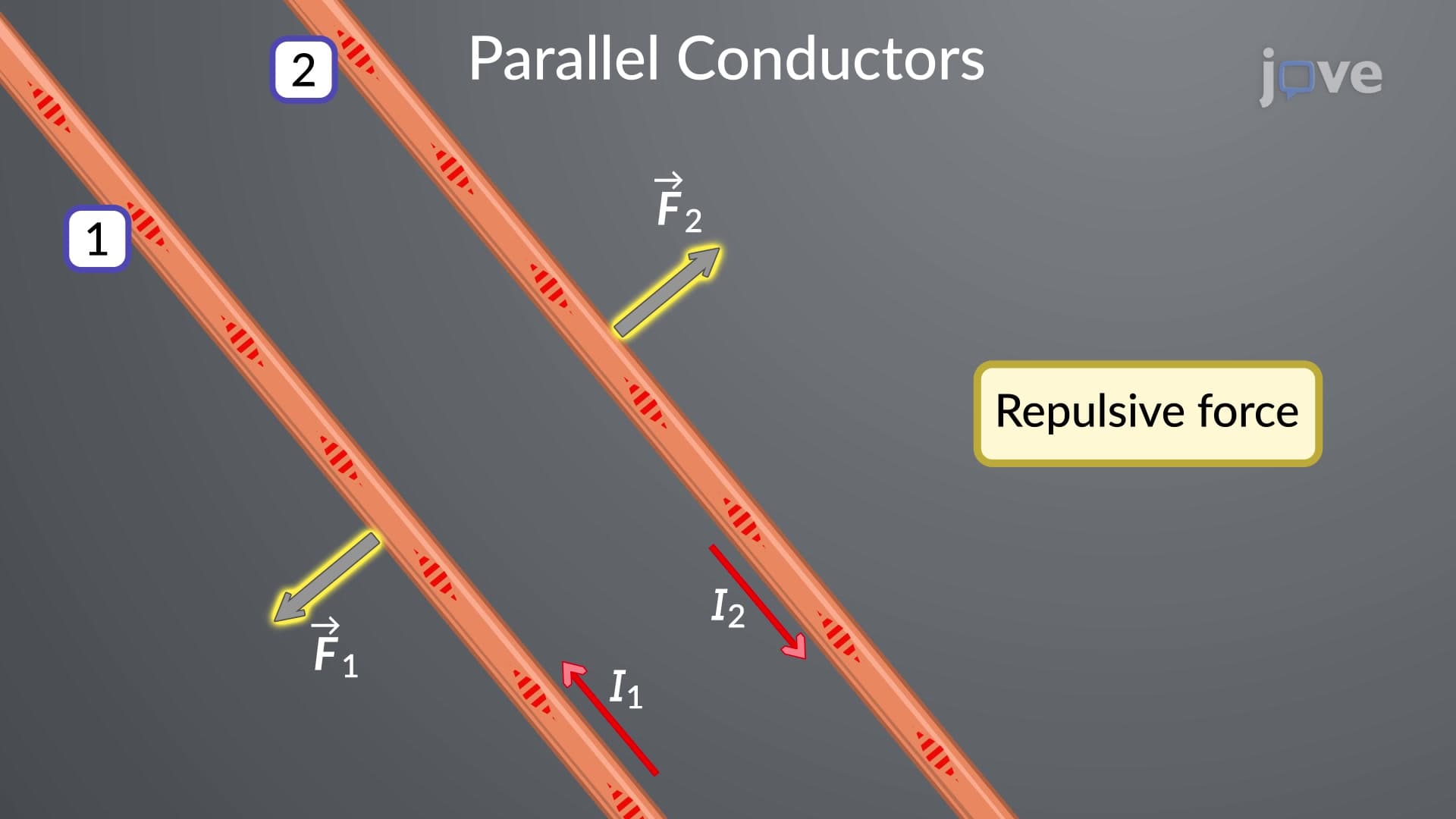
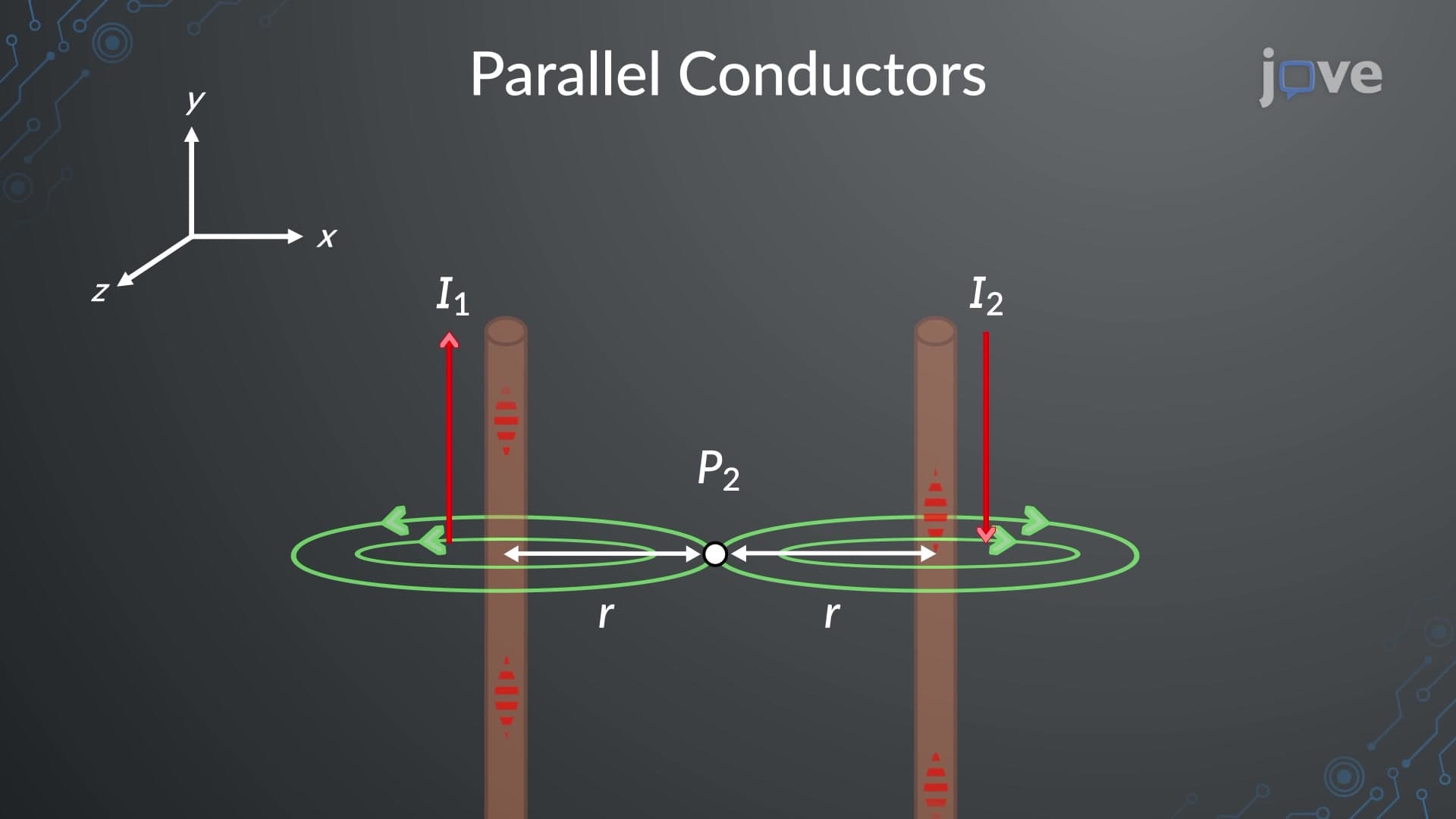
The key insight lies in understanding how magnetic fields combine. For two parallel conductors carrying currents in opposite directions, the magnetic field lines form concentric circles around each wire. At the midpoint between conductors, these circular field patterns align in the same direction, causing field magnitudes to add rather than cancel. This constructive interference occurs because the right-hand rule produces fields pointing the same way at this specific location.
The magnetic field strength follows predictable mathematical patterns. For a single straight conductor, field strength B = (μ₀I)/(2πr), where μ₀ represents permeability of free space, I equals current, and r indicates distance. With two conductors, the superposition principle requires vector addition of individual field contributions. At the midpoint, both fields point identically, so B(net) = B₁ + B₂. This relationship appears frequently on MCAT physics sections and college electromagnetic exams.
Understanding dual-conductor magnetic fields proves crucial for electrical engineers designing power transmission systems across the United States. High-voltage transmission lines use carefully calculated spacing to minimize electromagnetic interference with nearby equipment. Similarly, household electrical circuits employ hot and neutral wires carrying opposing currents, creating field cancellation that reduces electromagnetic radiation. Students studying electrical engineering at institutions like MIT or Caltech encounter these principles in introductory circuits courses, while pre-med students see applications in medical imaging technologies like MRI systems that rely on precise magnetic field control.
Related Micro-courses