Loading subject page…

- Physics
- Sources of Magnetic Fields
- Magnetic Force Between Two Parallel Currents
Micro-course: Sources of Magnetic Fields
80,625 views
Learn key concepts and earn your certificate.










Magnetic Force Between Two Parallel Currents

00:00
01:13
Video Summary: Magnetic Force Between Two Parallel Currents Explained
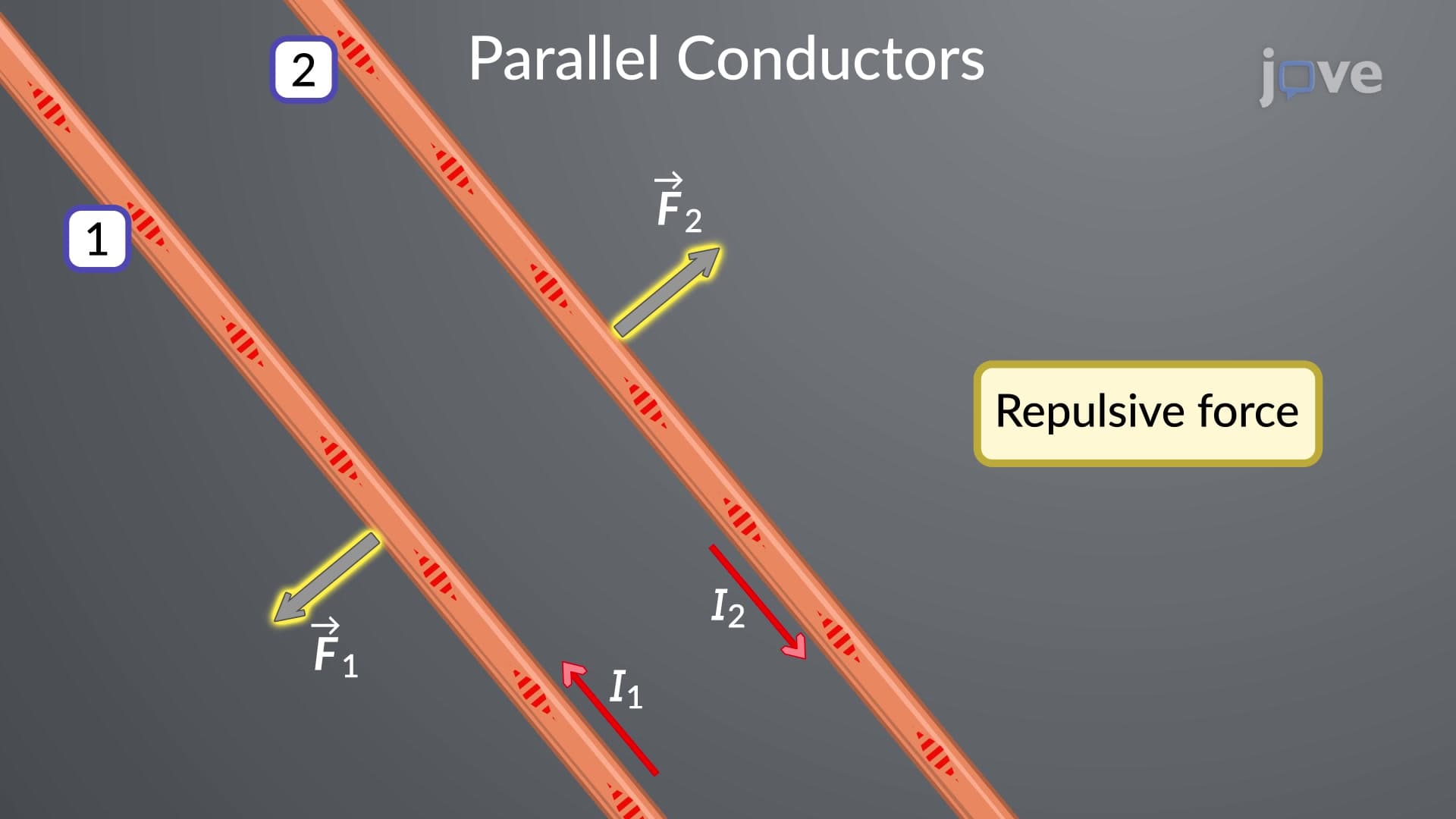
Ever wonder why power lines don't fall apart despite carrying massive currents? The magnetic force between two parallel currents creates either attraction or repulsion depending on current direction-the same principle that keeps electrical transmission systems stable across the US power grid. When currents flow in the same direction, conductors attract each other with a force proportional to both current magnitudes and inversely related to their separation distance. This fundamental electromagnetic phenomenon explains everything from transformer design to the behavior of superconducting magnets in MRI machines. Watch the full video on JoVE Coach to master this concept with expert-led visuals and step-by-step explanations.
- Understand how magnetic force between two parallel currents arises from the interaction of magnetic fields generated by current-carrying conductors
- Identify the mathematical relationship F = (μ₀I₁I₂L)/(2πd) that governs force magnitude between parallel current-carrying wires
- Analyze the direction of magnetic forces using the right-hand rule to predict whether currents will attract or repel
- Compare attractive forces (same-direction currents) versus repulsive forces (opposite-direction currents) in parallel conductor systems
- Evaluate how distance and current magnitude affect the strength of magnetic interactions between conductors
- Apply magnetic force principles to solve quantitative problems involving parallel wire configurations
- Recognize real-world applications in electrical power transmission, electromagnets, and magnetic levitation systems
- Explore the connection between Ampère's law and the magnetic fields that create forces between current-carrying conductors
Understanding Magnetic Force Between Two Parallel Currents
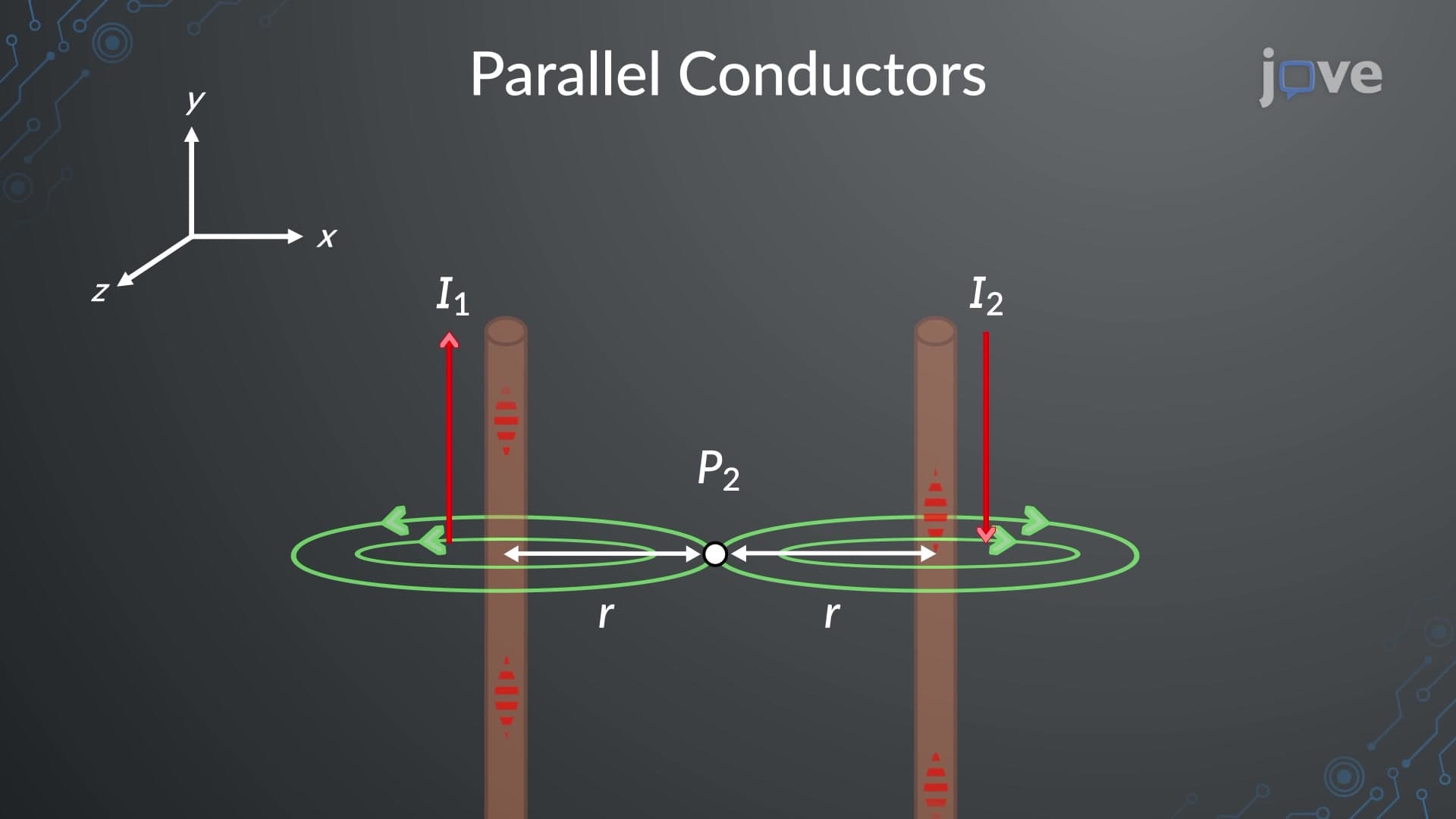
The magnetic force between two parallel currents represents one of electromagnetism's most elegant demonstrations of how electric currents create magnetic fields that exert forces on other currents. This phenomenon occurs because every current-carrying conductor generates a circular magnetic field around itself, and when two such conductors are placed parallel to each other, their magnetic fields interact to produce attractive or repulsive forces.
The Physics Behind Current-Induced Magnetic Forces
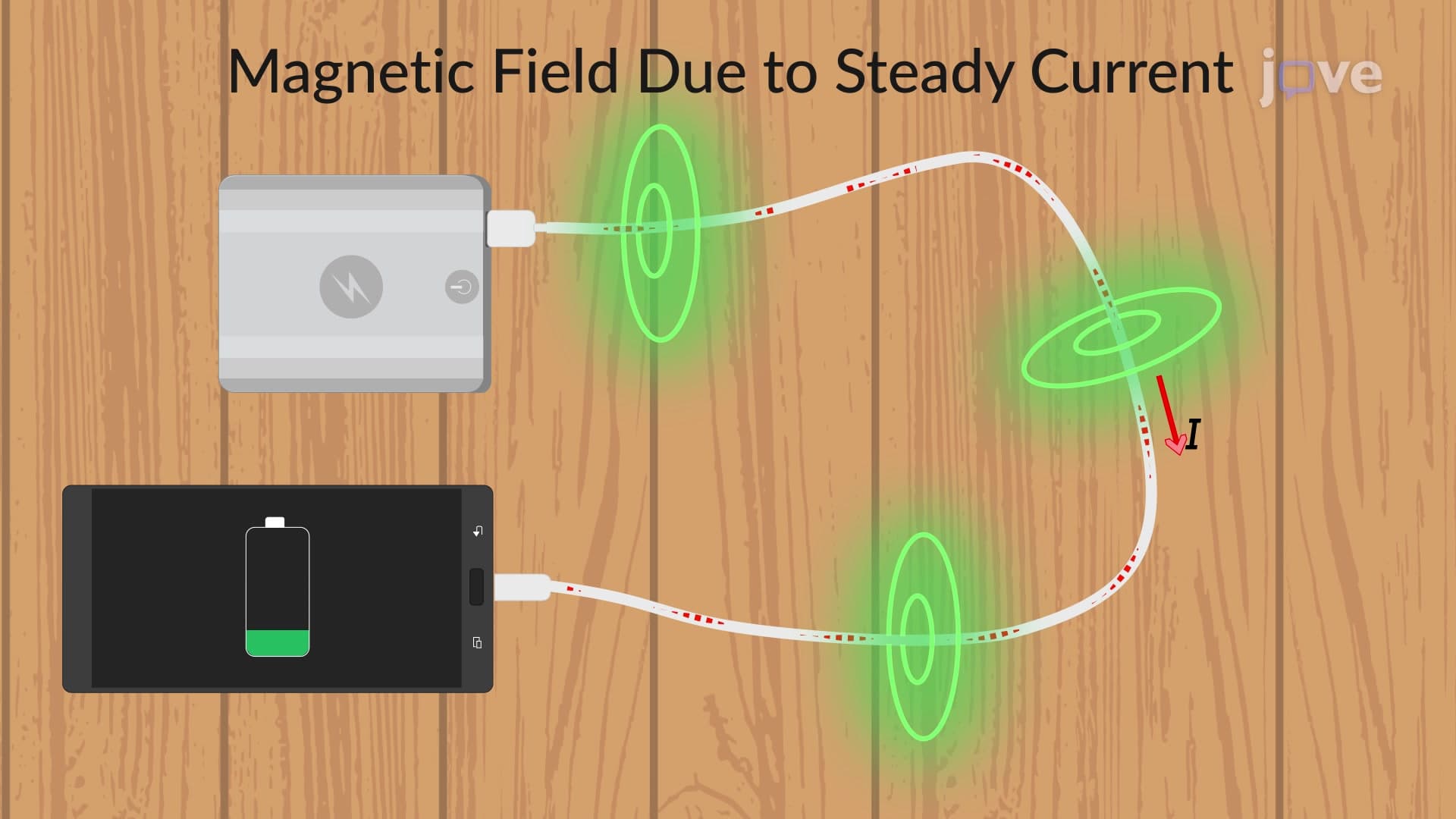
When current flows through a conductor, it creates a magnetic field that follows Ampère's law. For an infinitely long straight wire carrying current I, the magnetic field at distance r is B = μ₀I/(2πr), where μ₀ is the permeability of free space. This field is circular and perpendicular to both the current direction and the radial distance vector.
The force on a second parallel conductor results from the interaction between its current and the magnetic field created by the first conductor. Using the Lorentz force law F = IL × B, we derive the force per unit length as F/L = μ₀I₁I₂/(2πd), where I₁ and I₂ are the currents and d is the separation distance.
Direction Rules and Practical Applications
The right-hand rule determines force direction: when currents flow in the same direction, the magnetic force is attractive; when currents flow in opposite directions, the force is repulsive. This principle has crucial applications in US electrical infrastructure, including three-phase power transmission systems where conductor spacing must account for magnetic forces during high-current fault conditions.
Real-World Examples and Exam Relevance
Power grid engineers use these calculations when designing transmission line towers-the massive currents during electrical faults can create forces exceeding several tons per meter of conductor length. Similarly, particle accelerators like Fermilab's Tevatron rely on precise magnetic force calculations for beam focusing systems.
Students encounter this topic extensively on AP Physics C exams, college electromagnetism courses, and MCAT physics sections. Practice problems typically involve calculating forces between bus bars in electrical panels, analyzing forces in electromagnet windings, or determining optimal spacing for parallel conductors in transformers.
Frequently Asked Questions
Magnetic force between two parallel currents occurs when current-carrying conductors create magnetic fields that interact with each other. Same-direction currents attract while opposite-direction currents repel, with force magnitude following F = μ₀I₁I₂L/(2πd). This fundamental electromagnetic principle governs everything from power line design to MRI magnet construction.
AP Physics C frequently includes parallel current problems in both multiple-choice and free-response sections. Expect calculations involving force magnitude, direction determination using right-hand rules, and applications to solenoids or transmission lines. Practice with both qualitative explanations and quantitative problem-solving using the standard force equation.
The MCAT tests this concept through electromagnetic induction, motor principles, and medical imaging technology questions. Focus on understanding how parallel current interactions apply to MRI machines, defibrillator circuits, and cardiac pacemaker electromagnetic interference. Practice relating microscopic current interactions to macroscopic medical device function.
US power grids use parallel current calculations for transmission line design, transformer construction, and electrical panel layout. During fault conditions, distribution lines carrying thousands of amperes can experience forces exceeding 50 pounds per foot, requiring robust mechanical support systems. Electric vehicle charging stations also incorporate these principles for high-current cable management.
This topic builds naturally on basic magnetic field concepts and vector operations typically covered in Physics 2 or AP Physics C. Students who understand right-hand rules and basic calculus can master parallel current forces. The mathematical relationships are straightforward once you grasp the underlying field interactions.
Practice identifying current directions first, then apply the right-hand rule systematically for force direction. Master the force equation derivation and work through various scenarios including attractive/repulsive cases. Create concept maps connecting parallel currents to motors, generators, and transmission systems for deeper understanding.
Progress to electromagnetic induction, Faraday's law, and Lenz's law to understand how changing magnetic fields create electric fields. These concepts connect parallel current forces to generator operation, transformer design, and electromagnetic wave propagation. Consider exploring applications in renewable energy systems and wireless power transmission.
University electromagnetism courses expand parallel current analysis to include finite-length conductors, non-parallel geometries, and time-varying currents. Advanced topics include magnetic pressure in plasma physics, superconducting magnet design, and electromagnetic field energy calculations. These foundations prove essential for electrical engineering and physics majors.
Related Micro-courses