Loading subject page…


80,630 views

Video Summary: What Is Ferromagnetism
Ever wondered why your refrigerator magnets stick so strongly while others barely hold? Ferromagnetism is the powerful magnetic phenomenon behind permanent magnets, where atomic magnetic moments align in parallel domains. Unlike temporary magnetism, ferromagnetic materials like the iron in American steel production retain their magnetization even after removing external magnetic fields through a property called hysteresis. This creates the strong, permanent magnets essential in everything from MRI machines at Mayo Clinic to electric motors in Tesla vehicles. Watch the full video on JoVE Coach to master this concept with expert-led visuals and step-by-step explanations.
Ferromagnetism represents one of nature's most practically important magnetic phenomena. At its core, ferromagnetism occurs when unpaired electrons in atoms create permanent magnetic moments that naturally align parallel to each other within microscopic regions called magnetic domains. This parallel alignment distinguishes ferromagnetic materials from paramagnetic substances, where magnetic moments align randomly.
The key to understanding ferromagnetism lies in magnetic domains-microscopic regions where millions of atomic magnetic moments point in the same direction. In an unmagnetized ferromagnetic material like iron, these domains orient randomly, resulting in zero net magnetization. However, when an external magnetic field is applied, domains aligned with the field grow larger while opposing domains shrink. This domain wall movement creates the characteristic strong magnetic response.
Students preparing for AP Physics or college-level materials science courses should understand that this domain behavior explains why ferromagnets can be permanently magnetized. The Stanford Linear Accelerator Center uses this principle in their particle beam focusing magnets, where precise magnetic field control is essential.
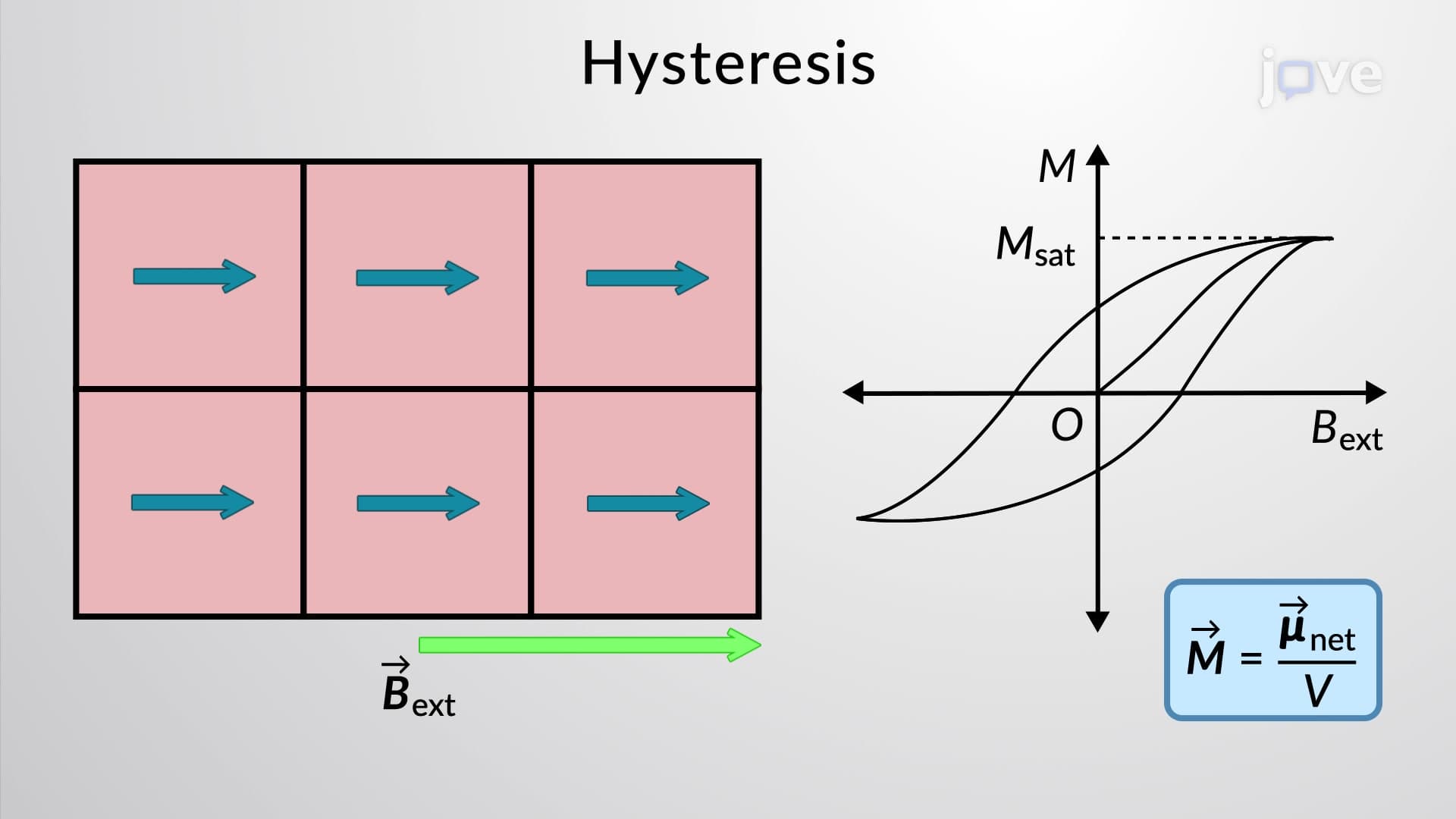
Hysteresis represents ferromagnetism's most distinctive feature-the ability to "remember" previous magnetization. When plotting magnetization versus applied field strength, ferromagnets trace a characteristic loop rather than a simple curve. This occurs because domains don't immediately return to random orientations when the external field is removed.
The coercive field-the reverse field strength needed to reduce magnetization to zero-varies significantly among ferromagnetic materials. Soft ferromagnets like pure iron have low coercive fields, making them ideal for transformer cores in electrical grids. Hard ferromagnets like neodymium-iron-boron alloys require strong reverse fields, making them perfect for permanent magnets in wind turbines manufactured by General Electric.
Every ferromagnetic material has a critical temperature called the Curie point, above which thermal energy disrupts the parallel alignment of magnetic moments. Beyond this temperature, ferromagnets become paramagnetic, losing their ability to maintain permanent magnetization. For iron, this transition occurs at 770°C (1418°F), which explains why heating destroys permanent magnets-a principle used in magnetic data destruction for secure disposal of hard drives containing sensitive information.
MCAT students should remember that ferromagnetic permeability is much greater than unity (often 1000-100,000 times that of free space), resulting in extremely high positive magnetic susceptibility values that enable the strong magnetic responses observed in applications from MRI contrast agents to magnetic levitation trains being developed at Johns Hopkins University.
Related Micro-courses