Loading video…


 22 Concepts
 80.6K views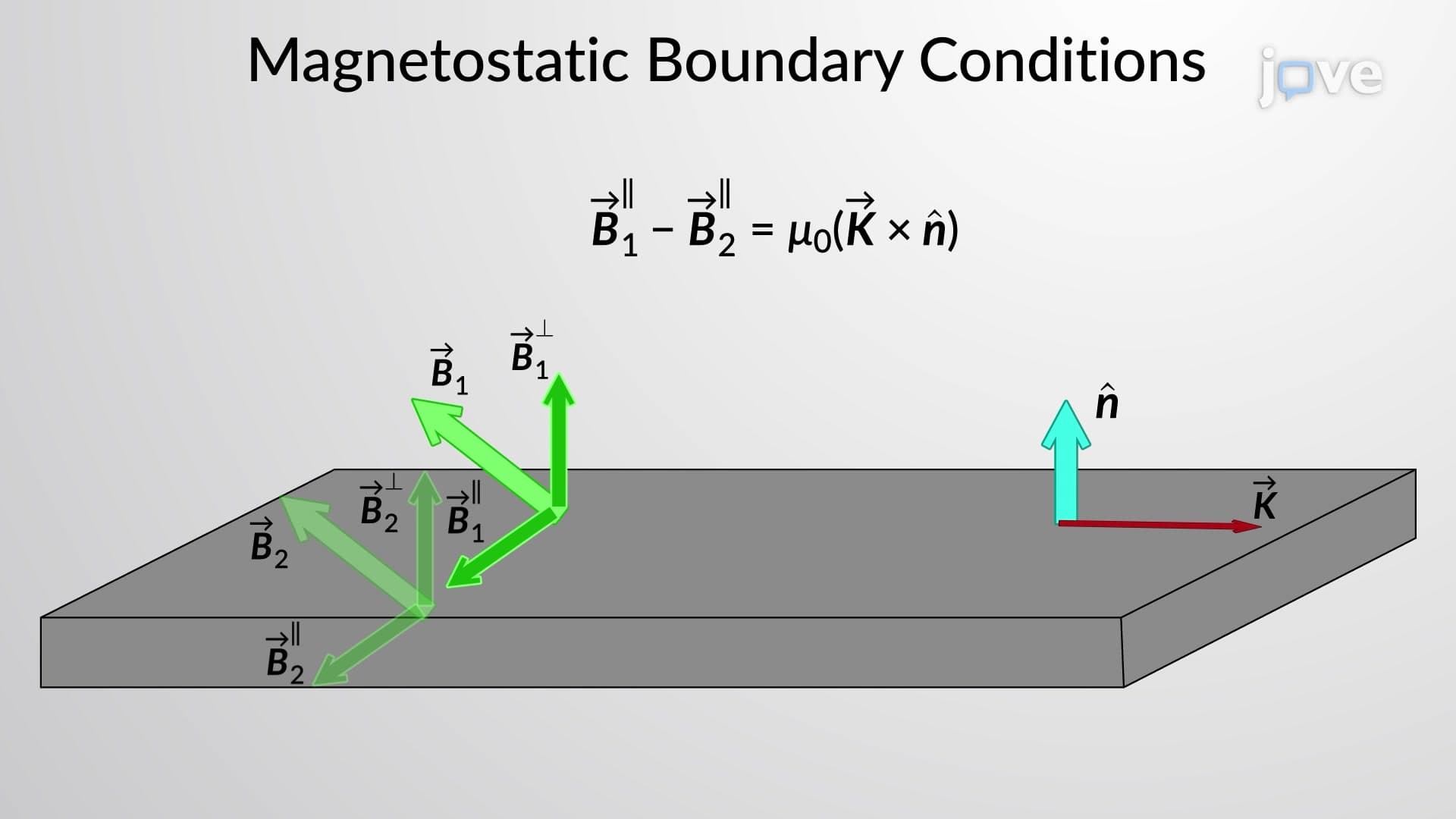

Video Summary: What Is Magnetostatic Boundary Conditions
Ever wonder why MRI machines can produce such detailed images of your brain tissue? The secret lies in magnetostatic boundary conditions, the fundamental rules governing how magnetic fields behave when crossing from one material to another. These principles explain why magnetic fields remain continuous in normal components but become discontinuous in tangential components at material interfaces, just like how different tissues in medical imaging respond uniquely to magnetic fields. Understanding what is magnetostatic boundary conditions helps explain everything from transformer design to medical diagnostics. Watch the full video on JoVE Coach to master this concept with expert-led visuals and step-by-step explanations.
Magnetostatic boundary conditions represent the essential rules that magnetic fields must obey when transitioning between different materials. These conditions arise from Maxwell's equations and determine how magnetic properties change at interfaces between materials with different magnetic permeabilities. In practical terms, these principles govern the operation of countless devices from power transformers in electrical grids to the gradient coils in hospital MRI machines.
The concept becomes crucial when analyzing magnetic circuits, designing electromagnetic devices, and understanding how magnetic fields interact with biological tissues in medical applications. For students preparing for AP Physics C or college-level electromagnetic theory courses, mastering these boundary conditions provides the foundation for advanced topics in electrical engineering and medical physics.
The normal component of magnetic flux density (B) remains continuous across any boundary between magnetic materials. This continuity stems directly from Gauss's law for magnetism, which states that the divergence of B equals zero everywhere. When applying this law to a thin Gaussian pillbox straddling the boundary, the net magnetic flux through the closed surface must be zero.
This principle has profound practical implications. In transformer cores used throughout the US power grid, the continuous normal component ensures efficient magnetic flux transfer between primary and secondary windings. Similarly, in magnetic resonance imaging systems at hospitals like Mayo Clinic or Cleveland Clinic, the continuous normal component allows precise control of magnetic field penetration into patient tissues.
Unlike the normal component, the tangential component of magnetic fields can exhibit discontinuities at boundaries, particularly when surface currents are present. Applying Ampère's law to a rectangular Amperian loop that straddles the boundary reveals that tangential components of the magnetic field intensity (H) become discontinuous in the presence of surface current density.
This discontinuity follows the relationship: n × (H2 - H1) = Ks, where n represents the unit normal vector and Ks denotes the surface current density. This principle explains why magnetic shielding materials used in sensitive equipment at national laboratories like Fermilab require specific geometric configurations to redirect magnetic field lines effectively.
These boundary conditions find extensive application in designing magnetic circuits for power systems, electric motors, and medical devices. Power engineers at companies like General Electric apply these principles when designing transformer cores that minimize energy losses. The discontinuity conditions help predict magnetic field distributions in complex geometries, enabling optimization of magnetic flux paths.
In biomedical applications, understanding these conditions helps medical physicists design MRI gradient coils that produce precisely controlled magnetic field variations for imaging. The boundary conditions also explain how magnetic nanoparticles behave at tissue interfaces in experimental cancer treatments being developed at institutions like Stanford Medical Center and Johns Hopkins Hospital.
Related Micro-courses