Loading subject page…


154,200 views

Video Summary: Relative Velocity in One Dimensional Motion
Ever wonder why a person walking on a moving airport walkway seems to glide effortlessly past stationary observers? Relative velocity in one-dimensional motion explains this everyday phenomenon by comparing how fast objects move from different reference frames. When a traveler at Chicago O'Hare walks forward on a moving walkway, their speed relative to the terminal floor combines both their walking speed and the walkway's speed. Watch the full video on JoVE Coach to master this concept with expert-led visuals and step-by-step explanations.
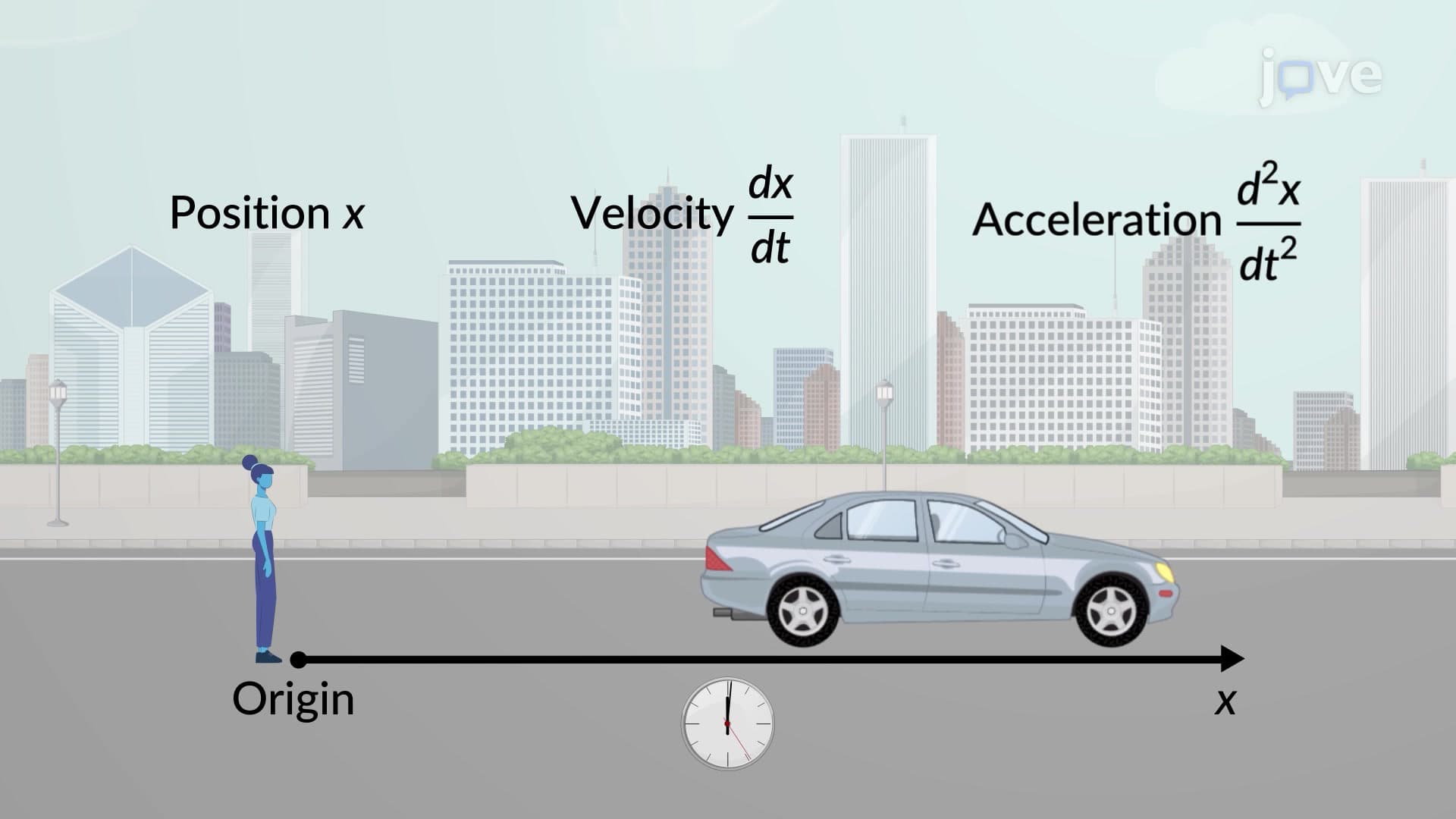
Relative velocity in one-dimensional motion forms the cornerstone of kinematics, describing how velocity measurements depend entirely on the observer's reference frame. A reference frame consists of a coordinate system with a time scale that allows observers to measure and describe an object's motion. The key insight is that velocity is not absolute-it's always measured relative to something else.
Consider this practical scenario: you're driving 60 mph on Interstate 95 while another car travels 70 mph in the same direction. To a roadside observer, both cars have their respective speeds. However, from your perspective inside the slower car, the faster car appears to move at only 10 mph relative to you. This demonstrates how relative velocity in one-dimensional motion depends on the chosen reference frame.
The relative velocity equation provides a systematic approach: v(A relative to C) = v(A relative to B) + v(B relative to B). This vector equation accounts for the direction of motion. When objects move in the same direction, velocities add; when they move in opposite directions, velocities subtract.
For the walkway example from the transcript: if a person walks at 1 m/s relative to a walkway moving at 2 m/s relative to the ground, the person's velocity relative to the ground becomes 1 + 2 = 3 m/s. This problem-solving approach-listing knowns and unknowns, writing the governing equation, then substituting values-mirrors the methodology emphasized in AP Physics courses and college mechanics classes.
Relative velocity in one-dimensional motion appears frequently in standardized tests including the AP Physics 1 exam, SAT Subject Tests, and college physics midterms. Students encounter these concepts when analyzing scenarios involving trains passing each other, boats crossing rivers (in one-dimensional simplification), or athletes running on treadmills.
Consider a practical application: emergency responders calculating response times. If an ambulance travels 45 mph through city traffic while the average traffic flow moves at 25 mph in the same direction, the ambulance's relative speed through traffic is 20 mph-crucial information for dispatch planning.
Success with relative velocity in one-dimensional motion requires careful attention to reference frames and sign conventions. Students often struggle when objects move in opposite directions, forgetting to account for negative values. The systematic approach-define reference frames clearly, establish a coordinate system, then apply the relative velocity equation-prevents these common errors and builds confidence for more complex two-dimensional problems encountered in advanced physics courses.
Related Micro-courses