Loading subject page…

- Physics
- Motion in Two or Three Dimensions
- Uniform Circular Motion
Micro-course: Motion in Two or Three Dimensions
154,200 views
Learn key concepts and earn your certificate.




Uniform Circular Motion

00:00
01:14
Video Summary: What Is Uniform Circular Motion
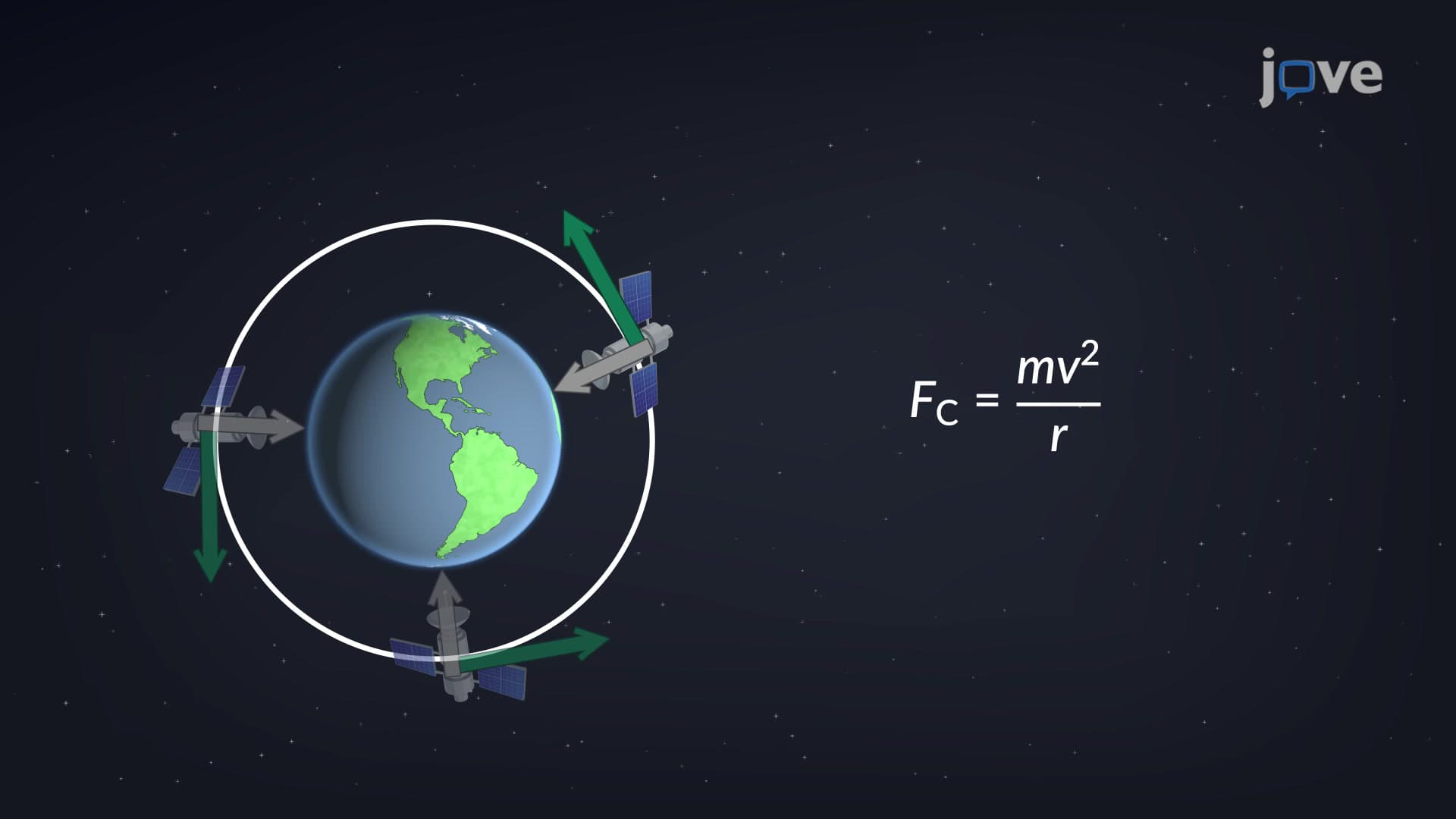
Ever wonder why satellites stay in orbit around Earth without flying off into space? Uniform circular motion explains this phenomenon perfectly, objects moving in perfect circles at constant speed while continuously changing direction. The International Space Station, orbiting 250 miles above us, demonstrates uniform circular motion as it completes one orbit every 90 minutes at 17,500 mph. This fundamental physics concept reveals how centripetal force keeps objects on their circular paths. Watch the full video on JoVE Coach to master this concept with expert-led visuals and step-by-step explanations.
- Understand what is uniform circular motion and distinguish it from linear motion and non-uniform circular motion
- Identify the key characteristics: constant speed, changing velocity direction, and continuous centripetal acceleration
- Analyze the relationship between centripetal force, mass, velocity, and radius in circular motion systems
- Apply uniform circular motion principles to solve problems involving satellites, cars on curves, and rotating objects
- Recognize that velocity is tangent to the circular path while acceleration points toward the center
- Evaluate real-world scenarios where uniform circular motion occurs, from amusement park rides to planetary motion
- Compare the mathematical relationships between period, frequency, angular velocity, and linear speed
- Explore how gravitational force provides centripetal force for orbiting bodies like the Moon and artificial satellites
Understanding Uniform Circular Motion Fundamentals
Uniform circular motion represents one of physics' most elegant concepts, where objects travel along circular paths at constant speeds while experiencing continuous acceleration. Unlike linear motion, where acceleration changes speed, circular motion acceleration changes only the direction of velocity, keeping the object on its curved trajectory.
The key insight lies in understanding that speed and velocity differ fundamentally. While speed (a scalar) remains constant in uniform circular motion, velocity (a vector) continuously changes direction. This directional change creates acceleration even when speed stays the same, a concept that often surprises students first encountering circular motion.
Centripetal Force and Acceleration in Action
Every object in uniform circular motion requires centripetal force directed toward the circle's center. This inward force prevents the object from flying off tangentially, as Newton's first law would predict. The centripetal acceleration magnitude equals v²/r, where v represents speed and r the radius.
Consider NASCAR drivers navigating banked turns at Daytona International Speedway. The combination of friction, normal force, and banking angle provides the centripetal force needed to maintain their circular path at speeds exceeding 180 mph. Without sufficient centripetal force, cars would slide outward, demonstrating the critical balance required in circular motion.
Mathematical Relationships and Practical Applications
The period T (time for one complete revolution) relates directly to speed and radius through T = 2πr/v. This relationship proves essential for understanding satellite orbital mechanics, where higher orbits correspond to longer periods. The Hubble Space Telescope, orbiting at 340 miles altitude, completes one orbit in approximately 95 minutes.
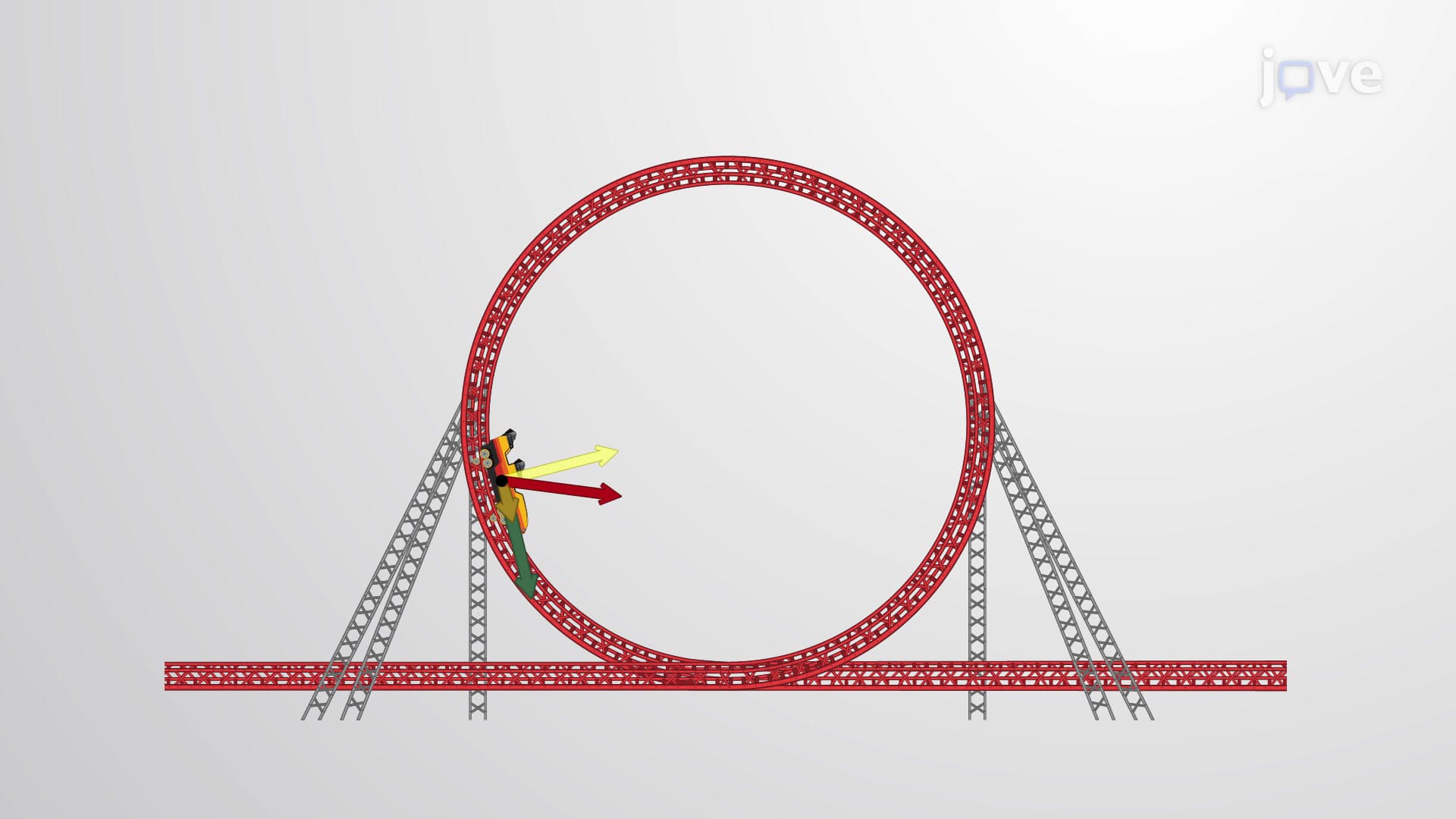
Students preparing for AP Physics exams frequently encounter uniform circular motion problems involving pendulums, roller coasters, and planetary motion. The MCAT also tests these concepts in biomechanics contexts, such as blood flow through curved arteries or centrifuge applications in laboratory medicine.
Real-World Applications and Engineering Considerations
Engineers designing everything from washing machine spin cycles to particle accelerators rely on uniform circular motion principles. The Large Hadron Collider at Fermilab uses magnetic fields to provide centripetal force, keeping high-energy particles on precise circular paths spanning miles underground.
Understanding these concepts proves invaluable for students pursuing STEM careers, particularly in aerospace engineering, mechanical engineering, and physics research where circular motion calculations determine mission success and equipment safety.
Frequently Asked Questions
Uniform circular motion occurs when an object travels in a perfect circle at constant speed, with velocity direction continuously changing while speed magnitude remains fixed. Unlike linear motion where acceleration changes speed, or non-uniform circular motion where both speed and direction vary, uniform circular motion maintains constant speed with purely directional acceleration toward the circle's center.
AP Physics C frequently tests uniform circular motion through satellite orbital problems, banked curve scenarios, and pendulum motion analysis. MCAT questions often focus on centrifuge applications, blood circulation through curved vessels, or molecular motion in biochemical processes. Both exams emphasize mathematical relationships between force, acceleration, radius, and velocity.
Uniform circular motion builds on basic algebra and trigonometry, no advanced calculus required for introductory physics courses. Start with conceptual understanding: objects need inward force to curve their paths. Then practice with simple examples like cars on curves before tackling complex orbital mechanics. Most students master these concepts within 2-3 weeks of focused study.
Watch the London Eye observation wheel in Las Vegas or similar Ferris wheels operating at constant rotational speed. Passengers experience uniform circular motion, moving at steady speed while their velocity direction continuously changes. You'll feel a slight outward pull (centrifugal sensation) as your body wants to travel straight while the wheel curves your path inward.
Focus on three key problem types: satellite orbits (gravitational centripetal force), banked curves (friction and normal forces), and vertical circles (varying normal force). Create formula sheets linking centripetal acceleration (v²/r), force (mv²/r), and period (2πr/v). Practice drawing free-body diagrams showing all forces, especially identifying which force provides the centripetal component.
Progress to rotational dynamics, exploring angular momentum, torque, and moment of inertia, concepts that extend circular motion into rotating rigid bodies. Advanced students can explore simple harmonic motion, where uniform circular motion helps visualize oscillatory behavior through projection techniques.
Acceleration measures velocity change rate, and velocity includes both magnitude (speed) and direction components. In uniform circular motion, speed magnitude remains constant but direction continuously changes as the object curves along its circular path. This directional change creates centripetal acceleration pointing toward the circle's center, even with zero speed change.
Problem statements explicitly mention "constant speed," "steady angular velocity," or "uniform rotation" for uniform circular motion cases. Non-uniform problems include phrases like "speeding up," "slowing down," or provide changing force/torque values. Uniform motion problems focus on centripetal force balance, while non-uniform cases require analyzing tangential acceleration components affecting speed changes.
The counterintuitive concept that constant speed still produces acceleration challenges students' everyday motion experience. Additionally, distinguishing between centripetal (real, inward) and centrifugal (apparent, outward) forces requires careful analysis. Vector mathematics for velocity and acceleration directions adds complexity, but mastering force diagrams and mathematical relationships builds strong problem-solving foundations for advanced physics courses.
Related Micro-courses

16 Concepts

10 Concepts
15 Concepts