Loading video…


 12 Concepts
 11.7K views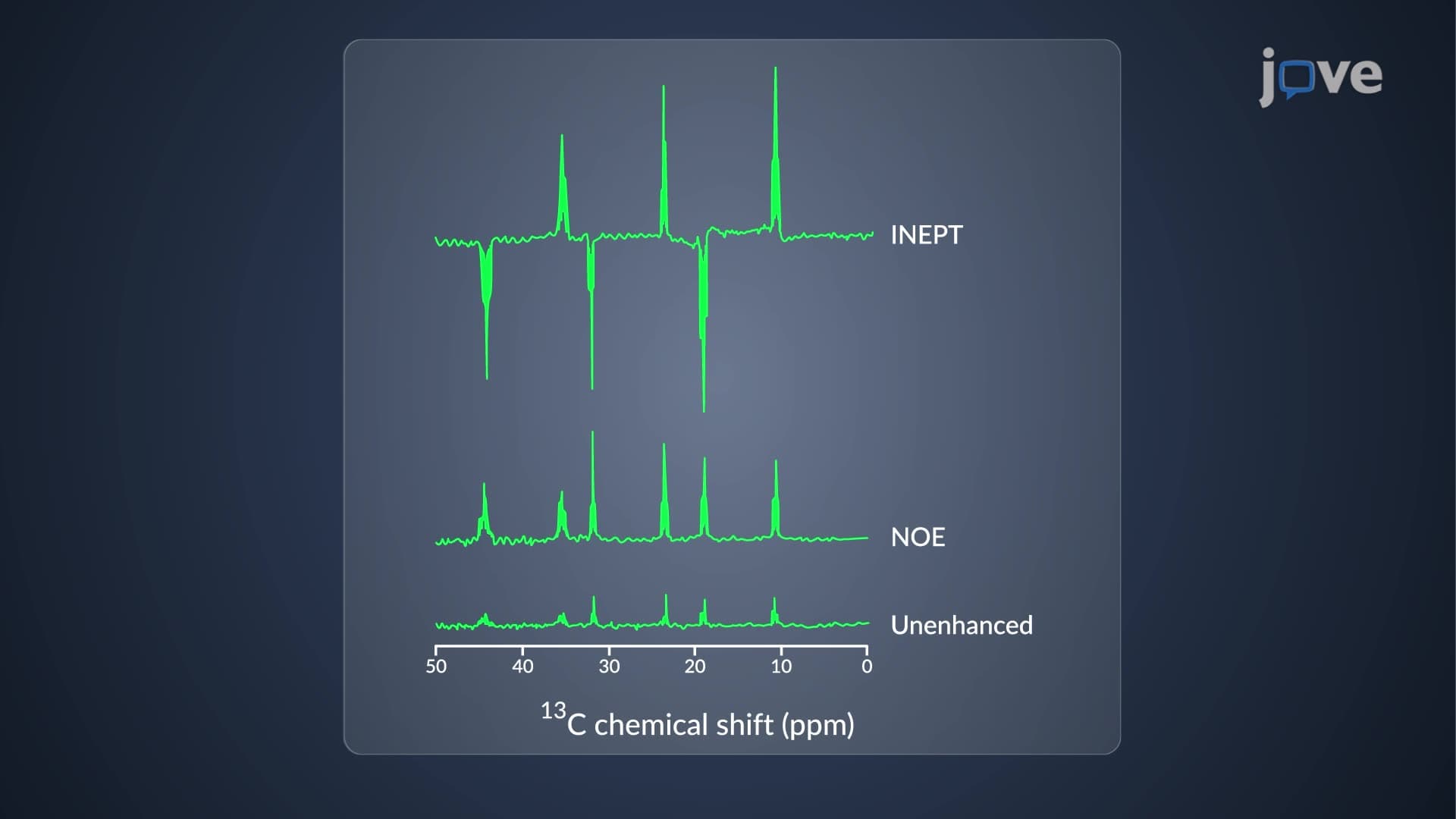

Video Summary: Insensitive Nuclei Enhanced by Polarization Explained
Ever wondered how scientists at Harvard Medical School detect trace carbon compounds in biological samples when regular NMR fails? The INEPT NMR technique explained reveals how researchers amplify weak signals from insensitive nuclei like carbon-13 by borrowing magnetization from abundant protons. This insensitive nuclei enhanced by polarization transfer method revolutionizes pharmaceutical analysis at companies like Pfizer. Watch the full video on JoVE Coach to master this concept with expert-led visuals and step-by-step explanations.
The INEPT NMR technique explained addresses a fundamental challenge in nuclear magnetic resonance: detecting nuclei with naturally low sensitivity. While protons give strong NMR signals due to their abundance and high magnetogyric ratio, nuclei like carbon-13 (1.1% natural abundance) and nitrogen-15 (0.4% natural abundance) produce signals roughly 6,000 times weaker. INEPT bridges this gap through strategic magnetization transfer.
The insensitive nuclei polarization transfer NMR process relies on scalar coupling between neighboring nuclei. The technique employs carefully timed pulse sequences: initial 90-degree pulses create transverse magnetization in both proton and carbon channels, followed by 180-degree pulses that refocus chemical shift evolution while preserving J-coupling effects. The critical timing depends on the coupling constant-typically 1/(4J) seconds, where J represents the one-bond C-H coupling constant (usually 125-250 Hz).
During these delays, the coupled spin system evolves under J-coupling, creating antiphase magnetization. A final 90-degree pulse on the proton channel converts this antiphase proton magnetization into enhanced in-phase carbon magnetization. This process can theoretically provide up to a 4-fold enhancement for carbon-13 signals compared to direct detection.
How INEPT enhances insensitive nuclei in NMR becomes crucial in pharmaceutical companies like Merck and academic research institutions. At MIT's chemistry department, students use INEPT for analyzing complex organic synthesis products. The technique proves invaluable for determining molecular structures where carbon frameworks must be identified despite low natural abundance.
For AP Chemistry and college organic chemistry courses, understanding INEPT helps students grasp advanced spectroscopic techniques. The MCAT often tests knowledge of NMR principles, making INEPT comprehension valuable for pre-med students. Graduate programs in chemistry at Stanford and Caltech extensively use these techniques for research applications.
The effectiveness of heteronuclear polarization transfer depends on relaxation times and coupling patterns. T1 relaxation of protons must be shorter than that of the insensitive nucleus for optimal transfer. Additionally, the technique works best for directly bonded nuclei, as coupling constants decrease rapidly with distance. Modern spectrometers at universities like UCLA routinely achieve 3-4 fold enhancements using optimized INEPT sequences.
Related Micro-courses