Loading video…

 7 Concepts
 329 views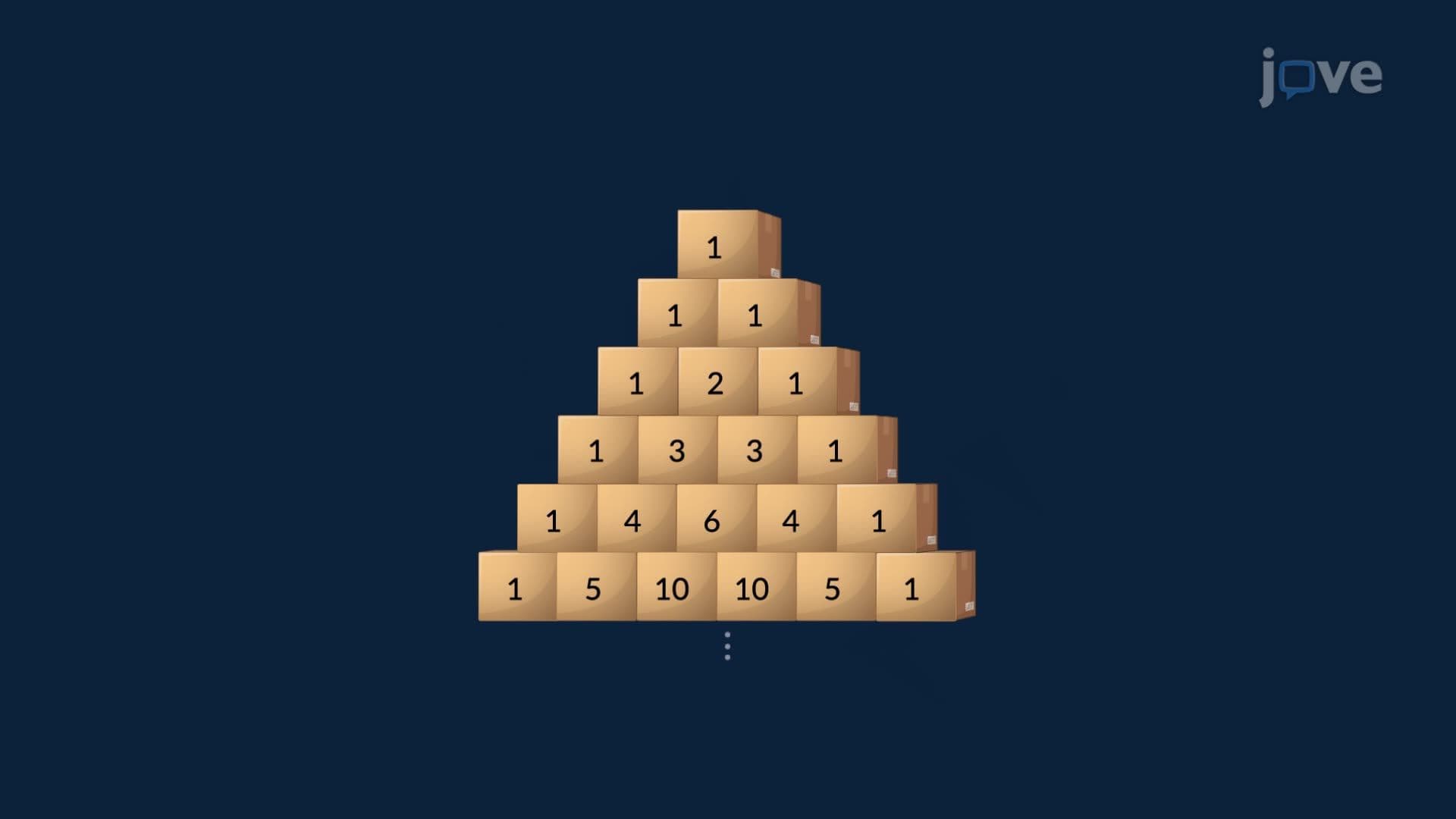

Video Summary: Binomial Expansion Using Pascals Triangle Explained
Did you know that flipping three coins creates exactly the same mathematical pattern as expanding (a + b)³? Binomial expansion using Pascal's triangle reveals this hidden connection between algebra and probability. When NASA engineers calculate trajectory probabilities or statisticians analyze clinical trial outcomes, they rely on these same fundamental patterns. Pascal's triangle provides a visual roadmap for expanding binomial expressions, where each row's numbers become the coefficients for higher powers. Watch the full video on JoVE Coach to master this concept with expert-led visuals and step-by-step explanations.
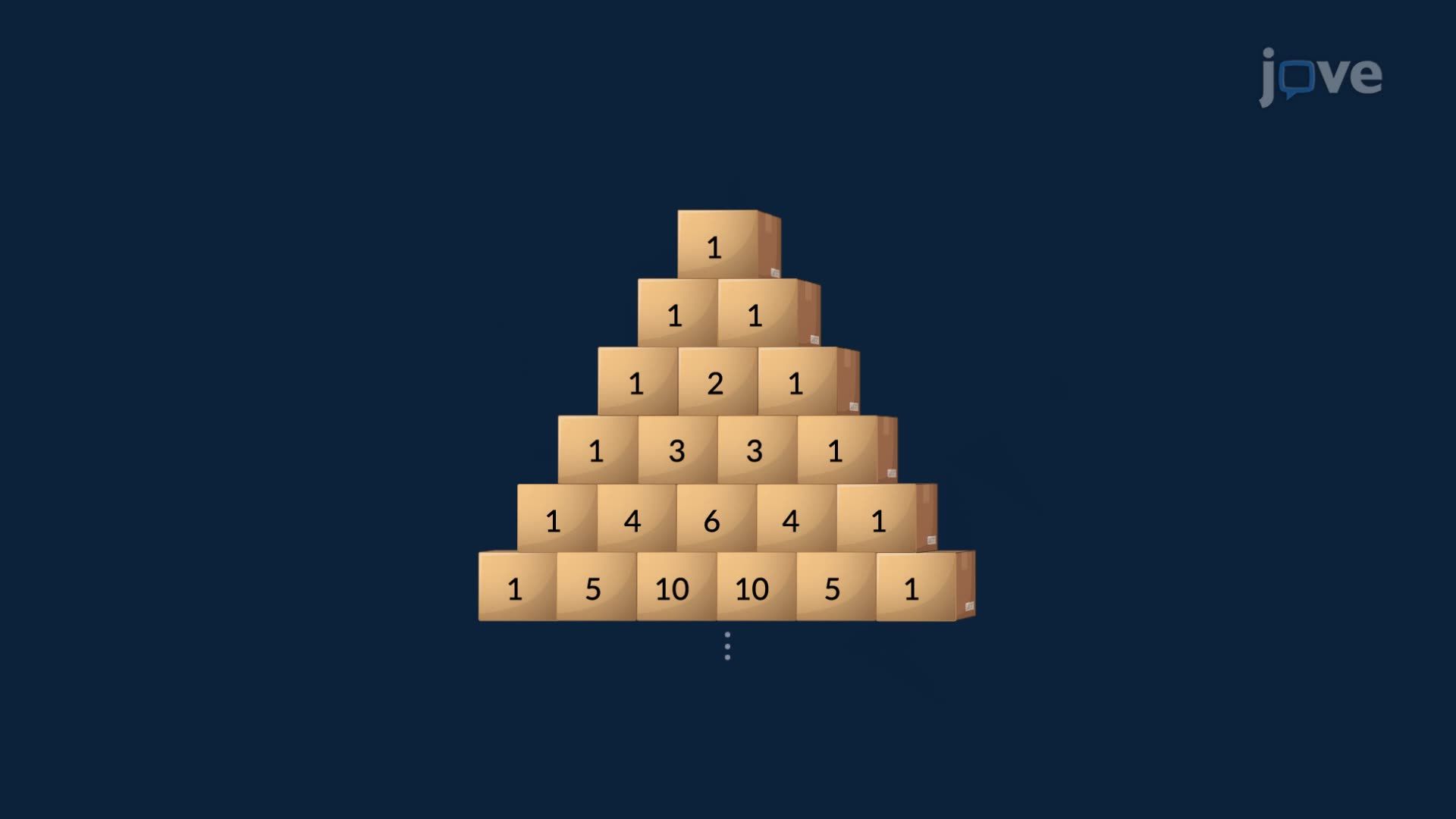
Binomial expansion transforms expressions like (x + y)ⁿ into series of terms with predictable coefficients. Pascal's triangle serves as a visual coefficient calculator, where each row corresponds to a specific power. The triangle's elegant construction-where each interior number equals the sum of the two numbers above it-creates the exact coefficients needed for binomial expansions.
Consider expanding (x + y)⁴. The fifth row of Pascal's triangle (1, 4, 6, 4, 1) provides the coefficients: x⁴ + 4x³y + 6x²y² + 4xy³ + y⁴. This systematic approach eliminates tedious multiplication while revealing underlying mathematical relationships that appear throughout advanced mathematics.
Pascal's triangle embodies the binomial coefficient formula "n choose k," written as C(n,k) or nCk. Each position represents the number of ways to select k items from n total items. For instance, in row 5, the third position shows C(5,2) = 10, indicating 10 ways to choose 2 items from 5 options.
This connection proves invaluable in AP Statistics and college probability courses. When analyzing SAT problem-solving strategies or preparing for standardized tests, students encounter binomial probability distributions that directly correspond to Pascal's triangle patterns. The triangle's symmetry reflects the mathematical principle that choosing k items from n equals choosing (n-k) items.
US pharmaceutical companies use binomial expansion principles when analyzing clinical trial success rates. If a drug shows 70% effectiveness, calculating the probability of specific success patterns across patient groups follows binomial distribution patterns found in Pascal's triangle.
In AP Calculus and college algebra courses, binomial expansion enables series approximations crucial for engineering applications. MIT and Stanford engineering programs emphasize these concepts because they underpin Taylor series expansions used in computer graphics, signal processing, and aerospace calculations.
SAT Math Level 2 and AP Statistics frequently test binomial expansion understanding through probability scenarios. Students might encounter questions about tournament brackets, genetic probability, or quality control sampling-all applications of Pascal's triangle principles.
The triangle's construction also connects to other mathematical concepts including combinatorics, probability distributions, and infinite series. Understanding these relationships prepares students for advanced topics in discrete mathematics and statistical analysis commonly required in STEM undergraduate programs across American universities.
Related Micro-courses