Loading subject page…


22,529 views

Video Summary: What Is Redox Equilibria
Ever wonder why your car battery eventually dies or how fuel cells power NASA's spacecraft? Understanding redox equilibria chemistry is the key to answering these questions. When electrons transfer between substances in reactions like those powering lithium-ion batteries in Tesla vehicles, the system eventually reaches a balance point called What is Redox Equilibria. This equilibrium state determines whether reactions will proceed spontaneously and helps predict the voltage output of electrochemical cells. Watch the full video on JoVE Coach to master this concept with expert-led visuals and step-by-step explanations.
Redox equilibria chemistry governs the fundamental balance that occurs when oxidation-reduction reactions reach their endpoint. Unlike simple acid-base equilibria, redox systems involve the physical transfer of electrons between chemical species, creating unique thermodynamic relationships that determine reaction spontaneity and final concentrations.
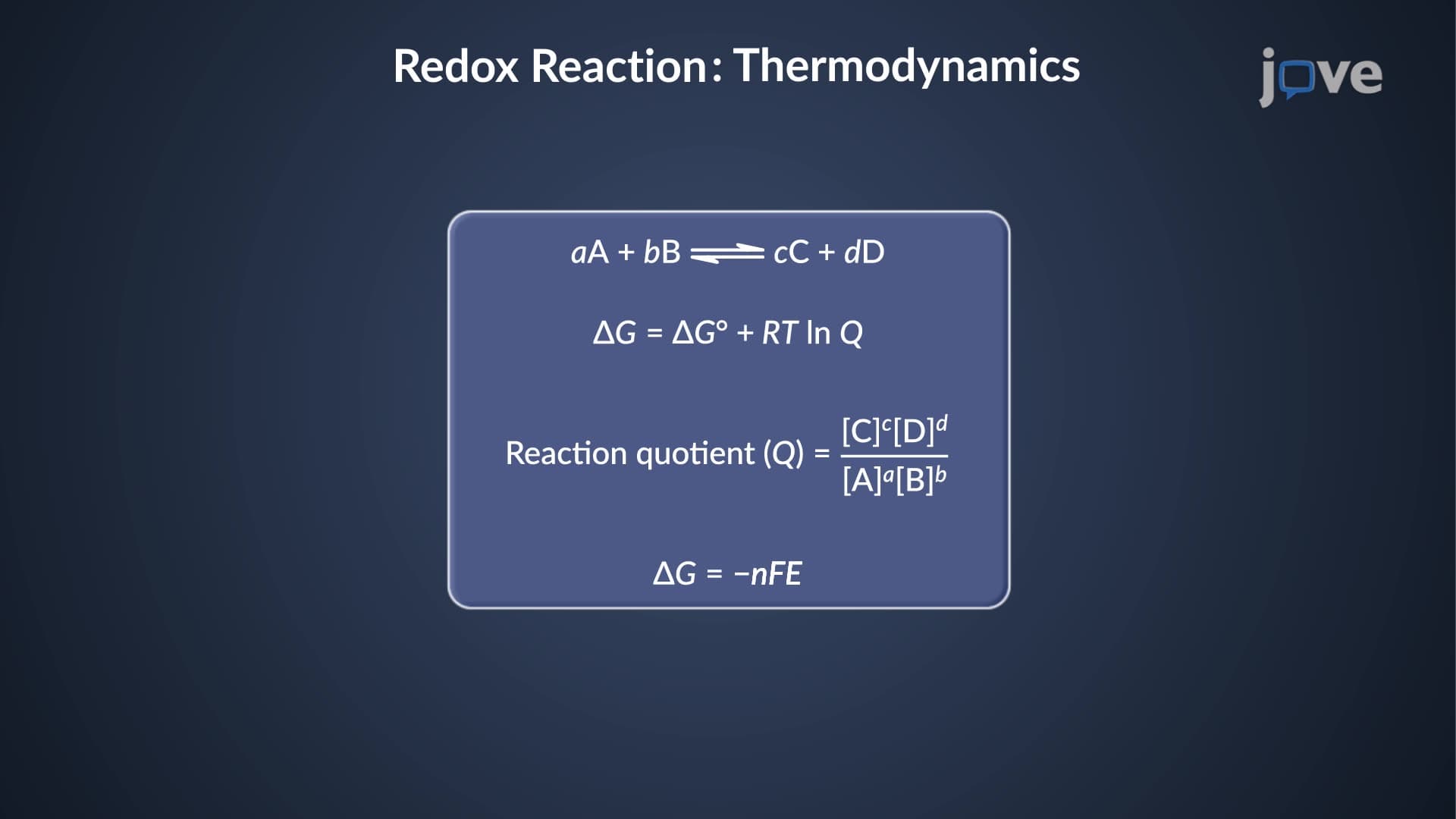
At equilibrium, the driving force for electron transfer becomes zero, meaning the electrochemical potential difference between oxidizing and reducing agents disappears. This occurs when the Gibbs free energy change (ΔG) equals zero, establishing a direct connection between thermodynamics and electrochemistry through the relationship ΔG = -nFE, where n represents electrons transferred, F is Faraday's constant (96,485 C/mol), and E is the cell potential.
The Nernst equation redox relationship becomes crucial for understanding real-world applications. At 25°C, this equation simplifies to E = E° - (0.0592/n)log(Q), where E° is the standard electrode potential and Q represents the reaction quotient. This mathematical framework explains why battery voltage decreases as chemicals are consumed during discharge.
Consider lithium-ion batteries used in electric vehicles throughout the United States. As lithium ions move between electrodes during discharge, their concentrations change, affecting the cell potential according to the Nernst equation. When the battery reaches equilibrium (E = 0), no more useful work can be extracted, requiring recharging to restore the concentration gradients.
Standard electrode potential values, measured under standard conditions (1 M concentrations, 1 atm pressure, 25°C), provide a quantitative method for predicting redox reaction spontaneity. The standard hydrogen electrode (SHE) serves as the universal reference point with E° = 0.00 V.
For AP Chemistry and college-level coursework, students learn to calculate overall cell potentials by combining half-cell reactions. A positive E°cell indicates spontaneous reaction under standard conditions, while negative values suggest non-spontaneous processes requiring external energy input.
Electrochemical cell equilibrium principles operate in numerous US industries. Water treatment facilities use redox reactions for disinfection, while metal refinement operations rely on controlled electrode potentials to purify copper, aluminum, and other metals. Even biological systems, from cellular respiration to photosynthesis, depend on carefully managed redox equilibria to store and transfer energy efficiently.
Understanding these equilibrium principles proves essential for MCAT preparation, particularly in biochemistry sections covering metabolic pathways and cellular energetics.
Related Micro-courses