Loading subject page…


30,224 views

Video Summary: Mass Spectrometry Branched Alkane Fragmentation Explained
Ever wonder why branched alkane MS fragmentation creates such distinctive patterns compared to straight-chain molecules? Unlike linear hydrocarbons that break randomly, branched alkanes fragment predictably at their branching points, forming stable secondary and tertiary carbocations. For example, analyzing gasoline components like 2-methylbutane reveals characteristic mass spectral fingerprints used by petroleum chemists across refineries from Texas to California. Watch the full video on JoVE Coach to master this concept with expert-led visuals and step-by-step explanations.
Mass spectrometry reveals the molecular architecture of branched alkanes through predictable fragmentation behaviors rooted in carbocation chemistry. Unlike straight-chain hydrocarbons that fragment somewhat randomly, branched alkanes exhibit characteristic breaking patterns governed by the stability hierarchy of carbocations formed during electron impact ionization.
The fundamental principle driving branched alkane mass spectrometry fragmentation centers on carbocation stability: tertiary carbocations (surrounded by three carbon atoms) are significantly more stable than secondary carbocations (two carbons), which are more stable than primary carbocations (one carbon). This stability difference, quantified through heats of formation studies at institutions like MIT and Caltech, creates predictable fragmentation hot spots.
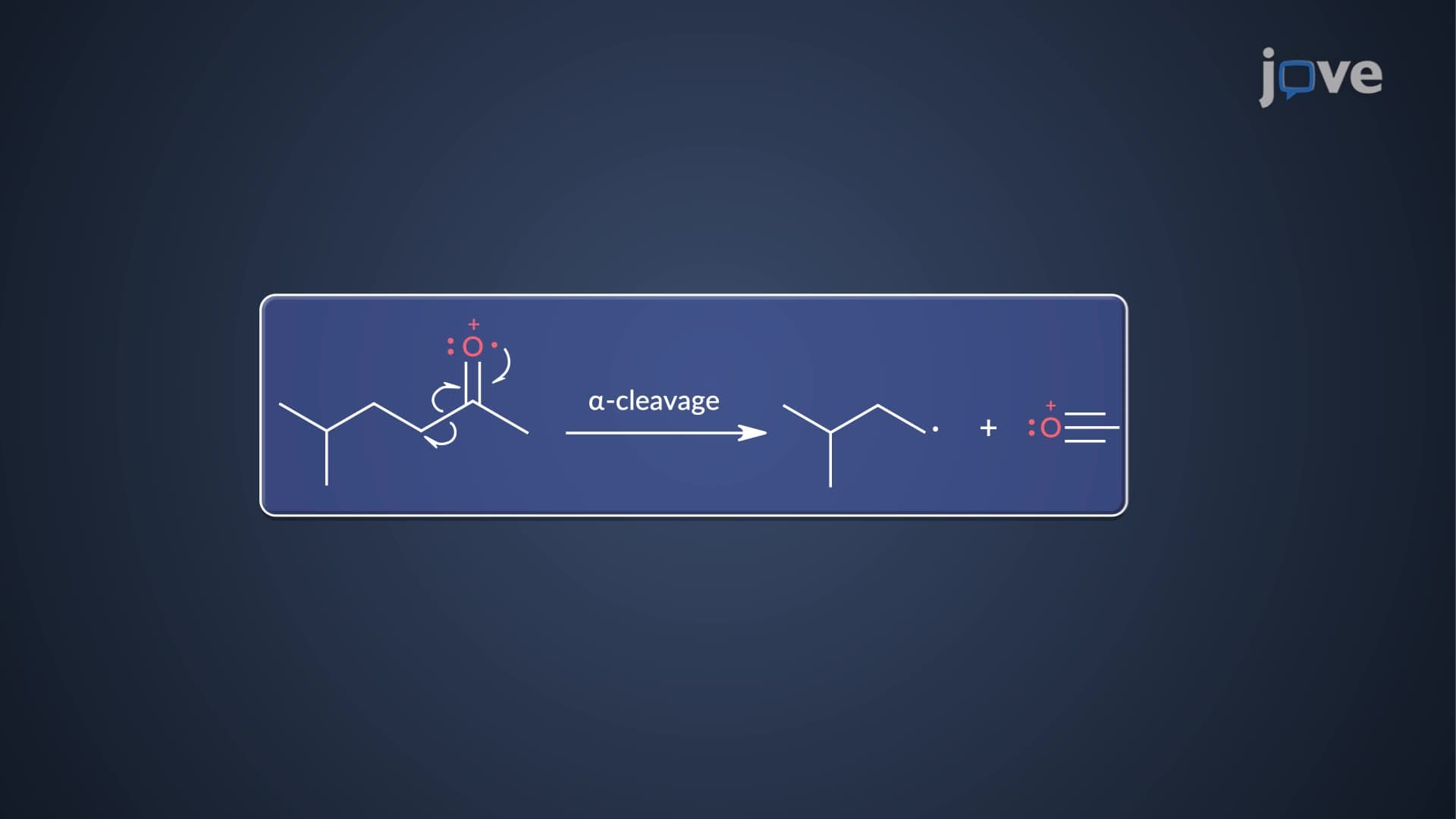
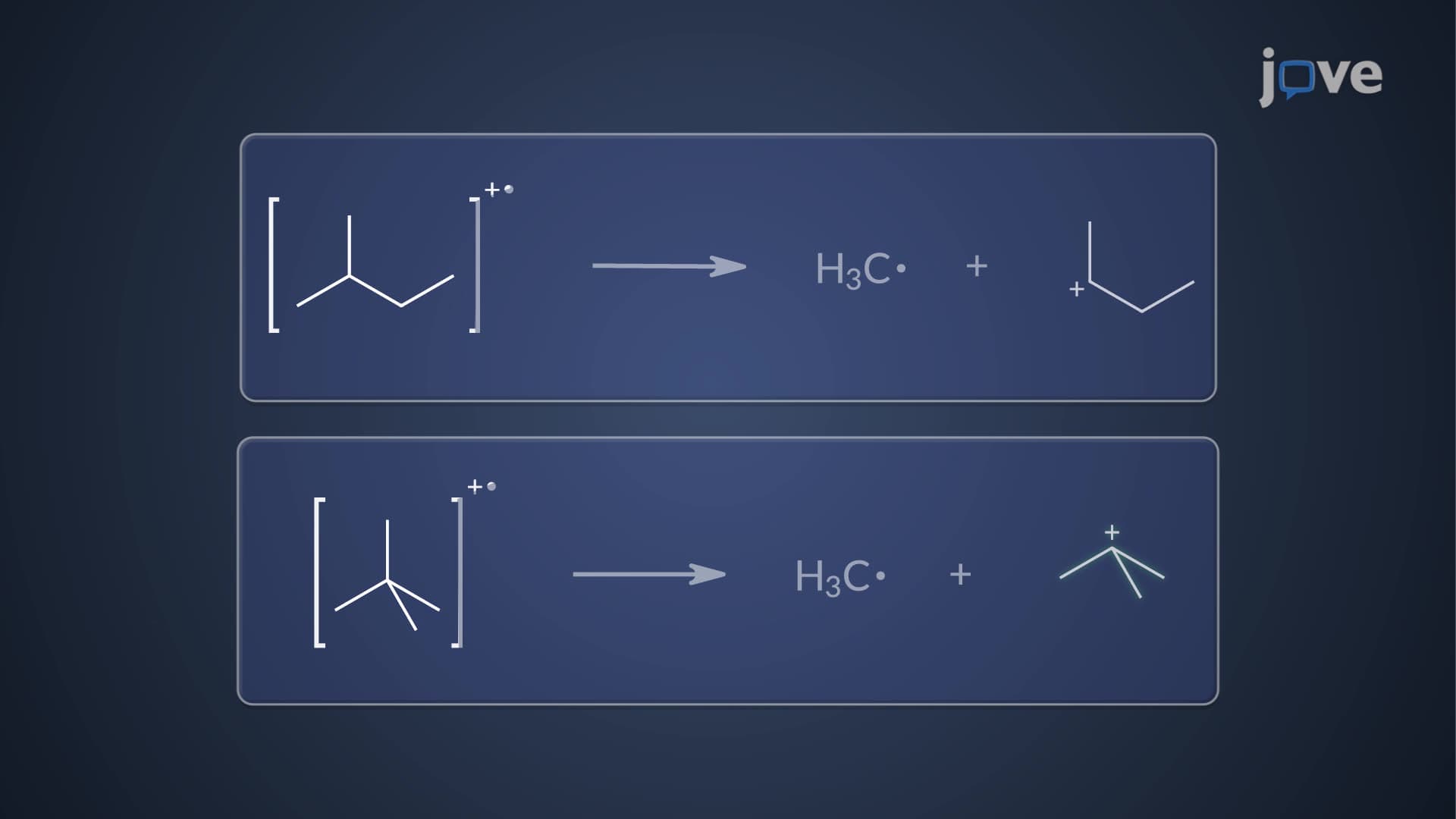
Consider 2-methylbutane, commonly found in petroleum fractions analyzed by ExxonMobil and Chevron laboratories. When this molecule loses a methyl radical (CH3•) from its branching point, it forms a relatively stable secondary carbocation. The molecular ion peak remains visible because competing fragmentation pathways don't completely overwhelm the parent ion signal.
In contrast, 2,2-dimethylpropane (neopentane) demonstrates extreme fragmentation behavior. Loss of any methyl group from the central quaternary carbon creates a highly stable tertiary carbocation. This exceptional stability makes fragmentation so favorable that virtually no molecular ion survives the ionization process-the molecular ion peak disappears entirely from the mass spectrum.
Advanced fragmentation analysis, essential for AP Chemistry students and undergraduate organic chemistry courses, reveals how both carbocation and radical stability determine fragment abundance. In 2,2-dimethylpentane, multiple fragmentation pathways compete because breaking bonds on either side of the tertiary center produces equivalent tertiary carbocations.
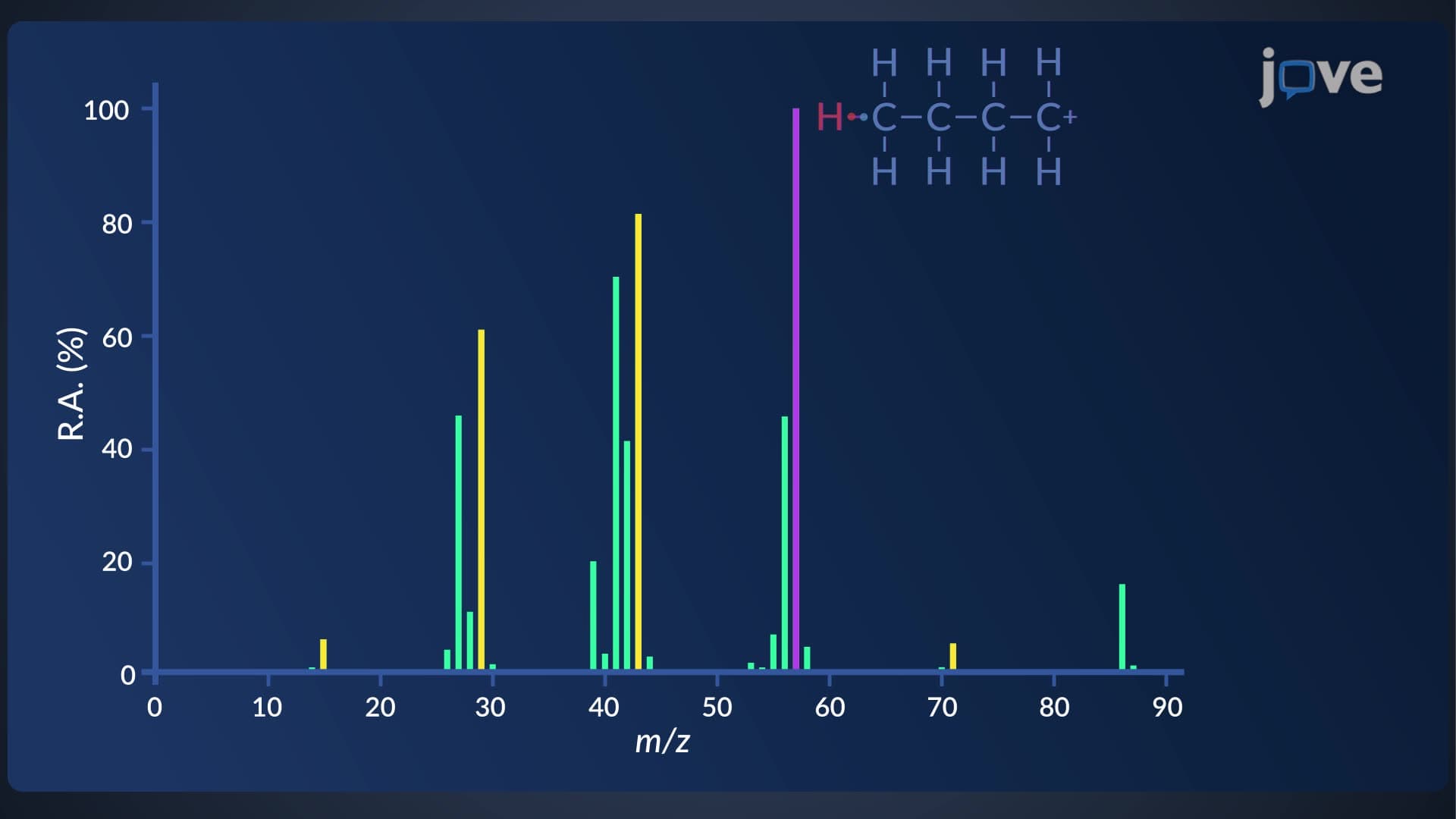
The observed fragmentation preference depends on radical stability: fragmentation producing a more stable primary radical (•CH2CH3) occurs more readily than pathways generating less stable methyl radicals (•CH3). This principle, tested regularly on MCAT organic chemistry sections, helps predict which fragments appear as base peaks versus minor signals.
Petroleum companies leverage these fragmentation rules for gasoline composition analysis, while pharmaceutical companies use them for drug metabolite identification. Students encountering these concepts in college analytical chemistry labs learn to recognize diagnostic patterns: prominent m/z -15 losses indicate tertiary centers, while persistent molecular ions suggest limited branching.
Understanding these patterns proves crucial for success on standardized exams, where students must predict fragmentation patterns, identify unknown structures from mass spectral data, and explain why certain molecular ions appear or disappear based on structural features.
Related Micro-courses