Loading subject page…

- Analytical Chemistry
- Introduction to Molecular Spectroscopy
- UV–Vis Spectroscopy: Beer–Lambert Law
Micro-course: Introduction to Molecular Spectroscopy
36,707 views
Learn key concepts and earn your certificate.




UV–Vis Spectroscopy: Beer–Lambert Law

00:00
01:09
Video Summary: Uv Vis Spectroscopy Beer Lambert Law Explained
Ever wonder how scientists determine the exact concentration of caffeine in your favorite energy drink? The Beer Lambert law explained reveals the mathematical relationship that makes this possible through UV-Vis spectroscopy. This fundamental principle connects light absorption to molecular concentration, enabling precise measurements in everything from pharmaceutical quality control at Pfizer to environmental testing by the EPA. Understanding how the Beer Lambert law works unlocks the science behind countless analytical procedures used across American laboratories daily. Watch the full video on JoVE Coach to master this concept with expert-led visuals and step-by-step explanations.
- Understand the UV Vis Spectroscopy Beer Lambert Law Explained and its fundamental equation A = εbc
- Identify the relationship between absorbance, molar absorptivity, concentration, and path length
- Analyze how molar absorptivity serves as a unique fingerprint for different compounds at specific wavelengths
- Apply the Beer Lambert law to calculate unknown concentrations from absorbance measurements
- Recognize high-intensity absorptions (ε > 10⁴) versus low-intensity absorptions (ε < 10³)
- Evaluate when the Beer Lambert law provides accurate results and when deviations occur
- Compare absorption spectra patterns to identify characteristic molecular features
- Explore real-world applications in pharmaceutical analysis, environmental monitoring, and clinical diagnostics
Understanding the Beer Lambert Law Foundation
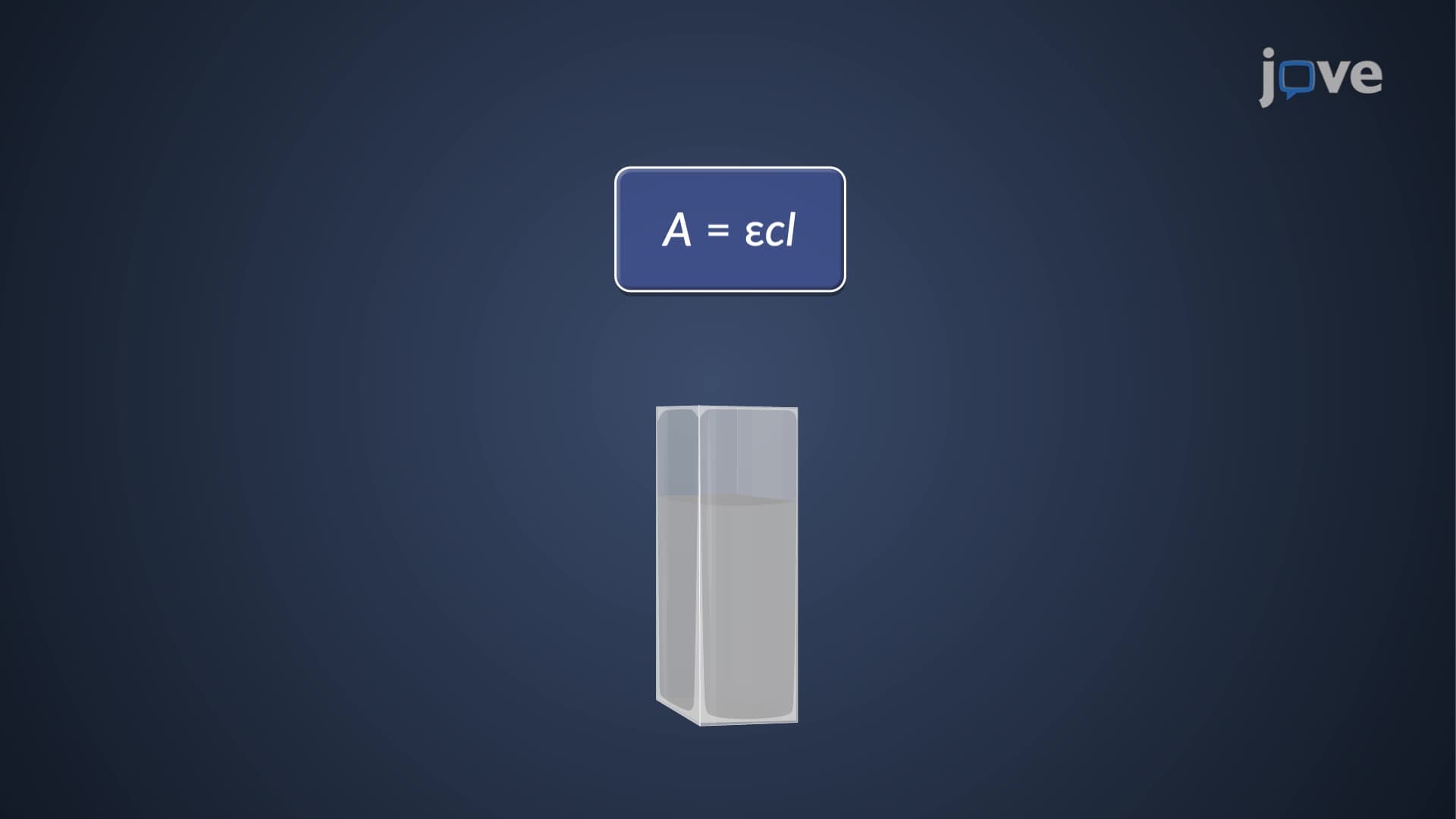
The Beer Lambert law represents one of the most fundamental relationships in analytical chemistry, providing the mathematical framework that connects light absorption to molecular concentration. This law states that absorbance is directly proportional to both the concentration of the absorbing species and the path length of light through the sample. The equation A = εbc elegantly captures this relationship, where A represents absorbance, ε is molar absorptivity, b is path length, and c is concentration.
Molar Absorptivity: The Molecular Fingerprint
Molar absorptivity (ε) serves as a unique characteristic for each compound at specific wavelengths, functioning like a molecular fingerprint. When pharmaceutical companies like Johnson & Johnson analyze drug purity, they rely on known molar absorptivity values to ensure accurate dosing. High-intensity absorptions (ε > 10,000 L/mol·cm) indicate strong light absorption, typical of compounds with extensive conjugated systems like beta-carotene. Conversely, low-intensity absorptions (ε < 1,000 L/mol·cm) characterize molecules with simple chromophores, such as basic alcohols or saturated hydrocarbons.
Real-World Applications in American Industries
The Beer Lambert law finds extensive application across American industries and academic institutions. Environmental Protection Agency (EPA) laboratories use this principle to monitor water quality, measuring pollutant concentrations in rivers and groundwater supplies. Clinical laboratories apply Beer Lambert calculations to determine glucose levels in blood samples, while food scientists at companies like General Mills employ UV-Vis spectroscopy to analyze vitamin content in fortified cereals.
Exam Success and Academic Applications
Students preparing for the MCAT encounter Beer Lambert law problems requiring calculation of unknown concentrations from given absorbance data. AP Chemistry students must understand how changes in concentration affect absorbance readings, while college analytical chemistry courses emphasize recognizing when the law's linear relationship breaks down due to high concentrations or chemical interactions. Mastering these calculations proves essential for success in pre-med curricula and chemistry majors pursuing careers in pharmaceuticals or environmental science.
Frequently Asked Questions
The Beer Lambert law describes the linear relationship between light absorbance and concentration in UV-Vis spectroscopy. It's crucial because it allows scientists to determine unknown concentrations by measuring how much light a solution absorbs. This principle forms the foundation for quantitative analysis in pharmaceutical testing, environmental monitoring, and clinical diagnostics across American laboratories.
MCAT Beer Lambert problems typically provide absorbance, path length, and molar absorptivity values, asking you to calculate concentration using A = εbc. First, identify the given variables, then rearrange the equation to solve for the unknown. Remember that molar absorptivity remains constant for each compound at specific wavelengths, making it a reliable reference value for calculations.
AP Chemistry exams focus on applying A = εbc to determine concentrations from absorbance data and understanding proportional relationships. Students must interpret graphs showing absorbance versus concentration, identify when the linear relationship holds, and explain deviations from Beer's law. Practice problems often involve serial dilutions and standard curve construction.
Pharmaceutical companies like Merck use Beer Lambert calculations for drug quality control, ensuring accurate medication concentrations. Environmental labs apply this law to measure pollutant levels in water supplies, while food manufacturers analyze nutrient content in products. Clinical laboratories rely on Beer Lambert principles for blood glucose testing and other diagnostic measurements.
No, the Beer Lambert law requires only basic algebra skills typically mastered by high school students. The equation A = εbc involves simple multiplication and division operations. Understanding logarithms helps with absorbance concepts, but most practical applications focus on the linear relationship between absorbance and concentration rather than complex mathematical derivations.
Focus on practicing unit conversions and equation rearrangement using A = εbc in different forms. Create a formula sheet with molar absorptivity values for common compounds, and work through problems involving standard curves and unknown concentration calculations. Understanding when the law breaks down due to high concentrations or chemical interactions proves equally important for exam success.
Advanced topics include multi-component analysis using simultaneous equations, non-linear calibration curves, and instrumental deviations from Beer's law. Students can explore fluorescence spectroscopy, where similar concentration-intensity relationships apply, or investigate how matrix effects influence absorbance measurements in complex samples like biological fluids or environmental matrices.
Related Micro-courses

19 Concepts

17 Concepts

15 Concepts