Loading subject page…


925,504 views

Video Summary: What Is Formation of Complex Ions
Ever wonder why silver jewelry tarnishes but cleaning solutions can restore its shine? The formation of complex ions explains this chemistry magic-when stronger Lewis bases replace water molecules around metal ions, creating stable new structures. This process is crucial in everything from medical imaging contrast agents used in US hospitals to industrial metal purification at facilities like those run by Freeport-McMoRan. Understanding what is formation of complex ions reveals how transition metals behave in solutions and why certain compounds dissolve when they normally wouldn't. Watch the full video on JoVE Coach to master this concept with expert-led visuals and step-by-step explanations.
The formation of complex ions represents one of chemistry's most elegant examples of Lewis acid-base interactions. When metal ions dissolve in water, they don't exist as bare cations-they're immediately surrounded by water molecules acting as Lewis bases, donating electron pairs to the electron-deficient metal center. This hydration is just the beginning of a more complex story.
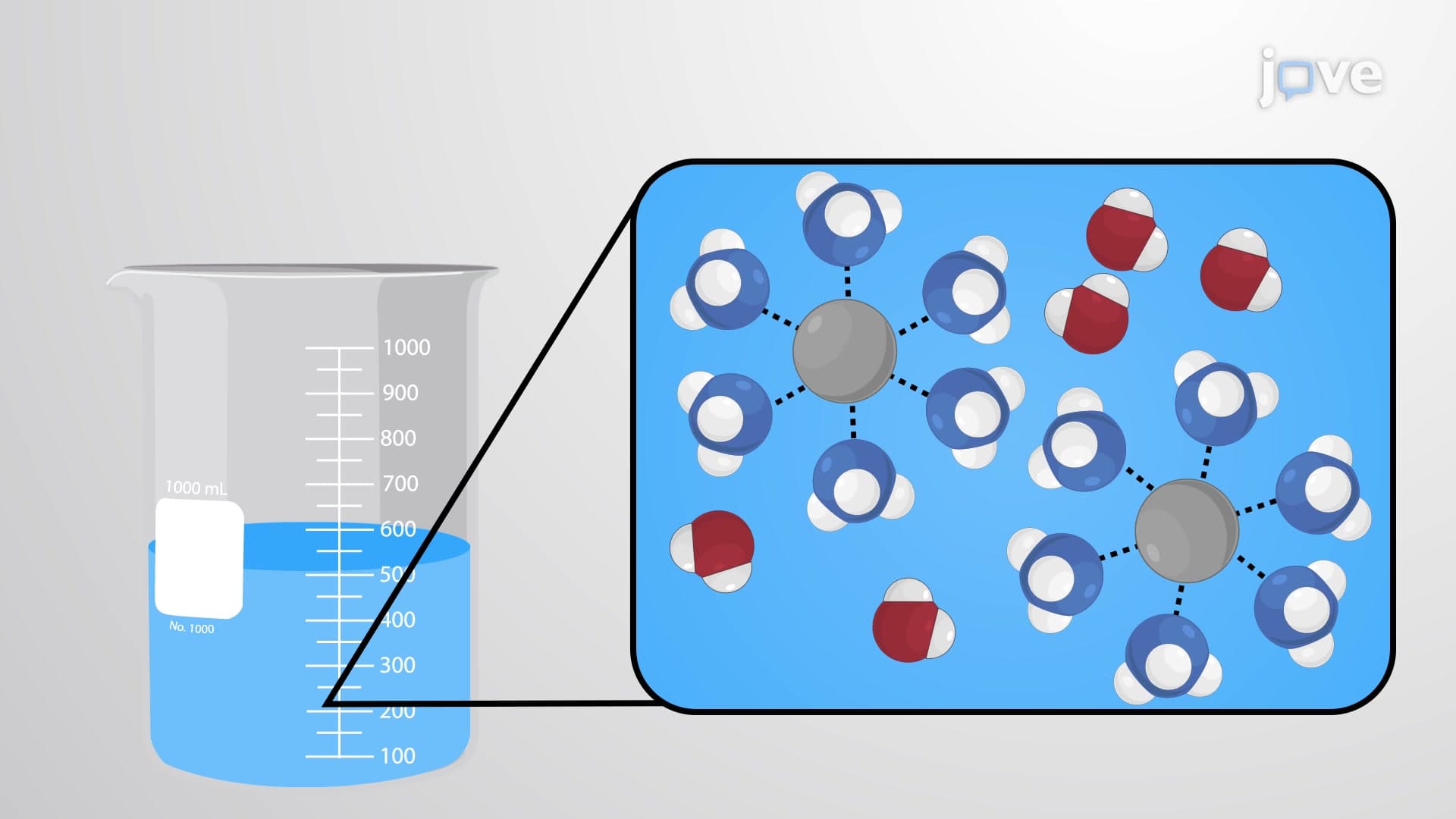
Complex ion formation occurs when stronger Lewis bases, called ligands, compete with water molecules for positions around the central metal ion. Think of it as a molecular game of musical chairs, where the strongest Lewis bases win the seats closest to the metal center. Common ligands include ammonia (NH₃), cyanide (CN⁻), and chloride (Cl⁻), each bringing different electron-donating abilities to the coordination sphere.
Transition metals dominate complex ion chemistry for compelling reasons. Their high charge density creates strong electrostatic attractions with electron-rich ligands, while their partially filled d orbitals provide convenient "parking spaces" for incoming electron pairs. This explains why iron(III), copper(II), and cobalt(III) form numerous stable complexes-characteristics frequently tested on AP Chemistry exams and college general chemistry courses.
Consider the hexammine cobalt(III) ion [Co(NH₃)₆]³⁺, where six ammonia molecules arrange octahedrally around the central cobalt ion. This geometry maximizes ligand-metal bonding while minimizing electron-electron repulsion, creating remarkable stability that chemists quantify using formation constants.
The formation constant (Kf) serves as complex ion chemistry's report card, measuring how completely metal ions and ligands combine. Large Kf values indicate highly stable complexes that form nearly completely, while small values suggest weaker associations. These calculations appear regularly on MCAT practice exams and college chemistry midterms.
When silver sulfide encounters cyanide solution, the dramatic increase in solubility demonstrates complex ion formation's practical power. The reaction Ag⁺ + 2CN⁻ → [Ag(CN)₂]⁻ has such a large Kf that virtually all silver ions convert to the dicyanoargentate complex, driving more solid AgS to dissolve according to Le Chatelier's principle.
Complex ion formation drives numerous industrial processes across the United States. Mining companies like Newmont Corporation use cyanide complexation to extract gold from low-grade ores, while pharmaceutical manufacturers employ metal complexes in contrast agents for MRI imaging at hospitals nationwide. Water treatment facilities rely on complex formation to remove heavy metals from drinking water supplies, protecting public health through controlled precipitation reactions.
Related Micro-courses