Loading subject page…


797,515 views


Video Summary: What Is Reaction Stoichiometry
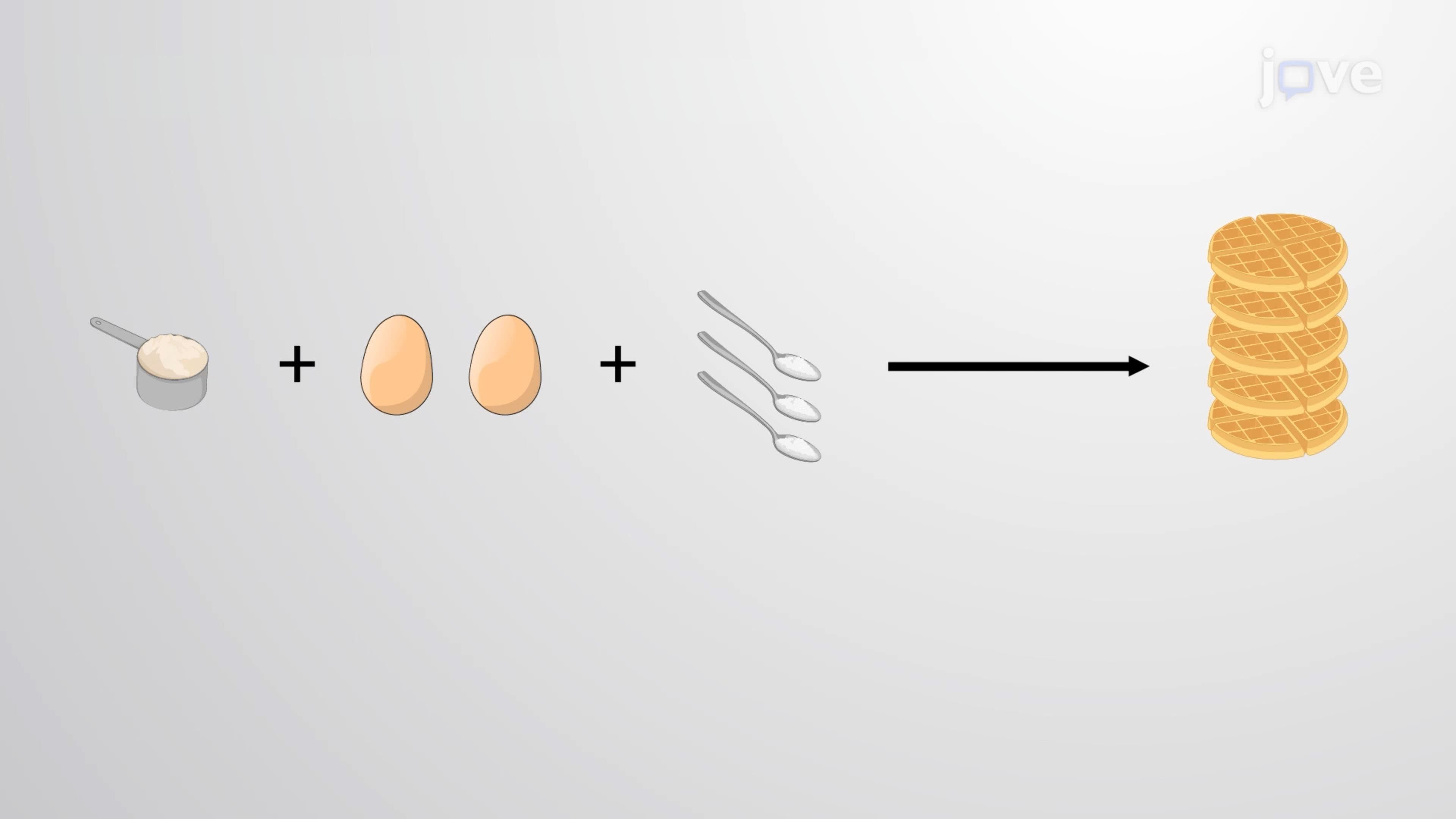
Ever wondered how NASA calculates exactly how much fuel a rocket needs to reach orbit? Reaction stoichiometry is the mathematical foundation that makes these precise calculations possible by revealing the quantitative relationships between reactants and products in chemical reactions. Just like following a recipe to make sandwiches, chemists use balanced equations to determine exact amounts needed for reactions-from manufacturing aspirin in pharmaceutical plants to designing efficient combustion engines. Watch the full video on JoVE Coach to master this concept with expert-led visuals and step-by-step explanations.
Reaction stoichiometry serves as chemistry's mathematical backbone, providing the quantitative framework for predicting and controlling chemical transformations. This concept extends far beyond academic exercises-it's the foundation upon which pharmaceutical companies calculate drug dosages, environmental engineers design pollution control systems, and aerospace engineers determine fuel requirements for spacecraft missions.
The term "stoichiometry" derives from Greek words meaning "element measure," reflecting its role in measuring elemental relationships within chemical reactions. At its core, reaction stoichiometry interprets the coefficients in balanced chemical equations as precise mathematical ratios, similar to ingredient proportions in cooking recipes but with molecular precision.
Stoichiometric coefficients directly translate to mole ratios, which function as conversion factors in chemical calculations. Consider the industrial synthesis of ammonia via the Haber process: N₂ + 3H₂ → 2NH₃. This equation reveals that one mole of nitrogen reacts with three moles of hydrogen to produce two moles of ammonia-ratios that remain constant regardless of scale.
These mole ratios prove invaluable for AP Chemistry students tackling free-response questions and college chemistry majors working through quantitative analysis problems. The key insight is recognizing that coefficients represent not just individual molecules, but vast populations measured in Avogadro's number (6.022 × 10²³).
Real-world applications typically involve mass measurements rather than mole counts, necessitating a systematic conversion approach. The stoichiometric pathway follows three distinct steps: convert known mass to moles using molar mass, apply the appropriate mole ratio from the balanced equation, then convert the resulting moles back to mass.
This methodology proves essential for pharmaceutical manufacturing, where precise dosing requirements demand exact calculations. For instance, aspirin production requires converting salicylic acid masses to acetylsalicylic acid yields with mathematical precision-a process that relies entirely on stoichiometric principles.
Reaction stoichiometry forms the foundation for more complex topics including limiting reactants, percent yield, and thermochemical calculations. MCAT test-takers encounter stoichiometric problems in both general chemistry and biochemistry contexts, while AP Chemistry students must master these concepts for success on both multiple-choice and free-response sections.
Industrial applications span numerous sectors: petrochemical refineries use stoichiometry to optimize fuel production, semiconductor manufacturers rely on precise stoichiometric ratios for chip fabrication, and food scientists apply these principles to develop nutritionally balanced products. Understanding reaction stoichiometry opens doors to careers in chemical engineering, pharmaceutical research, environmental science, and materials development.
Related Micro-courses