Loading subject page…

Micro-course: Gases
410,818 views
Learn key concepts and earn your certificate.





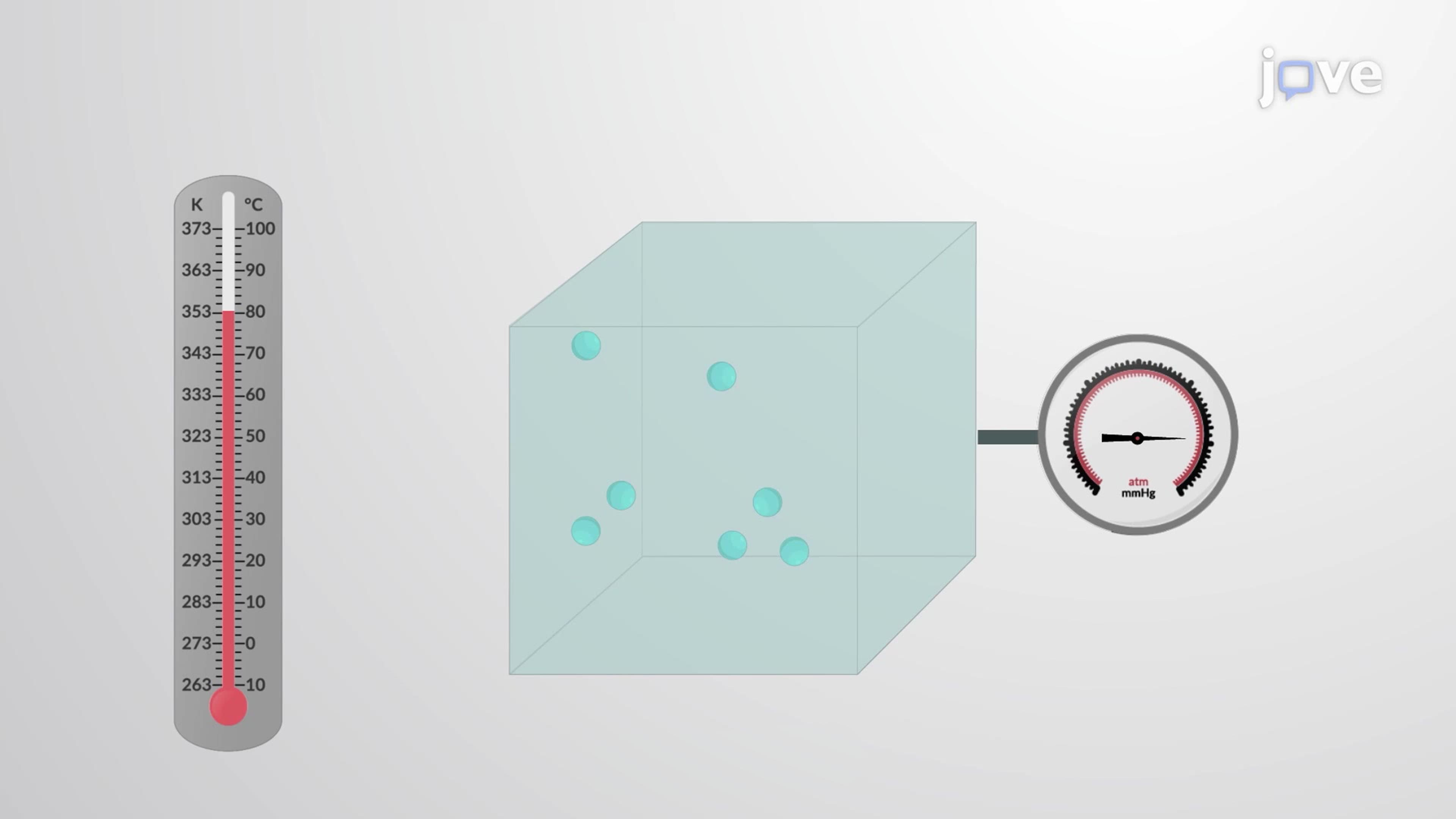



Basic Postulates of Kinetic Molecular Theory: Particle Size, Energy, and Collision


00:00
02:43
Video Summary: Basic Postulates of Kinetic Molecular Explained
Ever wonder why helium balloons float while car tires can be compressed? The basic postulates of kinetic molecular theory reveal the invisible world of gas particle behavior that explains these everyday phenomena. These fundamental assumptions describe how gas molecules move, collide, and respond to temperature changes, forming the foundation for understanding gas laws taught in AP Chemistry and college-level courses across the United States. Watch the full video on JoVE Coach to master this concept with expert-led visuals and step-by-step explanations.
- Understand the three Basic Postulates of Kinetic Molecular Theory and how they explain gas behavior at the particle level
- Identify why gas particles are considered negligible in size compared to the container volume they occupy
- Analyze the concept of perfectly elastic collisions between gas molecules and their energy conservation implications
- Compare how different gas molecules achieve the same average kinetic energy through varying velocities
- Evaluate the relationship between absolute temperature and average kinetic energy of gas particles
- Apply kinetic molecular theory principles to explain gas compressibility and particle motion patterns
- Recognize how molecular mass affects particle velocity when kinetic energy remains constant
- Explore connections between kinetic molecular theory and macroscopic gas law observations
Understanding the Basic Postulates of Kinetic Molecular Theory
The basic postulates of kinetic molecular theory provide the microscopic foundation for understanding gas behavior, bridging the gap between invisible particle interactions and observable gas properties. These postulates are essential for success in AP Chemistry, SAT Subject Tests, and introductory college chemistry courses across American universities.
Postulate 1: Negligible Particle Size and Maximum Compressibility
Gas particles occupy virtually no volume compared to their container, existing as point masses separated by enormous distances relative to their size. This explains why gases are highly compressible-unlike liquids and solids where particles are tightly packed. Consider a basketball inflated with air: the actual air molecules take up less than 0.1% of the ball's internal volume, with the rest being empty space. This postulate directly explains Boyle's Law behavior, where gas volume decreases proportionally under increased pressure, a concept frequently tested on MCAT physical chemistry sections.
Postulate 2: Perfectly Elastic Collisions and Energy Conservation
Gas particles collide like perfectly bouncing billiard balls, exchanging kinetic energy without any loss to heat, sound, or deformation. During these collisions, individual particles may speed up or slow down, but the total system energy remains constant. This principle is crucial for understanding how gases maintain consistent pressure against container walls through continuous molecular bombardment-a concept that appears regularly in college general chemistry midterm examinations.
Postulate 3: Temperature-Kinetic Energy Relationship and Molecular Velocity
The most powerful postulate establishes that average kinetic energy directly correlates with absolute temperature (Kelvin scale). At room temperature (298 K), all gases-whether helium in party balloons or oxygen in hospital tanks-possess identical average kinetic energy. However, since kinetic energy equals (1/2)mv², lighter molecules must move faster than heavier ones. Helium atoms zip around at approximately 1,370 m/s, while heavier nitrogen molecules cruise at about 515 m/s. This relationship explains gas effusion rates studied in advanced placement chemistry and helps predict molecular behavior in industrial applications from NASA rocket propulsion to pharmaceutical manufacturing processes.
Frequently Asked Questions
The basic postulates of kinetic molecular theory include three key assumptions: gas particles have negligible size, undergo perfectly elastic collisions, and possess average kinetic energy proportional to absolute temperature. These postulates explain fundamental gas behaviors like compressibility and pressure. Understanding these principles helps predict gas properties and solve related problems in chemistry courses.
AP Chemistry frequently tests kinetic molecular theory through multiple-choice questions about gas particle behavior and free-response problems requiring explanation of gas law phenomena. Students must connect molecular-level postulates to macroscopic observations like effusion rates or pressure changes. Practice problems often involve comparing molecular velocities of different gases at identical temperatures.
The third postulate linking kinetic energy to temperature explains molecular velocity differences, a common MCAT topic in general chemistry sections. Since KE = (1/2)mv² and lighter molecules must move faster to maintain equal kinetic energy, test-makers frequently ask students to rank molecular speeds. This concept appears in passages about respiratory physiology and anesthetic gas behavior.
College midterms typically require students to use kinetic molecular postulates for solving quantitative problems involving root-mean-square velocities, effusion rates, and temperature-pressure relationships. Professors often ask students to explain discrepancies between real and ideal gas behavior using these theoretical foundations. Understanding postulates helps tackle complex thermodynamics problems in physical chemistry courses.
Medical oxygen concentrators rely on molecular velocity differences to separate oxygen from nitrogen, while automotive airbags use rapid gas expansion principles. NASA spacecraft design considers molecular effusion rates for life support systems, and pharmaceutical companies apply these principles in aerosol medication delivery systems. These applications demonstrate how theoretical postulates solve practical engineering challenges.
Kinetic molecular theory builds naturally on basic particle concepts from earlier chemistry courses, making it accessible to most high school students. The key is visualizing invisible molecular motion through analogies like billiard ball collisions and connecting microscopic behavior to familiar macroscopic observations. Students with solid algebra skills can master the mathematical relationships without advanced calculus knowledge.
Create visual diagrams showing particle motion at different temperatures, practice connecting each postulate to specific gas law equations, and work through molecular velocity calculation problems regularly. Focus on explaining how microscopic postulates predict macroscopic behaviors, as this connection frequently appears on standardized tests. Use flashcards for memorizing the three main postulates and their applications.
Van der Waals equations for real gases, Maxwell-Boltzmann distribution curves, and statistical thermodynamics all extend kinetic molecular principles. Physical chemistry courses explore quantum mechanical descriptions of molecular motion, while biochemistry applies these concepts to enzyme kinetics and membrane transport. Advanced students may study computational chemistry methods that model molecular behavior using kinetic theory principles.
Related Micro-courses

12 Concepts

15 Concepts
8 Concepts