Loading subject page…


532,619 views


Video Summary: What Is Constant Pressure Calorimetry
Ever wondered how scientists measure the heat released when you burn a marshmallow or mix baking soda with vinegar? Constant pressure calorimetry provides the precise method to quantify these energy changes in chemical reactions. This technique, commonly demonstrated in high school chemistry labs using simple coffee cup calorimeters, measures enthalpy changes under atmospheric pressure conditions. Watch the full video on JoVE Coach to master this concept with expert-led visuals and step-by-step explanations.
Constant pressure calorimetry represents one of the most accessible yet powerful techniques in thermochemistry, allowing scientists and students to directly measure energy changes during chemical reactions. Unlike other calorimetric methods that operate under varying conditions, this approach maintains atmospheric pressure throughout the experiment, making it ideal for studying reactions that occur in open systems-much like those we encounter in everyday life.
The fundamental principle relies on the first law of thermodynamics: energy cannot be created or destroyed, only transferred. When a chemical reaction occurs in a constant pressure calorimeter, any heat released or absorbed by the reaction must be transferred to or from the surrounding solution and calorimeter walls. By carefully monitoring temperature changes, we can quantify this energy transfer with remarkable precision.
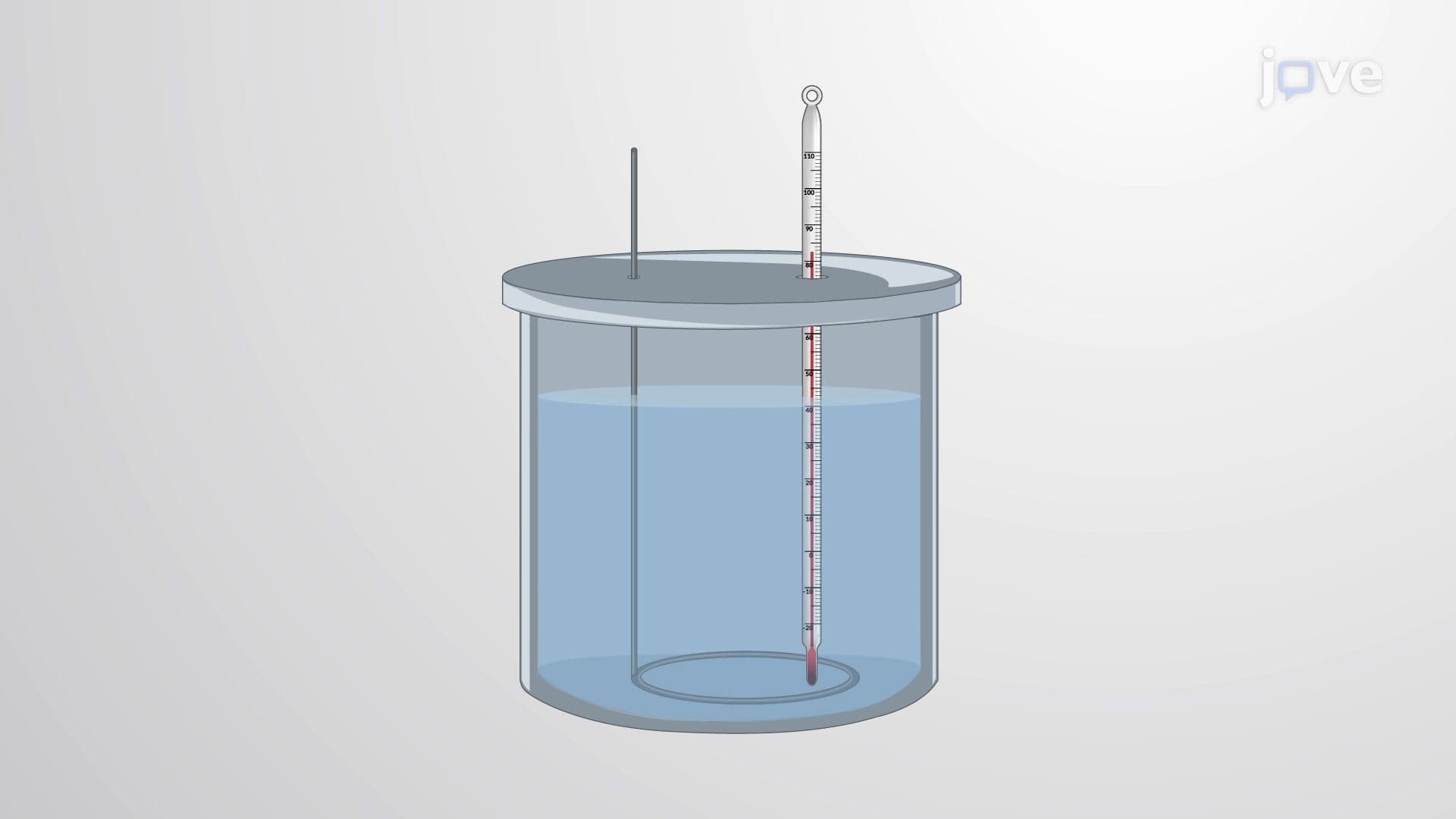
The coffee cup calorimeter, despite its seemingly simple construction, serves as the workhorse of undergraduate chemistry laboratories across American universities. This device typically consists of two nested Styrofoam cups, a thermometer, and a stirrer-materials that cost less than $10 but can generate data comparable to sophisticated equipment.
The Styrofoam construction provides excellent thermal insulation, preventing heat exchange with the external environment. The loose-fitting cork lid maintains constant atmospheric pressure while minimizing evaporation. This design allows students at institutions like UCLA, MIT, and community colleges nationwide to conduct meaningful thermochemical research with minimal equipment investment.
Constant pressure calorimetry extends far beyond academic exercises. Pharmaceutical companies use these principles to study drug stability, while food scientists apply calorimetric techniques to determine caloric content in products. Environmental engineers employ similar methods to assess the energy potential of biofuels and waste materials.
For students preparing for standardized exams, this topic frequently appears on AP Chemistry tests, SAT Subject Tests, and college entrance examinations. The MCAT often includes calorimetry problems that test both conceptual understanding and mathematical application skills. Medical students encounter these principles again when studying metabolic processes and drug thermodynamics.
The mathematical framework underlying constant pressure calorimetry centers on the heat equation: q = mcΔT, where q represents heat transfer, m indicates mass, c denotes specific heat capacity, and ΔT signifies temperature change. Under constant pressure conditions, this heat transfer directly equals the enthalpy change (ΔH) of the reaction.
Understanding sign conventions proves crucial for exam success. Exothermic reactions release heat, causing calorimeter temperature to rise, resulting in negative ΔH values. Endothermic reactions absorb heat, decreasing calorimeter temperature and producing positive ΔH values. This relationship appears consistently in college chemistry courses and professional certification examinations.
Related Micro-courses