Loading…
Loading video…

7,629 views
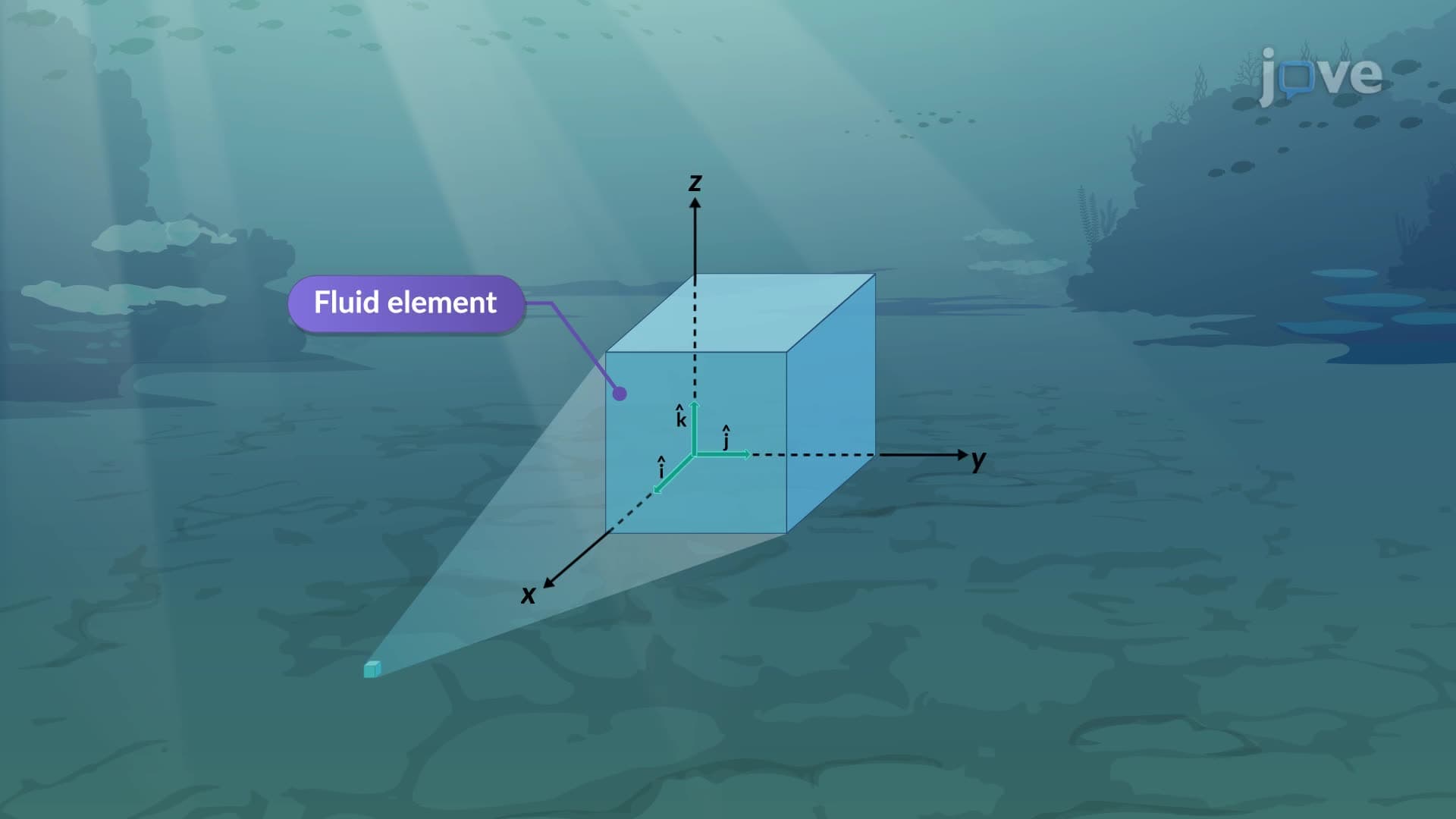
Ever wonder how engineers calculate water pressure at the bottom of the Hoover Dam or atmospheric pressure changes during a hurricane? The basic equation for pressure field reveals how forces acting on fluid elements create predictable pressure variations throughout any fluid system. This fundamental concept appears in everything from hydraulic systems in construction equipment to blood pressure measurements in medical diagnostics across US hospitals. Watch the full video on JoVE Coach to master this concept with expert-led visuals and step-by-step explanations.
The basic equation for pressure field forms the cornerstone of fluid mechanics, describing how pressure varies throughout any fluid system. This fundamental relationship emerges from applying Newton's laws to infinitesimally small fluid elements, revealing the intricate balance between forces that govern fluid behavior in everything from water distribution systems to atmospheric phenomena.
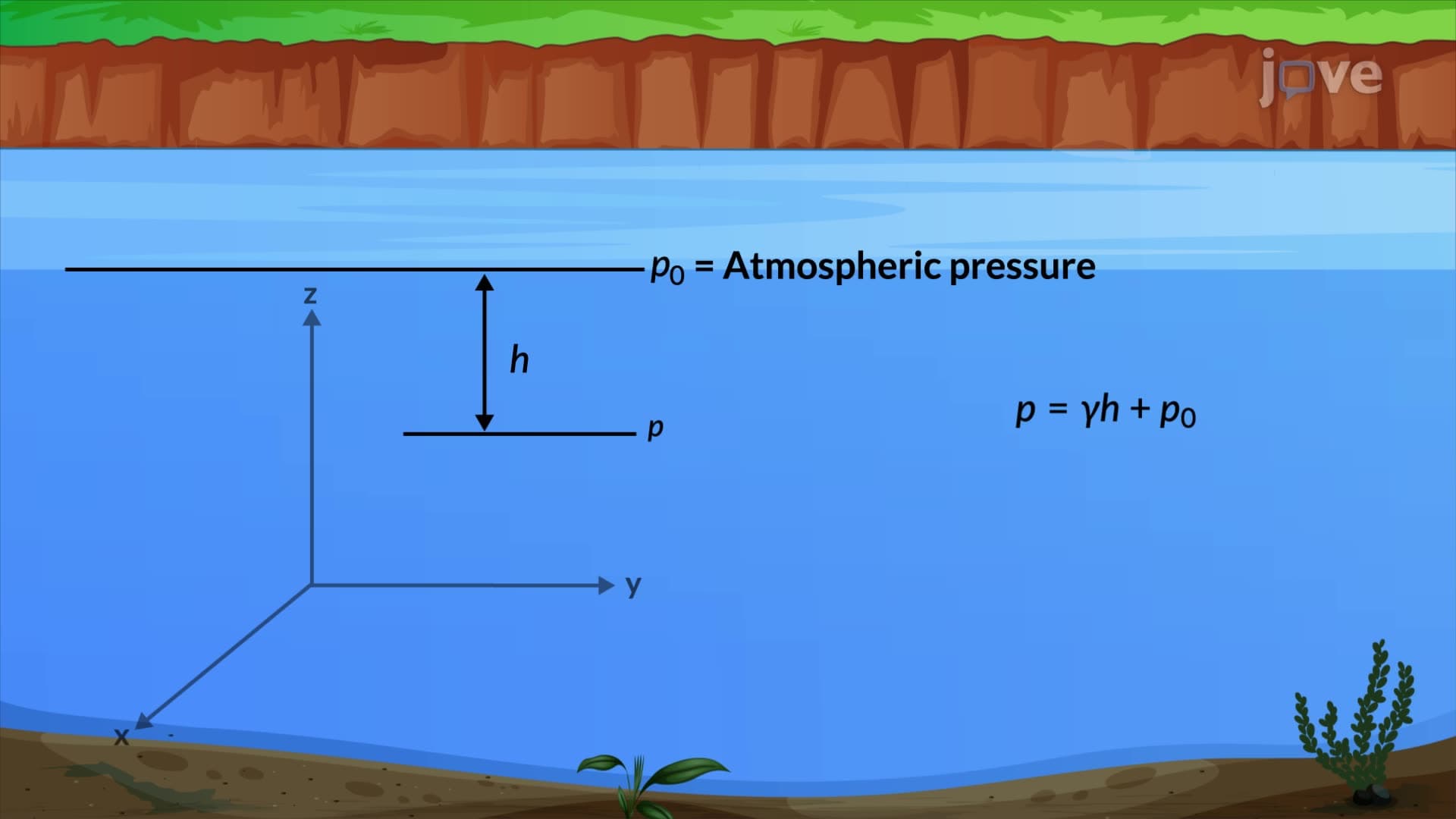
When analyzing fluid behavior, engineers consider a representative rectangular element within the fluid mass. Two distinct force categories act upon this element: surface forces generated by pressure differences across element faces, and body forces primarily consisting of gravitational weight. The pressure at the element's center, denoted as p, serves as a reference point for calculating average pressures on each face using mathematical derivatives.
This force analysis proves crucial for AP Physics students and college engineering majors studying fluid mechanics. The concept frequently appears on standardized tests like the MCAT, where understanding pressure relationships in biological systems becomes essential for medical school preparation.
The resultant surface force calculation involves summing pressure contributions from all six faces of the rectangular element. In the y-direction, this calculation considers pressure variations that create net forces, with similar analyses applied to x and z directions. These individual components combine vectorially to represent total surface force per unit volume.
Real-world applications include designing water towers in cities like Chicago, where engineers must calculate pressure distributions to ensure adequate water pressure at different building heights. The equation also governs hydraulic brake systems in vehicles manufactured by companies like Ford and General Motors, where precise pressure control ensures safety.
The final step involves applying Newton's second law to the fluid element, incorporating both surface forces per unit volume and gravitational weight effects. This combination yields the complete pressure field equation, enabling prediction of pressure variations throughout three-dimensional fluid systems. The specific weight term accounts for fluid density and gravitational acceleration, making the equation applicable across different fluid types and gravitational environments.
Frequently Asked Questions
The basic equation for pressure field describes how pressure varies throughout a fluid by balancing surface forces and body forces on fluid elements. It's fundamental to understanding everything from hydraulic systems to atmospheric pressure changes. This equation forms the foundation for advanced fluid mechanics concepts taught in college engineering programs and appears frequently on standardized exams like the MCAT and AP Physics.
AP Physics exams often test this concept through problems involving pressure variations in fluids, hydrostatic pressure calculations, and force analysis on submerged objects. Students might encounter questions about pressure differences in swimming pools or atmospheric pressure changes with altitude. The College Board frequently includes these applications in free-response sections requiring mathematical derivations and conceptual explanations.
Yes, MCAT questions frequently test pressure field concepts in biological contexts like blood pressure variations, fluid flow in circulatory systems, and pressure changes in respiratory mechanics. Understanding how pressure varies with height helps explain blood pressure differences between your head and feet. Medical schools expect students to apply these principles to physiological systems during coursework and clinical rotations.
Engineers at companies like Boeing apply pressure field equations when designing aircraft pressurization systems, while civil engineers use them for designing water distribution networks in cities like New York and Los Angeles. Oil companies like ExxonMobil rely on these equations for calculating pressure variations in drilling operations and pipeline systems across the United States.
While the complete mathematical derivation involves partial derivatives, high school students can grasp the fundamental concepts using basic algebra and physics principles. The core idea focuses on force balance and Newton's laws, concepts familiar from introductory physics courses. College courses gradually introduce the mathematical complexity as students develop stronger calculus skills.
Start by mastering force analysis on simple rectangular elements, then practice applying Newton's second law to fluid systems. Work through problems involving pressure variations in different fluids and gravitational fields. Focus on understanding the physical meaning behind mathematical expressions rather than memorizing formulas, as this approach succeeds better on conceptual exam questions.
Build upon this foundation by exploring the Navier-Stokes equations, which extend pressure field concepts to include viscous effects and fluid motion. Study Bernoulli's equation for flowing fluids, then advance to computational fluid dynamics methods used in aerospace and automotive industries. These topics prepare students for advanced engineering coursework and graduate school applications.
Pressure field equations demonstrate conservation principles and Newton's laws in continuous media, connecting to thermodynamics through fluid properties and electromagnetism through analogous field concepts. This interdisciplinary nature makes the topic valuable for students pursuing diverse STEM careers, from biomedical engineering to environmental science programs at universities nationwide.
Related Micro-courses
Related Subjects
 Electrical Engineering 33 micro-courses›Mechanical Engineering 28 micro-courses›