Loading subject page…
- Math Fundamentals
- Introduction to Sequences and Series
- Geometric Sequences
Micro-course: Introduction to Sequences and Series
326 views
Learn key concepts and earn your certificate.





Geometric Sequences

00:00
01:30
Video Summary: What are Geometric Sequences
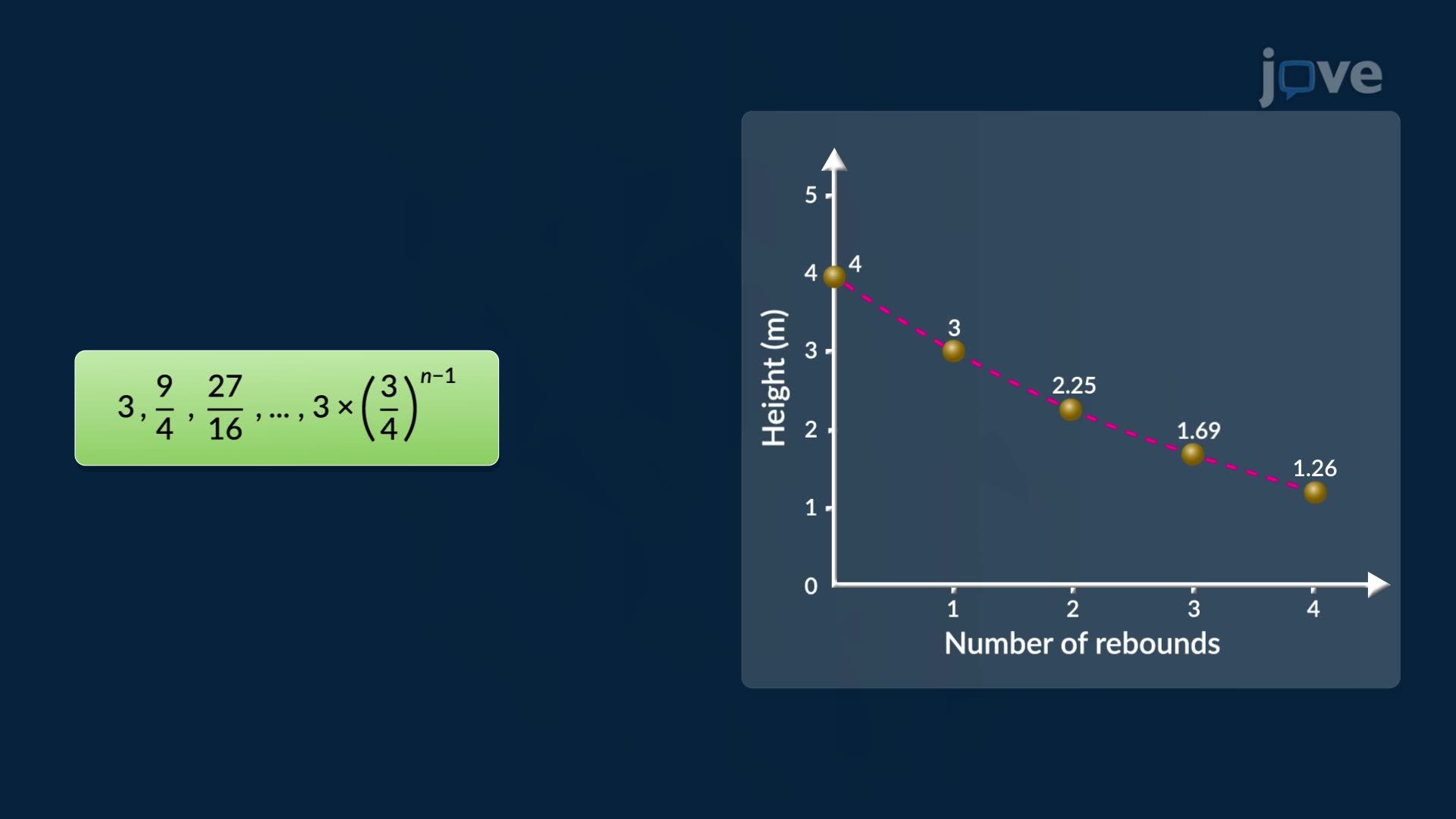
Ever wonder why a basketball bounces lower after each drop? Geometric sequences explain this fascinating pattern where each bounce reaches exactly half the previous height. This mathematical concept appears everywhere from compound interest calculations at major US banks like Wells Fargo to population growth models used by the CDC. What are geometric sequences? They're ordered lists of numbers where each term is found by multiplying the previous term by a fixed value called the common ratio. Watch the full video on JoVE Coach to master this concept with expert-led visuals and step-by-step explanations.
- Understand what are geometric sequences and how they differ from arithmetic sequences through clear definitions and examples
- Identify the common ratio in geometric sequences by examining the relationship between consecutive terms
- Apply geometric sequence formulas to find specific terms and calculate partial sums in real-world scenarios
- Analyze exponential growth and decay patterns using geometric sequence models in finance and physics
- Evaluate the behavior of geometric sequences with different common ratio values (greater than 1, between 0 and 1, or negative)
- Recognize geometric sequences in natural phenomena like population dynamics and radioactive decay
- Compare finite and infinite geometric series to determine when they converge or diverge
- Explore practical applications of geometric sequences in compound interest, medical dosages, and engineering problems
What Are Geometric Sequences: Foundation and Structure
Geometric sequences represent one of mathematics' most elegant patterns, where each term relates to its predecessor through consistent multiplication. Unlike arithmetic sequences that add a constant value, geometric sequences multiply by a fixed number called the common ratio (r). The general form is: a, ar, ar², ar³, ar⁴, ..., where 'a' represents the first term and 'r' is the common ratio.
This multiplicative relationship creates exponential behavior that appears throughout nature and human systems. When r > 1, the sequence grows exponentially (like compound interest). When 0 < r < 1, it decays exponentially (like radioactive half-life). When r < 0, the sequence alternates between positive and negative values while following the exponential pattern.
Types of Geometric Sequences in Practice
Understanding types of geometric sequences helps students recognize patterns across disciplines. Growth sequences (r > 1) model phenomena like bacterial reproduction, where E. coli populations double every 20 minutes under optimal conditions. The CDC uses these models to predict disease spread during outbreaks.
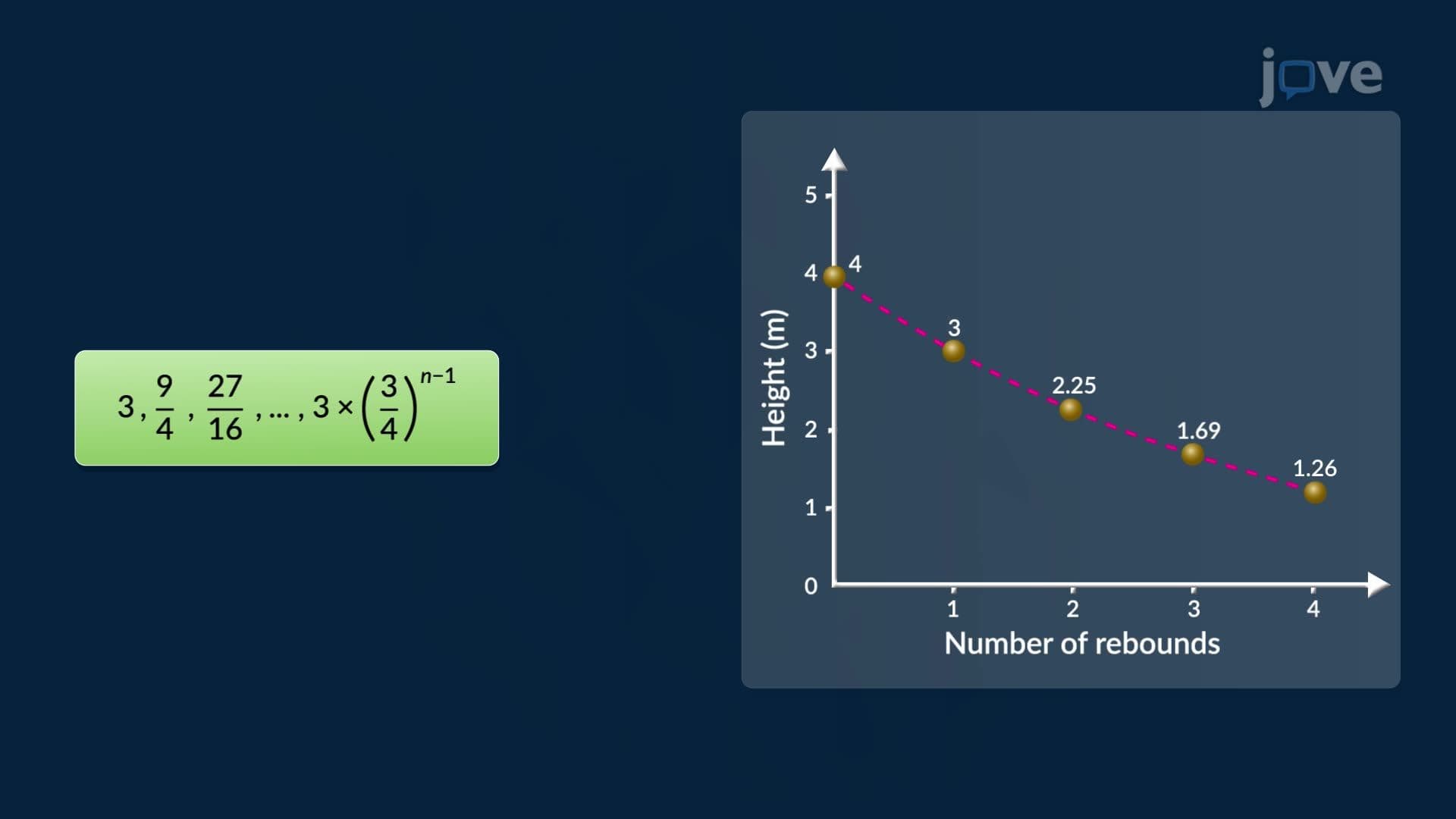
Decay sequences (0 < r < 1) describe diminishing processes. Pharmacologists at Johns Hopkins calculate medication dosages using geometric decay models, ensuring therapeutic levels remain effective while avoiding toxicity. The bouncing ball example perfectly illustrates this concept-each bounce reaches approximately 80% of the previous height due to energy loss.
Alternating geometric sequences (r < 0) appear in electrical engineering, particularly in AC circuit analysis taught at institutions like MIT and Stanford. These sequences help engineers understand oscillating currents and voltages in power systems.
Geometric Sequence Formulas and Calculations
The nth term formula, an = a₁ × r^(n-1), allows direct calculation without finding all preceding terms. This proves invaluable on standardized tests like the SAT Math Level 2, where time efficiency matters greatly.
Partial sum calculations become crucial for real-world applications. The formula Sn = a₁(1 - r^n)/(1 - r) determines cumulative effects over time periods. Investment firms like Fidelity use these calculations for compound interest projections, while environmental scientists at NOAA apply them to model carbon dioxide accumulation patterns.
Real-World Applications and Exam Connections
Geometric sequences overview extends beyond academic exercises into practical problem-solving. AP Calculus students encounter these concepts when studying limits and series convergence. College algebra courses at universities nationwide emphasize geometric sequences as foundations for advanced topics like Taylor series and differential equations.
Financial applications dominate real-world usage. Retirement planning relies heavily on geometric sequence calculations, where consistent percentage returns create exponential wealth accumulation over decades. The Federal Reserve uses similar models for economic forecasting and monetary policy decisions.
Frequently Asked Questions
Geometric sequences are ordered lists where each term equals the previous term multiplied by a constant called the common ratio. To recognize them, divide any term by the preceding term-if this ratio stays constant throughout, you have a geometric sequence. They appear in compound interest, population growth, and radioactive decay problems.
Finite geometric sequences have a specific number of terms, like calculating compound interest over 10 years. Infinite geometric sequences continue forever, useful for theoretical calculations. On exams, finite sequences typically involve finding specific terms or sums, while infinite sequences focus on convergence behavior.
SAT Math sections frequently test geometric sequence recognition and nth term calculations, often disguised as word problems involving compound interest or population growth. AP Calculus exams use geometric sequences as building blocks for series convergence tests and Taylor series expansions, making mastery essential for advanced placement success.
The common ratio determines growth behavior: ratios greater than 1 create exponential growth, ratios between 0 and 1 produce exponential decay, and negative ratios cause alternating patterns. This concept explains everything from bacterial multiplication in biology labs to medication effectiveness in clinical settings across major US medical centers.
The Fed applies geometric sequence models to predict inflation rates, money supply growth, and economic expansion patterns. When setting interest rates, they consider how small percentage changes compound geometrically over time, affecting everything from mortgage rates at Bank of America to student loan calculations for college financing.
Not at all-geometric sequences only require basic multiplication and division skills taught in middle school. The key insight is recognizing the multiplicative pattern, which most students grasp quickly through real-world examples like bouncing balls or savings account growth. Success depends more on pattern recognition than complex calculations.
Master three core skills: identifying the common ratio, using the nth term formula, and calculating partial sums. Practice with timed problems from SAT prep books and AP practice exams. Focus on word problems involving compound interest, population dynamics, and decay processes since these appear most frequently on standardized tests.
Geometric sequences provide foundations for infinite series, Taylor polynomials, and differential equations studied in college calculus courses. They're essential for understanding convergence tests, power series, and mathematical modeling techniques used in engineering programs at universities like Caltech and Georgia Tech. Strong geometric sequence skills accelerate learning in these advanced areas.
Related Micro-courses